Basedash Semantic Layer


Description
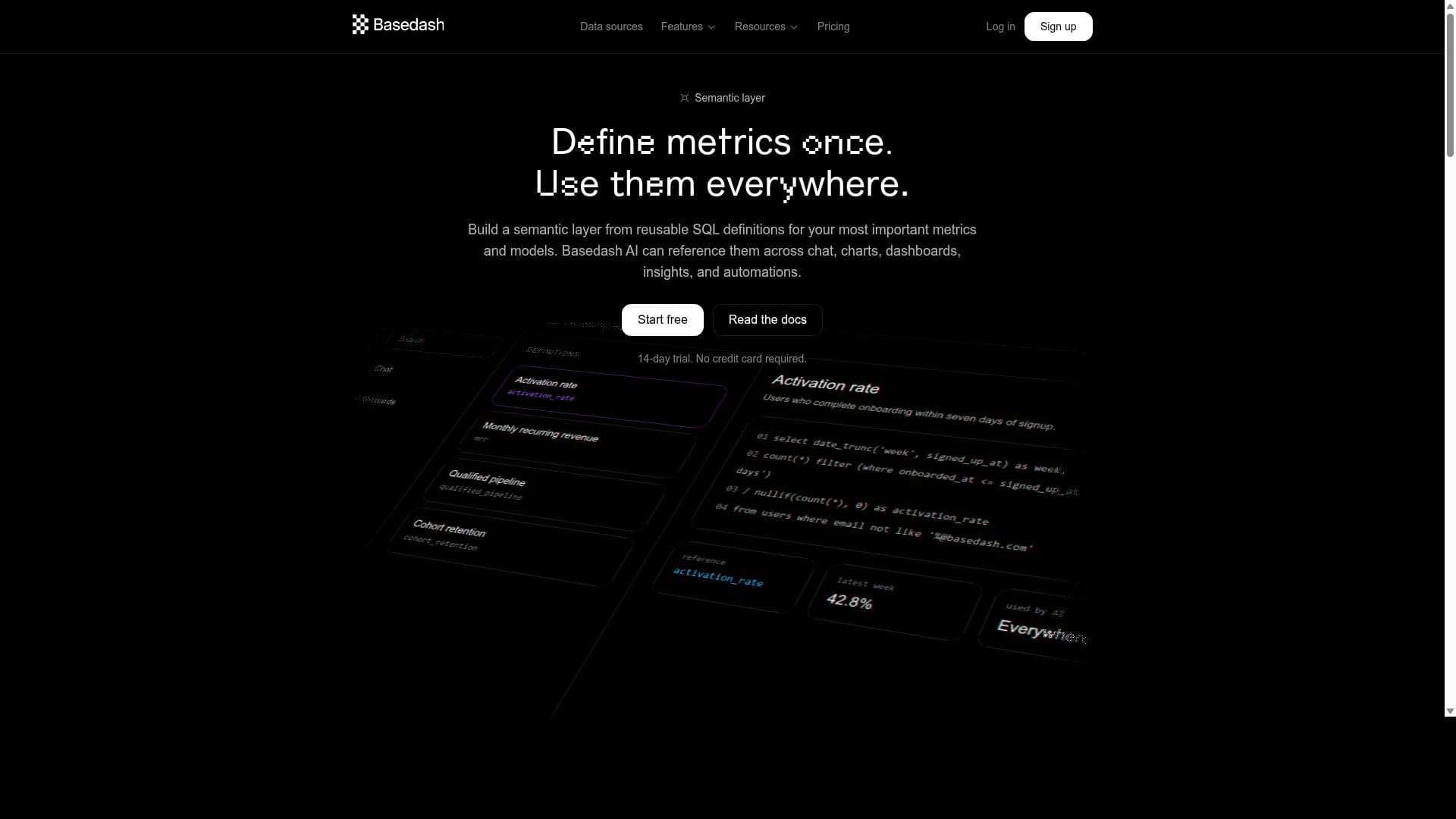
Basedash semantic layer revolutionizes SQL metric management by enabling teams to create reusable, AI-referenced definitions that ensure consistent analytics across chats, dashboards, and automations. Ideal for data-driven organizations seeking reliable, scalable metric logic powered by AI-enhanced workflows.
The Basedash semantic layer is a powerful AI-driven tool designed to streamline and standardize the way teams create, manage, and reuse SQL metrics and models across their data infrastructure. At its core, this semantic layer acts as a centralized catalog of saved SQL queries, known as definitions, which are scoped to specific data sources. These definitions include essential metadata such as a name, reference name, description, and the SQL query itself. By providing a reusable and consistent metric logic foundation, the Basedash semantic layer enables AI agents to reference, inspect, and update these definitions seamlessly across multiple interfaces including chatbots, charts, dashboards, insights, and automation workflows. This approach ensures that all users and AI-driven processes operate with a unified understanding of key business metrics, reducing discrepancies and enhancing data trustworthiness. Key features of the Basedash semantic layer revolve around its ability to create reusable SQL metrics and models that are tightly scoped to data sources. Users can define metrics with clear naming conventions and descriptions, making them easy to discover and understand. One of the standout capabilities is the integration of Liquid syntax, which allows definitions to be referenced inside other SQL queries dynamically. This promotes modular query building and improves readability, especially when definitions are placed inside Common Table Expressions (CTEs). The semantic layer also empowers AI agents to not only reference these definitions but to actively create and update reusable metric logic upon administrative requests, enabling continuous refinement and adaptability of business metrics without manual SQL rewriting. This feature is particularly valuable for organizations seeking to maintain consistent metric definitions while leveraging AI to automate data operations. The Basedash semantic layer is best suited for data teams, business analysts, and organizations that rely heavily on SQL-based analytics and want to integrate AI-driven insights into their workflows. It is ideal for companies that face challenges with metric consistency across multiple dashboards and reports or those looking to accelerate their analytics processes by automating metric creation and updates. Use cases include enabling AI-powered chat interfaces to answer complex data queries using standardized metrics, automating dashboard updates with consistent logic, and facilitating cross-team collaboration by providing a shared semantic framework. Additionally, this tool supports organizations aiming to reduce the overhead of maintaining multiple versions of SQL queries and ensuring that all stakeholders work with trusted and up-to-date metrics. Regarding pricing and plans, Basedash offers various subscription tiers tailored to different organizational needs, though specific pricing details for the semantic layer feature are not explicitly listed on the website. Interested users are encouraged to contact Basedash sales directly via their website for customized pricing and to explore potential free trials or demos. This approach allows organizations to assess how the semantic layer fits into their existing data stack and business intelligence workflows before committing financially. When compared to alternatives, the Basedash semantic layer stands out due to its tight integration with AI agents and its focus on reusable, deterministic SQL definitions rather than prose instructions or loosely defined metrics. Unlike traditional BI tools that often require manual metric replication or complex data modeling, Basedash provides a more automated and AI-augmented experience. Its use of Liquid syntax for referencing definitions inside queries and the ability for AI to update metric logic on demand offers a unique blend of flexibility and control. However, organizations heavily invested in non-SQL-based semantic layers or those requiring extensive support for non-relational data sources might find some limitations. Additionally, the semantic layer is distinct from Basedash's 'skills' feature, which focuses on AI instructions rather than reusable SQL logic, highlighting the semantic layer's specialized role in metric consistency. Notable considerations include the need for users to be comfortable with SQL and Liquid syntax to fully leverage the semantic layer's capabilities. While the AI integration simplifies many tasks, initial setup and ongoing governance of metric definitions require careful planning to avoid inconsistencies. Furthermore, as the semantic layer is scoped to data sources, organizations with highly fragmented or siloed data environments may need to invest effort in consolidating data or managing multiple semantic catalogs. Lastly, since pricing details are not publicly available, potential users should engage with Basedash sales to understand total cost of ownership and ensure alignment with their budget and scale requirements.

Description
Basedash semantic layer revolutionizes SQL metric management by enabling teams to create reusable, AI-referenced definitions that ensure consistent analytics across chats, dashboards, and automations. Ideal for data-driven organizations seeking reliable, scalable metric logic powered by AI-enhanced workflows.
The Basedash semantic layer is a powerful AI-driven tool designed to streamline and standardize the way teams create, manage, and reuse SQL metrics and models across their data infrastructure. At its core, this semantic layer acts as a centralized catalog of saved SQL queries, known as definitions, which are scoped to specific data sources. These definitions include essential metadata such as a name, reference name, description, and the SQL query itself. By providing a reusable and consistent metric logic foundation, the Basedash semantic layer enables AI agents to reference, inspect, and update these definitions seamlessly across multiple interfaces including chatbots, charts, dashboards, insights, and automation workflows. This approach ensures that all users and AI-driven processes operate with a unified understanding of key business metrics, reducing discrepancies and enhancing data trustworthiness. Key features of the Basedash semantic layer revolve around its ability to create reusable SQL metrics and models that are tightly scoped to data sources. Users can define metrics with clear naming conventions and descriptions, making them easy to discover and understand. One of the standout capabilities is the integration of Liquid syntax, which allows definitions to be referenced inside other SQL queries dynamically. This promotes modular query building and improves readability, especially when definitions are placed inside Common Table Expressions (CTEs). The semantic layer also empowers AI agents to not only reference these definitions but to actively create and update reusable metric logic upon administrative requests, enabling continuous refinement and adaptability of business metrics without manual SQL rewriting. This feature is particularly valuable for organizations seeking to maintain consistent metric definitions while leveraging AI to automate data operations. The Basedash semantic layer is best suited for data teams, business analysts, and organizations that rely heavily on SQL-based analytics and want to integrate AI-driven insights into their workflows. It is ideal for companies that face challenges with metric consistency across multiple dashboards and reports or those looking to accelerate their analytics processes by automating metric creation and updates. Use cases include enabling AI-powered chat interfaces to answer complex data queries using standardized metrics, automating dashboard updates with consistent logic, and facilitating cross-team collaboration by providing a shared semantic framework. Additionally, this tool supports organizations aiming to reduce the overhead of maintaining multiple versions of SQL queries and ensuring that all stakeholders work with trusted and up-to-date metrics. Regarding pricing and plans, Basedash offers various subscription tiers tailored to different organizational needs, though specific pricing details for the semantic layer feature are not explicitly listed on the website. Interested users are encouraged to contact Basedash sales directly via their website for customized pricing and to explore potential free trials or demos. This approach allows organizations to assess how the semantic layer fits into their existing data stack and business intelligence workflows before committing financially. When compared to alternatives, the Basedash semantic layer stands out due to its tight integration with AI agents and its focus on reusable, deterministic SQL definitions rather than prose instructions or loosely defined metrics. Unlike traditional BI tools that often require manual metric replication or complex data modeling, Basedash provides a more automated and AI-augmented experience. Its use of Liquid syntax for referencing definitions inside queries and the ability for AI to update metric logic on demand offers a unique blend of flexibility and control. However, organizations heavily invested in non-SQL-based semantic layers or those requiring extensive support for non-relational data sources might find some limitations. Additionally, the semantic layer is distinct from Basedash's 'skills' feature, which focuses on AI instructions rather than reusable SQL logic, highlighting the semantic layer's specialized role in metric consistency. Notable considerations include the need for users to be comfortable with SQL and Liquid syntax to fully leverage the semantic layer's capabilities. While the AI integration simplifies many tasks, initial setup and ongoing governance of metric definitions require careful planning to avoid inconsistencies. Furthermore, as the semantic layer is scoped to data sources, organizations with highly fragmented or siloed data environments may need to invest effort in consolidating data or managing multiple semantic catalogs. Lastly, since pricing details are not publicly available, potential users should engage with Basedash sales to understand total cost of ownership and ensure alignment with their budget and scale requirements.
Tool Features
- Create reusable SQL metrics and models scoped to data sources
- AI agents can reference and inspect definitions in SQL queries
- Definitions include name, reference name, description, and SQL query
- Use Liquid syntax to reference definitions inside queries
- Supports placing definitions inside CTEs for query readability
- Enables AI to create and update reusable metric logic on admin request
Frequently Asked Questions
What is Basedash semantic layer?
The Basedash semantic layer is a feature that allows teams to create and manage reusable SQL metrics and models scoped to data sources. It provides a catalog of saved SQL query definitions that AI agents can reference, inspect, and update to maintain consistent metric logic across various interfaces like chat, dashboards, and automations.
How much does Basedash semantic layer cost?
Specific pricing details for the Basedash semantic layer are not publicly listed. Interested users should contact Basedash sales directly through their website to get customized pricing information and discuss plans that fit their organizational needs.
Who is Basedash semantic layer best for?
It is best suited for data teams, business analysts, and organizations that rely on SQL for analytics and want to integrate AI-driven insights. It benefits companies seeking consistent metric definitions across dashboards and reports, as well as those aiming to automate metric creation and updates with AI assistance.
What are the main features of Basedash semantic layer?
Key features include the ability to create reusable SQL metrics and models scoped to data sources, AI agents that can reference and inspect SQL definitions, metadata-rich definitions with names and descriptions, use of Liquid syntax to reference definitions inside queries, support for placing definitions inside CTEs for readability, and enabling AI to create or update metric logic on admin request.
Does Basedash semantic layer offer a free trial?
The website does not explicitly mention a free trial for the semantic layer feature. Prospective users are encouraged to contact Basedash sales to inquire about demos, trials, or pilot programs.
What integrations does Basedash semantic layer support?
The semantic layer is scoped to data sources, meaning it integrates with the SQL databases and data sources connected to Basedash. While specific integrations are not detailed, it supports any data source accessible via SQL queries within the Basedash platform.
How does Basedash semantic layer work?
It works by storing saved SQL queries called definitions, each with a name, reference name, description, and SQL code. These definitions can be referenced inside other queries using Liquid syntax, allowing modular and reusable metric logic. AI agents access this catalog to inspect, reference, and update definitions, ensuring consistent and automated metric calculations across various analytics interfaces.
Socials
Use ToolSponsored Tools


















Reviews
No reviews yet. Be the first to share your experience.