Description
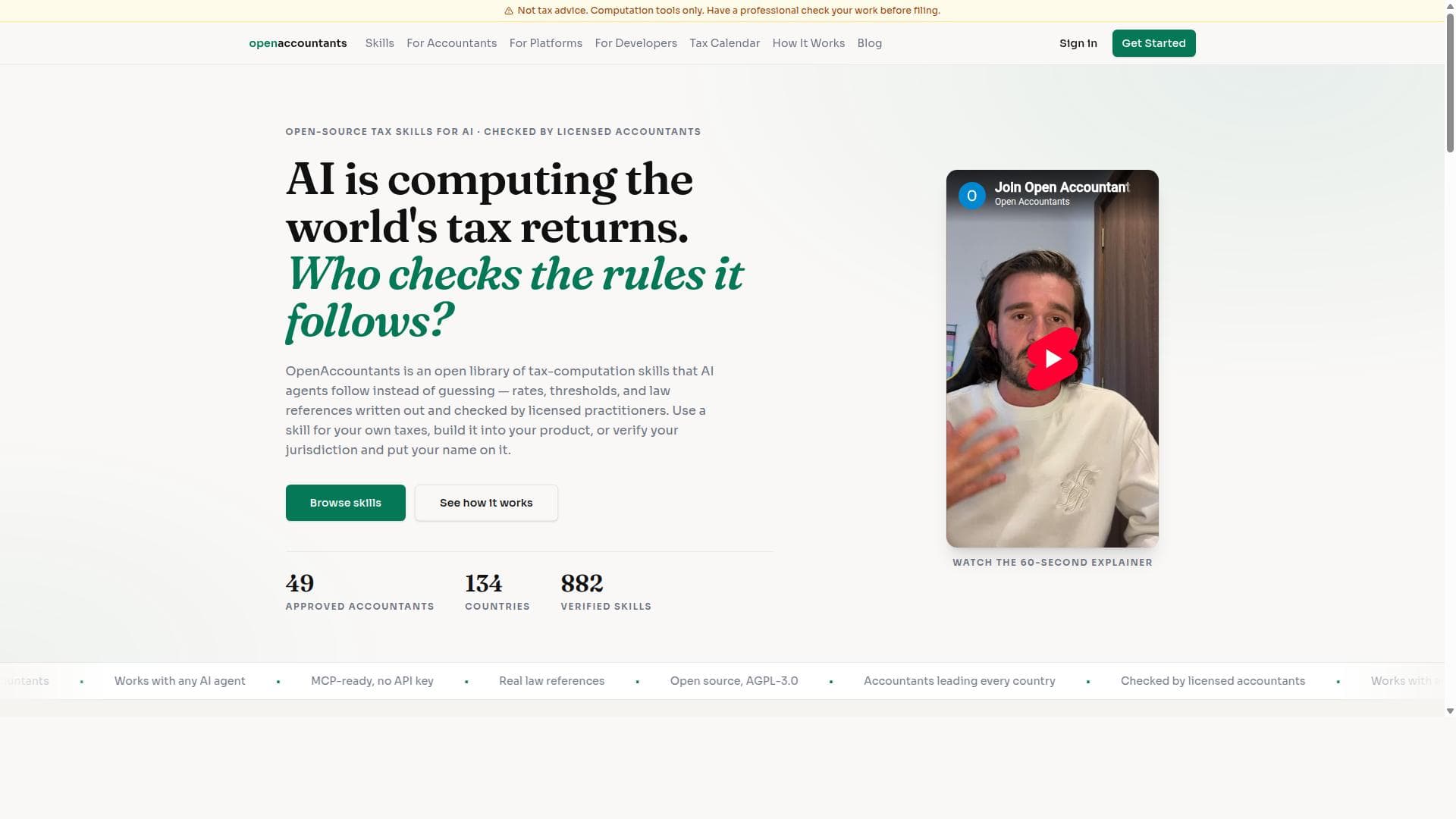
OpenAccountants is a free, open-source library that equips AI agents with verified, jurisdiction-specific tax and accounting skills across 130+ countries. Ideal for developers and fintech companies, it enables seamless integration of compliant payroll, VAT/GST, and tax computation features without reinventing complex tax rules.
OpenAccountants is a comprehensive, free, and open-source library designed specifically to empower AI agents with advanced tax and accounting capabilities. Its core purpose is to provide developers and AI builders with a reliable, jurisdiction-specific repository of tax, payroll, VAT/GST, and company formation rules that are encoded as executable code. This approach eliminates the need for reinventing complex tax rulebooks for each country, enabling seamless integration of compliant financial features into AI applications. By leveraging OpenAccountants, AI agents can accurately compute taxes and handle accounting tasks across more than 130 countries, making it a truly global solution for financial automation. At the heart of OpenAccountants are its meticulously crafted skills, each representing a country’s tax and accounting regulations. These skills are not only open-source but also rigorously verified by licensed accountants in their respective jurisdictions, ensuring the highest level of accuracy and compliance. The tax rates, rules, and computations are encoded as code, which means they can be directly executed by AI agents without ambiguity or manual interpretation. This code-driven approach facilitates automatic updates and maintenance, keeping pace with changing tax laws worldwide. The platform supports a wide range of financial functions including payroll calculations, VAT/GST processing, tax filing computations, and business formation requirements, all tailored to the specific rules of each country. OpenAccountants is designed to be highly interoperable, integrating seamlessly with any AI agent through the MCP (Modular Code Plug-in) framework. This modularity allows developers to plug in the exact tax and accounting skills they need, making it easy to build compliant financial features into chatbots, virtual assistants, or any AI-driven financial software. The jurisdiction-specific nature of the skills means that businesses operating internationally can rely on OpenAccountants to handle local compliance without having to engage multiple vendors or build custom solutions from scratch. The tool is ideal for AI developers, fintech startups, accounting software companies, and enterprises looking to automate and scale their financial operations globally. Use cases include automating payroll processing for multinational companies, enabling AI-powered tax advisory services, integrating VAT/GST calculations into e-commerce platforms, and supporting automated business formation workflows. Because it is open-source and free, it lowers the barrier to entry for startups and developers who want to incorporate sophisticated tax compliance features without incurring high licensing costs. OpenAccountants is offered entirely free of charge under an open-source license, encouraging community contributions and continuous improvement. This contrasts with many proprietary tax software solutions that charge substantial fees and often lack transparency. While commercial alternatives may offer more polished user interfaces or bundled services, OpenAccountants excels in flexibility, transparency, and jurisdictional accuracy verified by licensed professionals. However, users should note that as an open-source library, it requires technical expertise to integrate and maintain within AI systems, and it does not provide end-user applications out of the box. In comparison to other tax and accounting AI tools, OpenAccountants stands out due to its extensive global coverage and its unique approach of encoding tax rules as executable code verified by licensed accountants. This ensures both compliance and adaptability, which are critical in the fast-evolving regulatory landscape. Nonetheless, organizations without in-house technical resources may find the integration process challenging and might prefer commercial solutions with dedicated support. Additionally, while the library covers a vast number of countries, some niche or emerging jurisdictions may have limited or evolving coverage. Overall, OpenAccountants is a powerful, transparent, and cost-effective solution for embedding tax and accounting intelligence into AI applications. Its open-source nature, combined with expert verification and broad jurisdictional coverage, makes it a standout choice for developers and businesses aiming to automate financial compliance at scale.
Description
OpenAccountants is a free, open-source library that equips AI agents with verified, jurisdiction-specific tax and accounting skills across 130+ countries. Ideal for developers and fintech companies, it enables seamless integration of compliant payroll, VAT/GST, and tax computation features without reinventing complex tax rules.
OpenAccountants is a comprehensive, free, and open-source library designed specifically to empower AI agents with advanced tax and accounting capabilities. Its core purpose is to provide developers and AI builders with a reliable, jurisdiction-specific repository of tax, payroll, VAT/GST, and company formation rules that are encoded as executable code. This approach eliminates the need for reinventing complex tax rulebooks for each country, enabling seamless integration of compliant financial features into AI applications. By leveraging OpenAccountants, AI agents can accurately compute taxes and handle accounting tasks across more than 130 countries, making it a truly global solution for financial automation. At the heart of OpenAccountants are its meticulously crafted skills, each representing a country’s tax and accounting regulations. These skills are not only open-source but also rigorously verified by licensed accountants in their respective jurisdictions, ensuring the highest level of accuracy and compliance. The tax rates, rules, and computations are encoded as code, which means they can be directly executed by AI agents without ambiguity or manual interpretation. This code-driven approach facilitates automatic updates and maintenance, keeping pace with changing tax laws worldwide. The platform supports a wide range of financial functions including payroll calculations, VAT/GST processing, tax filing computations, and business formation requirements, all tailored to the specific rules of each country. OpenAccountants is designed to be highly interoperable, integrating seamlessly with any AI agent through the MCP (Modular Code Plug-in) framework. This modularity allows developers to plug in the exact tax and accounting skills they need, making it easy to build compliant financial features into chatbots, virtual assistants, or any AI-driven financial software. The jurisdiction-specific nature of the skills means that businesses operating internationally can rely on OpenAccountants to handle local compliance without having to engage multiple vendors or build custom solutions from scratch. The tool is ideal for AI developers, fintech startups, accounting software companies, and enterprises looking to automate and scale their financial operations globally. Use cases include automating payroll processing for multinational companies, enabling AI-powered tax advisory services, integrating VAT/GST calculations into e-commerce platforms, and supporting automated business formation workflows. Because it is open-source and free, it lowers the barrier to entry for startups and developers who want to incorporate sophisticated tax compliance features without incurring high licensing costs. OpenAccountants is offered entirely free of charge under an open-source license, encouraging community contributions and continuous improvement. This contrasts with many proprietary tax software solutions that charge substantial fees and often lack transparency. While commercial alternatives may offer more polished user interfaces or bundled services, OpenAccountants excels in flexibility, transparency, and jurisdictional accuracy verified by licensed professionals. However, users should note that as an open-source library, it requires technical expertise to integrate and maintain within AI systems, and it does not provide end-user applications out of the box. In comparison to other tax and accounting AI tools, OpenAccountants stands out due to its extensive global coverage and its unique approach of encoding tax rules as executable code verified by licensed accountants. This ensures both compliance and adaptability, which are critical in the fast-evolving regulatory landscape. Nonetheless, organizations without in-house technical resources may find the integration process challenging and might prefer commercial solutions with dedicated support. Additionally, while the library covers a vast number of countries, some niche or emerging jurisdictions may have limited or evolving coverage. Overall, OpenAccountants is a powerful, transparent, and cost-effective solution for embedding tax and accounting intelligence into AI applications. Its open-source nature, combined with expert verification and broad jurisdictional coverage, makes it a standout choice for developers and businesses aiming to automate financial compliance at scale.
Tool Features
- Open-source tax-computation skills
- Rates and rules written as code
- Verified tax rules by country
- Checked by licensed accountants
- Jurisdiction-specific tax rules
Frequently Asked Questions
What is OpenAccountants?
OpenAccountants is a free, open-source library of tax and accounting skills designed for AI agents. It encodes country-specific tax rates and rules as executable code, verified by licensed accountants, enabling AI applications to perform compliant tax, payroll, VAT/GST, and business formation computations across over 130 countries.
How much does OpenAccountants cost?
OpenAccountants is completely free to use under an open-source license, allowing developers and businesses to integrate its tax and accounting skills without any licensing fees.
Who is OpenAccountants best for?
OpenAccountants is best suited for AI developers, fintech startups, accounting software companies, and enterprises that need to automate and scale tax and accounting compliance across multiple jurisdictions globally.
What are the main features of OpenAccountants?
Key features include open-source tax-computation skills, tax rates and rules encoded as executable code, verification of tax rules by licensed accountants, jurisdiction-specific tax rules covering over 130 countries, and seamless integration with AI agents via the MCP framework.
Does OpenAccountants offer a free trial?
Since OpenAccountants is open-source and free to use, there is no need for a free trial; users can access and integrate the library immediately without cost.
What integrations does OpenAccountants support?
OpenAccountants is designed to plug into any AI agent or software system via the Modular Code Plug-in (MCP) framework, enabling flexible integration into various AI platforms and financial applications.
How does OpenAccountants work?
OpenAccountants works by providing AI agents with executable code modules that encode country-specific tax and accounting rules. These modules are verified by licensed accountants and can be integrated via MCP, allowing AI systems to perform accurate, compliant tax and payroll computations across multiple jurisdictions.
Socials
Use ToolSponsored Tools

































Reviews
No reviews yet. Be the first to share your experience.