Description
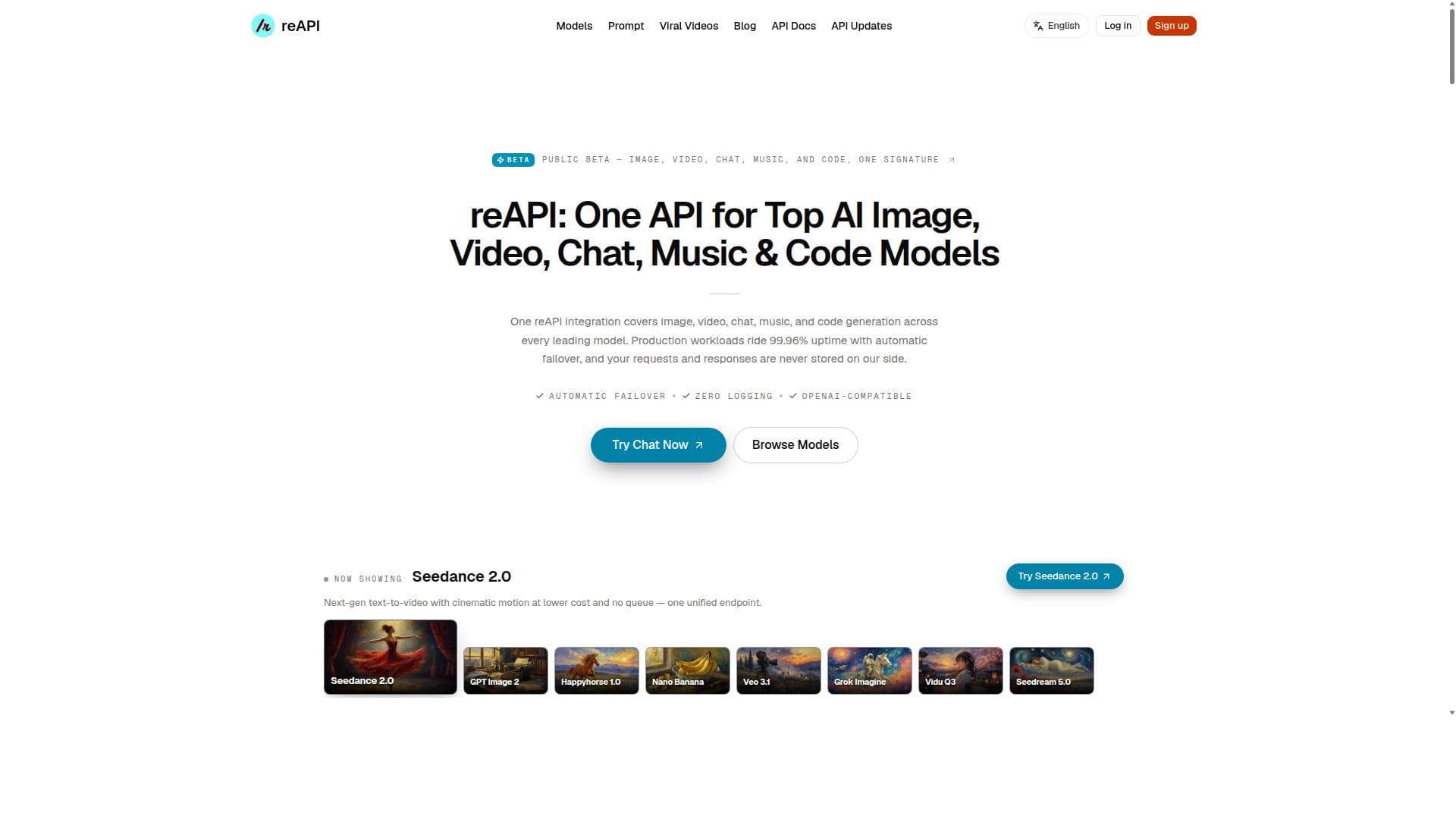
reAPI offers a single, unified API endpoint that integrates top AI models across image, video, chat, music, and code, delivering high reliability with 99.96% uptime and automatic failover. Its OpenAI-compatible interface and zero request logging make it an ideal choice for developers and businesses seeking secure, versatile, and seamless AI model access without vendor lock-in.
reAPI is a versatile AI integration platform designed to simplify and unify access to leading artificial intelligence models across multiple domains including image generation, video processing, chatbots, music creation, and code generation. Its core purpose is to provide developers and businesses with a single, reliable API endpoint that aggregates top AI models, eliminating the complexity of managing multiple APIs and vendor relationships. This unified approach allows users to seamlessly switch between different AI capabilities and providers without changing their integration, streamlining development workflows and accelerating AI adoption. One of the standout features of reAPI is its support for a broad spectrum of AI models, covering various modalities such as image, video, chat, music, and code. This makes it a comprehensive solution for projects requiring multimodal AI capabilities. The platform guarantees an impressive 99.96% uptime, ensuring that applications relying on AI remain highly available and responsive. To further enhance reliability, reAPI incorporates automatic failover mechanisms that reroute requests to backup models or endpoints in case of downtime or degraded performance, minimizing service interruptions. reAPI is also built with privacy and security in mind. It offers zero request logging, meaning that user data and API calls are not stored, which is critical for applications handling sensitive or proprietary information. Additionally, its API is compatible with OpenAI’s API specifications, making it easy for developers familiar with OpenAI’s ecosystem to integrate reAPI without a steep learning curve. This compatibility also facilitates a smooth transition or fallback between OpenAI and other AI providers supported by reAPI. The platform is ideal for developers, startups, and enterprises looking to leverage AI across diverse use cases without the overhead of managing multiple AI service contracts or dealing with inconsistent API interfaces. Use cases range from building intelligent chatbots and virtual assistants, generating creative content like images and music, automating video editing or analysis, to accelerating software development with AI-assisted coding tools. reAPI’s unified endpoint and high reliability make it particularly valuable for mission-critical applications where uptime and data privacy are paramount. Regarding pricing, reAPI typically offers tiered plans tailored to different usage levels, though specific pricing details are best obtained directly from their website or sales team. Many users benefit from a free trial or developer tier that allows experimentation with the API before committing to paid plans. This flexible pricing model supports both small-scale projects and large enterprise deployments. Compared to alternatives, reAPI’s key differentiators are its unified multi-model endpoint, high uptime guarantee, automatic failover, and strict privacy policies. While many AI platforms specialize in a single domain or provider, reAPI’s aggregation approach reduces vendor lock-in and simplifies scaling across AI capabilities. However, some users might find that specialized platforms offer deeper customization or model tuning for niche tasks. Additionally, as a relatively new player, reAPI’s ecosystem and community support may be less mature than long-established providers. Potential limitations to consider include dependency on the availability and performance of integrated third-party AI models, which can vary. Also, while zero request logging enhances privacy, it may limit certain analytics or debugging capabilities. Organizations with highly specialized AI needs might require supplementary tools alongside reAPI. Nonetheless, for most users seeking a reliable, secure, and versatile AI integration solution, reAPI presents a compelling option that balances breadth of features with operational robustness.
Description
reAPI offers a single, unified API endpoint that integrates top AI models across image, video, chat, music, and code, delivering high reliability with 99.96% uptime and automatic failover. Its OpenAI-compatible interface and zero request logging make it an ideal choice for developers and businesses seeking secure, versatile, and seamless AI model access without vendor lock-in.
reAPI is a versatile AI integration platform designed to simplify and unify access to leading artificial intelligence models across multiple domains including image generation, video processing, chatbots, music creation, and code generation. Its core purpose is to provide developers and businesses with a single, reliable API endpoint that aggregates top AI models, eliminating the complexity of managing multiple APIs and vendor relationships. This unified approach allows users to seamlessly switch between different AI capabilities and providers without changing their integration, streamlining development workflows and accelerating AI adoption. One of the standout features of reAPI is its support for a broad spectrum of AI models, covering various modalities such as image, video, chat, music, and code. This makes it a comprehensive solution for projects requiring multimodal AI capabilities. The platform guarantees an impressive 99.96% uptime, ensuring that applications relying on AI remain highly available and responsive. To further enhance reliability, reAPI incorporates automatic failover mechanisms that reroute requests to backup models or endpoints in case of downtime or degraded performance, minimizing service interruptions. reAPI is also built with privacy and security in mind. It offers zero request logging, meaning that user data and API calls are not stored, which is critical for applications handling sensitive or proprietary information. Additionally, its API is compatible with OpenAI’s API specifications, making it easy for developers familiar with OpenAI’s ecosystem to integrate reAPI without a steep learning curve. This compatibility also facilitates a smooth transition or fallback between OpenAI and other AI providers supported by reAPI. The platform is ideal for developers, startups, and enterprises looking to leverage AI across diverse use cases without the overhead of managing multiple AI service contracts or dealing with inconsistent API interfaces. Use cases range from building intelligent chatbots and virtual assistants, generating creative content like images and music, automating video editing or analysis, to accelerating software development with AI-assisted coding tools. reAPI’s unified endpoint and high reliability make it particularly valuable for mission-critical applications where uptime and data privacy are paramount. Regarding pricing, reAPI typically offers tiered plans tailored to different usage levels, though specific pricing details are best obtained directly from their website or sales team. Many users benefit from a free trial or developer tier that allows experimentation with the API before committing to paid plans. This flexible pricing model supports both small-scale projects and large enterprise deployments. Compared to alternatives, reAPI’s key differentiators are its unified multi-model endpoint, high uptime guarantee, automatic failover, and strict privacy policies. While many AI platforms specialize in a single domain or provider, reAPI’s aggregation approach reduces vendor lock-in and simplifies scaling across AI capabilities. However, some users might find that specialized platforms offer deeper customization or model tuning for niche tasks. Additionally, as a relatively new player, reAPI’s ecosystem and community support may be less mature than long-established providers. Potential limitations to consider include dependency on the availability and performance of integrated third-party AI models, which can vary. Also, while zero request logging enhances privacy, it may limit certain analytics or debugging capabilities. Organizations with highly specialized AI needs might require supplementary tools alongside reAPI. Nonetheless, for most users seeking a reliable, secure, and versatile AI integration solution, reAPI presents a compelling option that balances breadth of features with operational robustness.
Tool Features
- One API endpoint for multiple top AI models
- Supports image, video, chat, music, and code AI models
- 99.96% uptime guarantee
- Automatic failover for reliability
- OpenAI-compatible API
- Zero request logging for privacy
Frequently Asked Questions
What is reAPI?
reAPI is a unified API platform that integrates multiple top AI models for image, video, chat, music, and code into a single endpoint, simplifying AI access and management for developers and businesses.
How much does reAPI cost?
reAPI offers tiered pricing plans tailored to different usage levels, including options for developers and enterprises. Specific pricing details are available on their website or through direct contact with their sales team.
Who is reAPI best for?
reAPI is best suited for developers, startups, and enterprises that need reliable, secure, and versatile AI capabilities across multiple domains without managing multiple APIs or vendors.
What are the main features of reAPI?
Key features include a single API endpoint for multiple AI models, support for image, video, chat, music, and code AI, 99.96% uptime guarantee, automatic failover, OpenAI-compatible API, and zero request logging for privacy.
Does reAPI offer a free trial?
Yes, reAPI typically offers a free trial or developer tier to allow users to test the platform and its capabilities before committing to a paid plan.
What integrations does reAPI support?
reAPI integrates top AI models across various domains including image generation, video processing, conversational AI, music creation, and code generation, all accessible through a unified API endpoint.
How does reAPI work?
reAPI works by providing a single API endpoint that routes requests to multiple integrated AI models across different modalities. It ensures high availability through automatic failover and maintains user privacy by not logging requests.
Sponsored Tools





































Reviews
No reviews yet. Be the first to share your experience.