Description
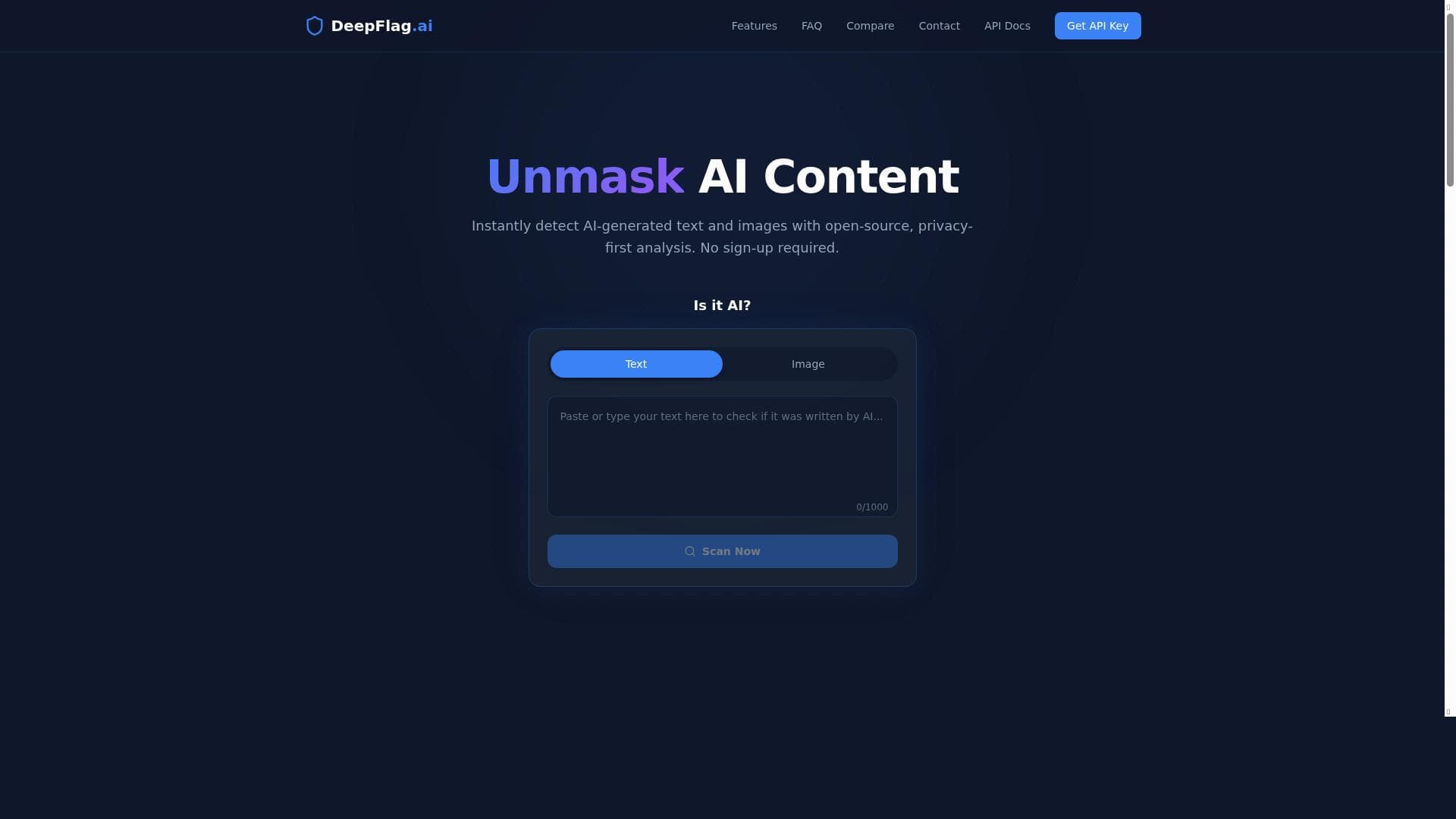
DeepFlag.ai offers instant, privacy-first detection of AI-generated text and images by combining multiple advanced analytical techniques into a transparent confidence score. Ideal for content creators, developers, and researchers, it provides powerful detection capabilities without requiring sign-up, backed by an open-source foundation and a flexible freemium pricing model.
DeepFlag.ai is a cutting-edge AI detection tool designed to instantly identify AI-generated text and images through a comprehensive, open-source, and privacy-first analytical approach. Its core purpose is to provide users with reliable, transparent, and immediate insights into whether content has been produced by artificial intelligence, addressing the growing need for authenticity verification in digital media. By combining multiple detection signals into a unified confidence score, DeepFlag.ai offers a nuanced and trustworthy assessment without compromising user privacy or requiring cumbersome sign-ups. At the heart of DeepFlag.ai's capabilities is its sophisticated text detection system. This system leverages several advanced analytical techniques, including perplexity scoring, which measures how predictable a piece of text is based on language models; burstiness analysis, which examines the variability in sentence length and structure; and entropy measurement, assessing the randomness or complexity of the text. Complementing these statistical methods is a RoBERTa-based machine learning classifier, a state-of-the-art model trained specifically to distinguish AI-generated text from human-written content. Together, these methods provide a multi-faceted evaluation that enhances detection accuracy. For image detection, DeepFlag.ai employs a combination of frequency domain analysis and metadata inspection. The tool uses Fast Fourier Transform (FFT) frequency analysis to detect subtle artifacts and patterns typical of AI-generated images. Additionally, it inspects EXIF metadata, which can reveal information about the image's origin and editing history. A dedicated image classifier model further refines the detection process by analyzing visual features indicative of synthetic generation. This layered approach ensures robust identification of AI-manipulated or created images. Developers and enterprises benefit from DeepFlag.ai’s comprehensive API, which features a RESTful interface secured by API key authentication. The API is fully documented with OpenAPI specifications, facilitating seamless integration into existing workflows, content management systems, or moderation tools. This makes DeepFlag.ai highly adaptable for various applications, from academic research and journalism to social media platforms and corporate compliance. One of the standout aspects of DeepFlag.ai is its commitment to transparency and user privacy. The tool provides clear confidence scores and detailed analysis metrics, allowing users to understand the basis of each detection result. Importantly, it operates without requiring users to create accounts or submit personal data, aligning with privacy-first principles and reducing barriers to immediate use. DeepFlag.ai is ideal for content creators, educators, journalists, social media managers, and developers who need to verify the authenticity of text and images quickly and reliably. It is particularly useful in combating misinformation, detecting deepfakes, and ensuring content integrity in environments where AI-generated material is increasingly prevalent. Researchers studying AI-generated content can also leverage its open-source foundation to customize or extend its capabilities. The tool offers a freemium pricing model, allowing users to access core detection features at no cost, which is perfect for casual or initial use. For more extensive or commercial applications, premium plans provide enhanced API access, higher usage limits, and priority support. This flexible pricing structure makes DeepFlag.ai accessible to a wide range of users, from individual professionals to large organizations. Compared to alternatives, DeepFlag.ai distinguishes itself through its multi-signal detection methodology, open-source transparency, and privacy-centric design. Many competing tools either focus solely on text or image detection or require user registration and data submission, which can raise privacy concerns. DeepFlag.ai’s combination of advanced analytical techniques and ease of use without sign-up sets it apart as a trustworthy and user-friendly solution. However, users should be aware that no AI detection tool is infallible. The rapidly evolving nature of AI-generated content means detection models must continuously adapt. While DeepFlag.ai provides detailed metrics and confidence scores, borderline cases may still require human judgment. Additionally, the freemium model may impose usage limits that could affect high-volume users unless they upgrade to paid plans. In summary, DeepFlag.ai is a powerful, transparent, and privacy-conscious tool for detecting AI-generated text and images. Its advanced multi-modal detection techniques, developer-friendly API, and no-sign-up instant access make it an excellent choice for anyone seeking to verify digital content authenticity in an increasingly AI-driven world.

Description
DeepFlag.ai offers instant, privacy-first detection of AI-generated text and images by combining multiple advanced analytical techniques into a transparent confidence score. Ideal for content creators, developers, and researchers, it provides powerful detection capabilities without requiring sign-up, backed by an open-source foundation and a flexible freemium pricing model.
DeepFlag.ai is a cutting-edge AI detection tool designed to instantly identify AI-generated text and images through a comprehensive, open-source, and privacy-first analytical approach. Its core purpose is to provide users with reliable, transparent, and immediate insights into whether content has been produced by artificial intelligence, addressing the growing need for authenticity verification in digital media. By combining multiple detection signals into a unified confidence score, DeepFlag.ai offers a nuanced and trustworthy assessment without compromising user privacy or requiring cumbersome sign-ups. At the heart of DeepFlag.ai's capabilities is its sophisticated text detection system. This system leverages several advanced analytical techniques, including perplexity scoring, which measures how predictable a piece of text is based on language models; burstiness analysis, which examines the variability in sentence length and structure; and entropy measurement, assessing the randomness or complexity of the text. Complementing these statistical methods is a RoBERTa-based machine learning classifier, a state-of-the-art model trained specifically to distinguish AI-generated text from human-written content. Together, these methods provide a multi-faceted evaluation that enhances detection accuracy. For image detection, DeepFlag.ai employs a combination of frequency domain analysis and metadata inspection. The tool uses Fast Fourier Transform (FFT) frequency analysis to detect subtle artifacts and patterns typical of AI-generated images. Additionally, it inspects EXIF metadata, which can reveal information about the image's origin and editing history. A dedicated image classifier model further refines the detection process by analyzing visual features indicative of synthetic generation. This layered approach ensures robust identification of AI-manipulated or created images. Developers and enterprises benefit from DeepFlag.ai’s comprehensive API, which features a RESTful interface secured by API key authentication. The API is fully documented with OpenAPI specifications, facilitating seamless integration into existing workflows, content management systems, or moderation tools. This makes DeepFlag.ai highly adaptable for various applications, from academic research and journalism to social media platforms and corporate compliance. One of the standout aspects of DeepFlag.ai is its commitment to transparency and user privacy. The tool provides clear confidence scores and detailed analysis metrics, allowing users to understand the basis of each detection result. Importantly, it operates without requiring users to create accounts or submit personal data, aligning with privacy-first principles and reducing barriers to immediate use. DeepFlag.ai is ideal for content creators, educators, journalists, social media managers, and developers who need to verify the authenticity of text and images quickly and reliably. It is particularly useful in combating misinformation, detecting deepfakes, and ensuring content integrity in environments where AI-generated material is increasingly prevalent. Researchers studying AI-generated content can also leverage its open-source foundation to customize or extend its capabilities. The tool offers a freemium pricing model, allowing users to access core detection features at no cost, which is perfect for casual or initial use. For more extensive or commercial applications, premium plans provide enhanced API access, higher usage limits, and priority support. This flexible pricing structure makes DeepFlag.ai accessible to a wide range of users, from individual professionals to large organizations. Compared to alternatives, DeepFlag.ai distinguishes itself through its multi-signal detection methodology, open-source transparency, and privacy-centric design. Many competing tools either focus solely on text or image detection or require user registration and data submission, which can raise privacy concerns. DeepFlag.ai’s combination of advanced analytical techniques and ease of use without sign-up sets it apart as a trustworthy and user-friendly solution. However, users should be aware that no AI detection tool is infallible. The rapidly evolving nature of AI-generated content means detection models must continuously adapt. While DeepFlag.ai provides detailed metrics and confidence scores, borderline cases may still require human judgment. Additionally, the freemium model may impose usage limits that could affect high-volume users unless they upgrade to paid plans. In summary, DeepFlag.ai is a powerful, transparent, and privacy-conscious tool for detecting AI-generated text and images. Its advanced multi-modal detection techniques, developer-friendly API, and no-sign-up instant access make it an excellent choice for anyone seeking to verify digital content authenticity in an increasingly AI-driven world.
Tool Features
- Text Detection using perplexity scoring, burstiness analysis, entropy measurement, and RoBERTa-based ML classifier
- Image Detection through FFT frequency analysis, EXIF metadata inspection, and dedicated image classifier model
- Developer API with RESTful interface, API key authentication, and full OpenAPI documentation
- Transparent confidence scores and analysis metrics
- No sign-up required for instant detection
- Open-source and privacy-first analysis
Frequently Asked Questions
What is DeepFlag.ai?
DeepFlag.ai is an AI detection tool that instantly identifies AI-generated text and images using open-source, privacy-first analysis. It combines multiple detection signals into a single confidence score with transparent metrics and requires no sign-up for use.
How much does DeepFlag.ai cost?
DeepFlag.ai operates on a freemium pricing model, offering free access to core detection features with optional premium plans for enhanced API access, higher usage limits, and priority support.
Who is DeepFlag.ai best for?
DeepFlag.ai is best suited for content creators, educators, journalists, social media managers, developers, and researchers who need to verify the authenticity of text and images quickly and reliably.
What are the main features of DeepFlag.ai?
Key features include text detection using perplexity scoring, burstiness analysis, entropy measurement, and a RoBERTa-based ML classifier; image detection via FFT frequency analysis, EXIF metadata inspection, and a dedicated image classifier; a developer API with RESTful interface and OpenAPI documentation; transparent confidence scores; no sign-up required; and an open-source, privacy-first approach.
Does DeepFlag.ai offer a free trial?
Yes, DeepFlag.ai offers free access to its core detection features without requiring sign-up, effectively serving as a free trial for users to test its capabilities.
What integrations does DeepFlag.ai support?
DeepFlag.ai provides a developer API with a RESTful interface and full OpenAPI documentation, allowing easy integration into various platforms, content management systems, and moderation tools.
How does DeepFlag.ai work?
DeepFlag.ai detects AI-generated content by analyzing multiple signals: for text, it uses perplexity scoring, burstiness analysis, entropy measurement, and a RoBERTa-based classifier; for images, it applies FFT frequency analysis, inspects EXIF metadata, and utilizes a dedicated image classifier model. These signals are combined into a transparent confidence score to determine the likelihood that content is AI-generated.
Sponsored Tools

















Reviews
No reviews yet. Be the first to share your experience.