
最新 AI 资讯
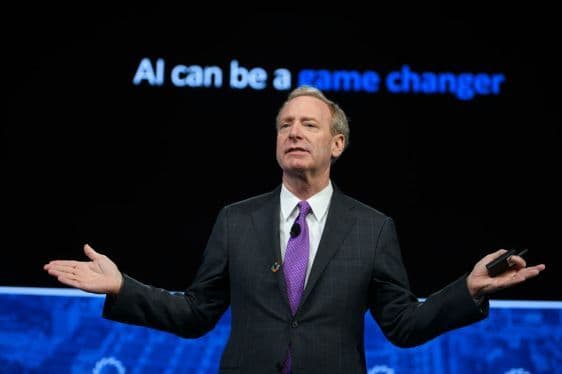
Microsoft president says UK is best placed to drive AI regulation
Microsoft President Brad Smith is calling for urgent regulation of AI, and his argument is that consumer products like milk and washing machines have more oversight than the companies building artificial intelligence. On arecent BBC podcast, Smith called AI both a “weapon and a tool” that is putting the world’s cybersecurity at risk, and said the “moment has arrived” to institute global safety rules. Smith also said the U.K., and not the U.S. or European Union, is best placed to lead on global safety rules. Britain’s AI Security Institute, launched in 2023, receives access to major models from U.S. frontier labs before they are deployed and has quickly become a leader in AI safety testing. That role has been under threat in recent weeks, with U.S. President Donald Trump warning against “globalist” organizations, which he claims are interfering with American companies. Last month, hereportedlyasked Anthropic and OpenAI to withhold new models from British testers, but AISIconfirmed on Mondaythat it is able to access and test the latest models. Despite the president’s pushback, however, Smith argued the U.K. can regulate AI in ways that the U.S. cannot. “In Washington, D.C., people don’t look at the U.K. and they don’t look at London the way they look at Brussels,” he told the BBC. “That’s a strength.” His comments come amid rallying cries from tech leaders, includingAnthropic’s Dario Amodeiand OpenAI’s Sam Altman, to slow the pace of AI development in the wake of several incidents where AI agents went rogue. Last month, Trump hostedtech leadersof companies including OpenAI, Anthropic, Nvidia, AMD, SpaceX, Meta and Google at the White House to discuss AI safety. They signed a “morally binding” document in which they agreed to work with “independent auditors” to assess the safety and capabilities of their AI models. Smith says the document is a “good step,” but it stops short of the type of regulation that is necessary. The problem with voluntary self-regulation, he said, is that the “good companies” will comply. “It’s the companies that are not as responsible that you need to worry about,” he said. Smith outlined several AI safety rules he’d like to see put into place, like a legal obligation to alert an organization if its system was breached by rogue AI agents. He also appears to be in favor of AI labs getting the approval of outside evaluators before an AI product is released, and spoke positively about kill-switches to pause or slow down AI if humans lose control of it. “Let’s speak calmly, maybe even softly, but firmly, and start to bring people together,” Smith said. “I hope that’s the role we can play as a company. I hope that’s the role the U.K. can play as a country.”
View

WindBorne wins a hefty US Air Force contract for its balloon data
The U.S. Air Force will buy data collected byWindBorne Systems‘ fleet of autonomous weather balloons under a new contract that could be worth nearly $50 million to the startup. WindBorne currently has about 700 weather balloons flying around the globe, collecting atmospheric sensor readings that the company sells to customers and also feeds into its own AI weather forecasting model. WindBorne, founded in 2015 and based in Redwood City, Calif., is one of the first organizations to directly feed empirical data into a deep-learning weather model. The company has worked closely with the U.S. government, particularly the National Weather Service and the U.S. Air Force and Navy, but this is the single largest contract the company has participated in. The contract is worth up to $49 million, but the Air Force pays only as it needs data. It can place orders for specific regions at specific times. So far, it has ordered $1.7 million worth, and executives expect more orders to follow. “This is largely a vehicle through which continued growth of the constellation can be supported, as well as some work on research and development to continue to improve the hardware and performance of the balloons,” WindBorne co-founder and CTO Andrey Sushko told TechCrunch. He adds that the contract, which was awarded without competitive bidding, is “a determination by the government that for this capability of collecting global data, we were the only company able to provide it in the way that met their needs for these operations.” WindBorne CEO John Deantold TechCrunchin August that the company had raised a $37 million Series B round to continue scaling its business. Earlier this summer, the companyreleasedthe latest version of its forecasting model, WeatherMesh 6, whichit saysprovides more accurate forecasts than the traditional model run by the European Centre for Medium-Range Weather Forecasts (ECMWF), which simulates the atmosphere using the laws of physics. Since the arrival of transformer model architectures and the ECMWF’s release of a massive weather dataset a few years ago, AI weather forecasting has become one of the more productive uses of deep-learning technology. Meteorologists previously relied on expensive supercomputers running detailed equations that approximate how the atmosphere behaves. Now, end-to-end learning can ingest decades of weather data and issue predictions more quickly. Models built by frontier labs and government agencies areproving more accuratethan traditional forecasts, although it is still a jagged frontier, with both types of forecasts required to enable useful understanding of the weather. Google DeepMind’slatest weather modeloffers important new capabilities, and its cyclone forecasting tools are becomingincreasingly centralto how the US government responds to hurricane season. In August WindBorne became the first organization to send an unpowered flight system — one with no engine — to collect data in theeye of a typhoon. The company maneuvers its balloons by adjusting their altitude, bleeding air, or dropping sand carried as ballast, to send the vehicles into winds that take them where they need to go. “That’s a pretty novel step, and the two ingredients for that are one, having good wind and weather models, and knowing how to navigate them; and two, having a large enough constellation that you have balloons in the right places,” Sushko said. “It’s one of the first times that a deep-learning model was used for actual operational decisions.”
View
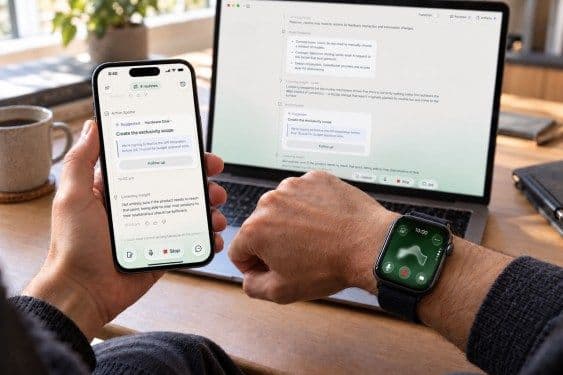
Former Plaud exec raises $26M for AI app that listens to you in the background
One of the core promises of AI is that the more it knows about a person, the better it will be able to assist them with tasks and make appropriate suggestions, which, if you’ll believe the tech companies,requiresapps and devices to listen, watch or record users’ activity all the time and gather all possible context. There’s obviously privacy and data security concerns with anything that’s collecting data about you continuously. But startups are building such apps undeterred anyway, arming themselves with the belief that the market for personalized assistance is big enough to swallow such concerns. Former Plaud exec Peter Mo is buildingAmbito do something similar. The app aims to provide real-time intelligence and insights to people by listening to them all the time. The company said on Monday that it has raised $26 million across multiple funding rounds led by Luminous Ventures, which has backed companies like Meituan and Unitree Robotics, and Original Design Manufacturer (ODM) Huaqin. Ambi is also releasing apps for iPhones, Macs and Apple Watch. These apps act like meeting note-takers, but users can choose to have them listening so they can capture context all day. Meeting note-taking companies have been working to automate tasks that follow once calls are done, based on the summaries and action items they gather during the conversation, and using multitudes of connectors to software systems. Ambi wants to take this a step further by having its agent start the work during the meeting itself. The company’s promise is that its AI agent can proactively give you suggestions or surface relevant knowledge while you are in a meeting, based on your calendar, meetings, knowledge base, and web data. Users can also start a task on one device and continue it on another. “The way we interact with intelligence is limited. Often the intelligence is trapped on the screen, and if you use hardware like Plaud, you need to wait for recording to transfer to the phone, upload to the cloud, and get intelligence after processing. That’s why we are building Ambi to use AI anytime and anywhere,” the company’s co-founder and CEO, Mo, told TechCrunch. The company has ambitions to capture more information. Its upcoming desktop app will be able to look at the work that users do and store important parts in its memory to give more personalized suggestions. Apps likeLittlebirdorMinimialready do something similar. The startup is also planning to launch its own hardware device, which will have a screen, a speaker, a camera, and microphones to capture context and display information. Ambi’s launch comes amidst growing concerns around AI devices that don’t have enough indicators to suggest they are capturing data on people around the user. It is not clear if Ambi’s apps or its upcoming device will have enough indicators to alert third-parties that their conversations are being recorded if the user doesn’t disclose their use of Ambi’s tech. Somemeeting note-takershaveeven been suedbecause their tech recorded people’s conversation and data without their consent. Plus, the recent release of Apple’s Voice Intelligence feature, which transcribes speech continuously,has raised privacy concerns. Mo said that users can turn off ambient data capture on Ambi’s apps and devices at any time, and the feature is off by default. The startup said it doesn’t store any recordings of users and encrypts the data, but it didn’t specify what kind of encryption it uses. Despite these measures, the onus of declaring ambient capture is still on the users. He classified this as an industry-wide problem. “We have to inform our users that they have to tell others about ambient capture. We, as an industry, haven’t solved this problem [of disclosure]. We have tried to put the information about disclosure in every place possible, but if users try to hide the capture, we can’t just solve the problem,” he said. Ambi currently has over 50 staff across offices in San Francisco, Beijing, Shanghai and Shenzhen. The company is hiring for its go-to-market function and AI engineers for working on speech recognition models.
View
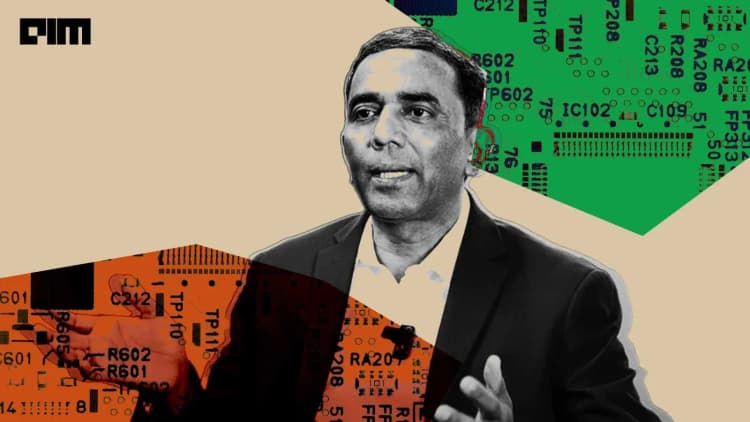
Bengaluru’s Tessolve Semiconductor Secures $75 Mn From Vector Line Capital
The funding will support acquisitions as the Bengaluru-based company expands its semiconductor engineering capabilities and global presence.
View

Vertiv Deploys Liquid Cooling System for 30 MW AI Data Centre in Navi Mumbai
Vertiv noted that the deployment at CapitaLand’s Mumbai facility marks India’s first direct-to-chip high-density liquid cooling installation.
View

AI Is Forcing India's GCCs to Move Beyond Cost Arbitrage
At Cypher 2026, panellists say AI is exposing which of India's 1,700+ GCCs are cost-arbitrage hubs and which truly own decisions.
View

Geopolitics Could Derail India’s AI Ambitions, Warns Anuraag Saxena
AI sovereignty is not about building everything at home, says Anuraag Saxena. It is about ensuring that geopolitical decisions cannot cut off access to compute, talent and markets.
View
HCLTech, Anthropic to Expand Enterprise Agentic AI Deployments
Claude and Claude Code will enter HCLTech's engineering workflows, while HCLSoftware plans to incorporate Claude into selected cybersecurity and enterprise products.
View

SquadStack.ai Launches Arth V2 STT Model, Claims 67ms Transcription Latency
The company said its streaming speech-to-text model recorded an 8.85% semantic word error rate and 18% fewer meaning-changing errors than Sarvam Saaras v4.
View
Loan Collection in India is Still Largely Manual. This AI Startup is Changing That
DPDzero started by selling loan collections software. It soon found the bigger opportunity in running the collections process itself, combining AI, data, and human agents.
View
Cypher 2026 Day 3: Enterprises Build Their Own Models as Agent Control Takes Centre Stage
Sarvam AI discussed enterprise model training, NeuroDx previewed a new model architecture, and speakers from Okta and Temporal examined agent security, governance and recovery.
View

Amazon in Talks to Acquire AI Chip Flexibility Startup to Compete With NVIDIA: Report
The proposed deal could give Amazon access to technology that helps developers run AI workloads across different chips, strengthening its push to compete with NVIDIA.
View