Description
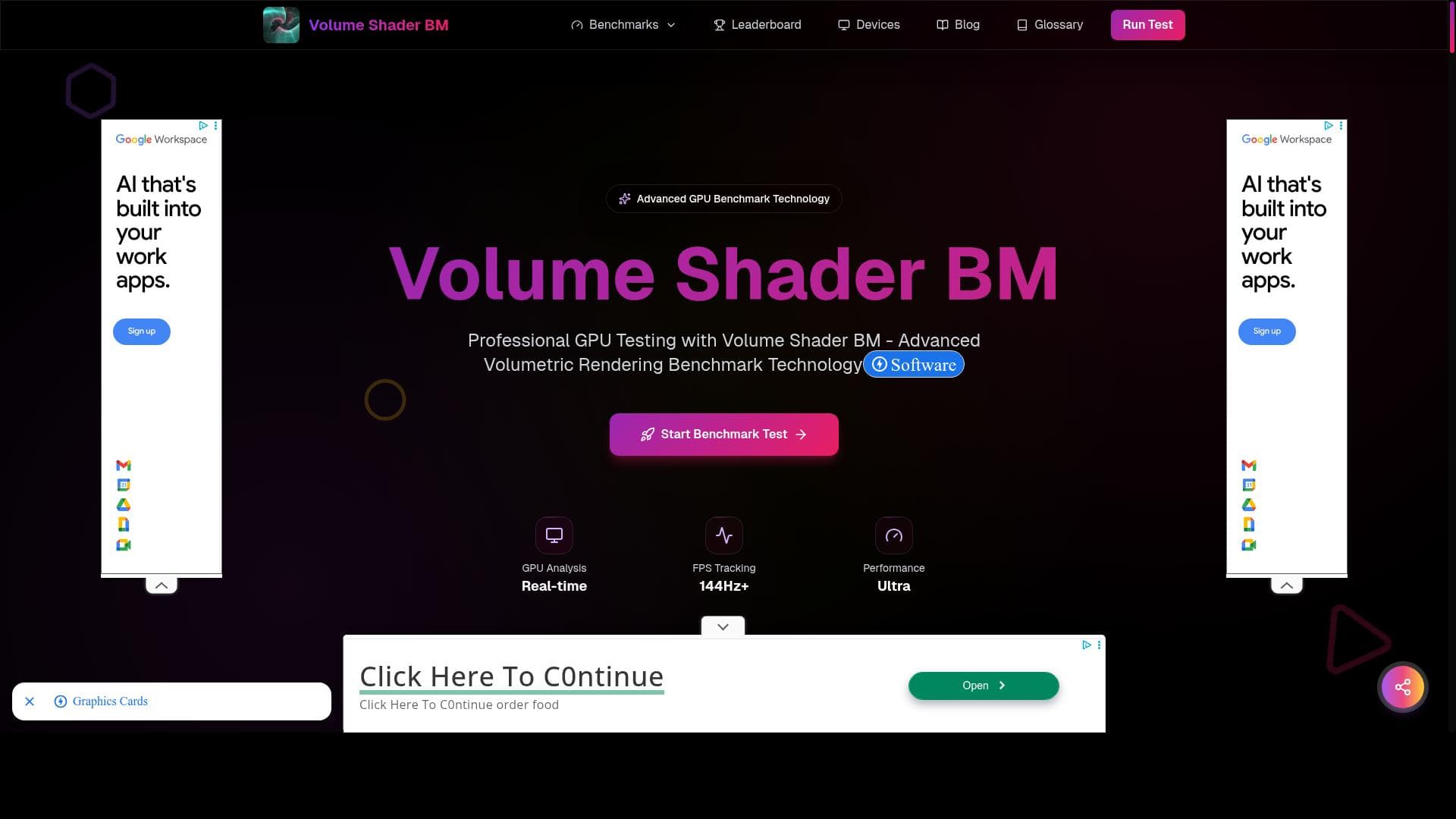
Volume Shader BM is a free, advanced GPU benchmarking tool that specializes in volumetric rendering and shader performance within WebGL and real-time 3D graphics environments. It offers developers and hardware testers detailed insights into GPU capabilities, making it ideal for optimizing graphics performance in web and gaming applications.
Volume Shader BM is a specialized GPU benchmarking tool that focuses on evaluating graphics processing unit (GPU) performance through advanced volumetric rendering tests. Its core purpose is to provide developers, hardware enthusiasts, and graphics professionals with a detailed and accurate assessment of GPU capabilities, particularly in the context of WebGL, real-time 3D graphics, and shader programming. By leveraging complex volumetric rendering techniques, Volume Shader BM pushes GPUs to their limits, enabling users to understand how well their hardware handles demanding graphical computations and shader executions in real time. One of the standout features of Volume Shader BM is its comprehensive GPU performance testing framework. Unlike generic benchmarks, it emphasizes volumetric rendering—a sophisticated method of visualizing 3D data that requires intensive computation and memory bandwidth. This makes it an ideal tool for assessing how GPUs perform under realistic, high-load graphical scenarios. Additionally, the tool evaluates WebGL performance, which is critical for developers working on web-based 3D applications and games. By measuring WebGL capabilities, Volume Shader BM helps users gauge how efficiently their GPUs can render interactive 3D graphics within browsers. The tool also excels in real-time 3D graphics benchmarking, providing dynamic tests that simulate practical rendering workloads. This includes shader programming performance analysis, where the tool assesses how effectively a GPU can compile and execute complex shader programs. Shaders are essential for creating visual effects and realistic lighting in 3D environments, so this feature is particularly valuable for graphics programmers and game developers aiming to optimize their applications. Volume Shader BM is best suited for a range of users including GPU hardware testers, graphics developers, game designers, and technology enthusiasts who require precise and detailed insights into GPU performance. It is especially useful for those developing WebGL applications or working with real-time 3D graphics, as it highlights strengths and bottlenecks in shader execution and volumetric rendering. Use cases include hardware benchmarking before purchasing or upgrading GPUs, performance tuning for graphics-intensive software, and academic research in computer graphics. The tool is available for free, making it accessible to a broad audience without any financial commitment. This pricing model encourages widespread use and experimentation, allowing users to benchmark their GPUs without restrictions. Compared to other GPU benchmarking tools that may focus on synthetic tests or gaming performance, Volume Shader BM’s emphasis on volumetric rendering and shader analysis offers a more specialized and in-depth perspective on GPU capabilities, particularly for WebGL and real-time graphics contexts. However, there are some considerations to keep in mind. Because Volume Shader BM targets advanced volumetric rendering and shader performance, it may require a certain level of technical knowledge to interpret the results effectively. Users unfamiliar with GPU architecture or shader programming might find the detailed metrics less accessible. Additionally, since the tool is web-based and relies on WebGL, performance results can be influenced by browser differences and system configurations, which may introduce variability in benchmarking outcomes. In summary, Volume Shader BM is a powerful, free benchmarking tool that provides detailed and specialized insights into GPU performance through volumetric rendering and shader testing. It stands out for its focus on WebGL and real-time 3D graphics, making it an essential resource for developers and enthusiasts seeking to understand and optimize their graphics hardware in demanding rendering scenarios.

Description
Volume Shader BM is a free, advanced GPU benchmarking tool that specializes in volumetric rendering and shader performance within WebGL and real-time 3D graphics environments. It offers developers and hardware testers detailed insights into GPU capabilities, making it ideal for optimizing graphics performance in web and gaming applications.
Volume Shader BM is a specialized GPU benchmarking tool that focuses on evaluating graphics processing unit (GPU) performance through advanced volumetric rendering tests. Its core purpose is to provide developers, hardware enthusiasts, and graphics professionals with a detailed and accurate assessment of GPU capabilities, particularly in the context of WebGL, real-time 3D graphics, and shader programming. By leveraging complex volumetric rendering techniques, Volume Shader BM pushes GPUs to their limits, enabling users to understand how well their hardware handles demanding graphical computations and shader executions in real time. One of the standout features of Volume Shader BM is its comprehensive GPU performance testing framework. Unlike generic benchmarks, it emphasizes volumetric rendering—a sophisticated method of visualizing 3D data that requires intensive computation and memory bandwidth. This makes it an ideal tool for assessing how GPUs perform under realistic, high-load graphical scenarios. Additionally, the tool evaluates WebGL performance, which is critical for developers working on web-based 3D applications and games. By measuring WebGL capabilities, Volume Shader BM helps users gauge how efficiently their GPUs can render interactive 3D graphics within browsers. The tool also excels in real-time 3D graphics benchmarking, providing dynamic tests that simulate practical rendering workloads. This includes shader programming performance analysis, where the tool assesses how effectively a GPU can compile and execute complex shader programs. Shaders are essential for creating visual effects and realistic lighting in 3D environments, so this feature is particularly valuable for graphics programmers and game developers aiming to optimize their applications. Volume Shader BM is best suited for a range of users including GPU hardware testers, graphics developers, game designers, and technology enthusiasts who require precise and detailed insights into GPU performance. It is especially useful for those developing WebGL applications or working with real-time 3D graphics, as it highlights strengths and bottlenecks in shader execution and volumetric rendering. Use cases include hardware benchmarking before purchasing or upgrading GPUs, performance tuning for graphics-intensive software, and academic research in computer graphics. The tool is available for free, making it accessible to a broad audience without any financial commitment. This pricing model encourages widespread use and experimentation, allowing users to benchmark their GPUs without restrictions. Compared to other GPU benchmarking tools that may focus on synthetic tests or gaming performance, Volume Shader BM’s emphasis on volumetric rendering and shader analysis offers a more specialized and in-depth perspective on GPU capabilities, particularly for WebGL and real-time graphics contexts. However, there are some considerations to keep in mind. Because Volume Shader BM targets advanced volumetric rendering and shader performance, it may require a certain level of technical knowledge to interpret the results effectively. Users unfamiliar with GPU architecture or shader programming might find the detailed metrics less accessible. Additionally, since the tool is web-based and relies on WebGL, performance results can be influenced by browser differences and system configurations, which may introduce variability in benchmarking outcomes. In summary, Volume Shader BM is a powerful, free benchmarking tool that provides detailed and specialized insights into GPU performance through volumetric rendering and shader testing. It stands out for its focus on WebGL and real-time 3D graphics, making it an essential resource for developers and enthusiasts seeking to understand and optimize their graphics hardware in demanding rendering scenarios.
Tool Features
- GPU performance testing
- Advanced volumetric rendering test
- WebGL performance evaluation
- Real-time 3D graphics benchmarking
- Shader programming performance analysis
Frequently Asked Questions
What is Volume Shader BM?
Volume Shader BM is a GPU benchmark test tool designed to evaluate graphics processing unit performance through advanced volumetric rendering tests, focusing on WebGL, real-time 3D graphics, and shader programming.
How much does Volume Shader BM cost?
Volume Shader BM is available for free, allowing users to perform GPU benchmarking without any cost.
Who is Volume Shader BM best for?
It is best suited for GPU hardware testers, graphics developers, game designers, and technology enthusiasts who need detailed insights into GPU performance, especially in WebGL and real-time 3D graphics contexts.
What are the main features of Volume Shader BM?
Key features include GPU performance testing, advanced volumetric rendering tests, WebGL performance evaluation, real-time 3D graphics benchmarking, and shader programming performance analysis.
Does Volume Shader BM offer a free trial?
Since Volume Shader BM is completely free to use, there is no need for a separate free trial.
What integrations does Volume Shader BM support?
Volume Shader BM operates primarily as a standalone web-based benchmarking tool focused on WebGL and does not require or offer specific third-party integrations.
How does Volume Shader BM work?
The tool runs advanced volumetric rendering and shader execution tests within a WebGL environment, stressing the GPU with real-time 3D graphics workloads to measure performance metrics and provide detailed insights into graphics processing capabilities.
Sponsored Tools






































Reviews
No reviews yet. Be the first to share your experience.