Description
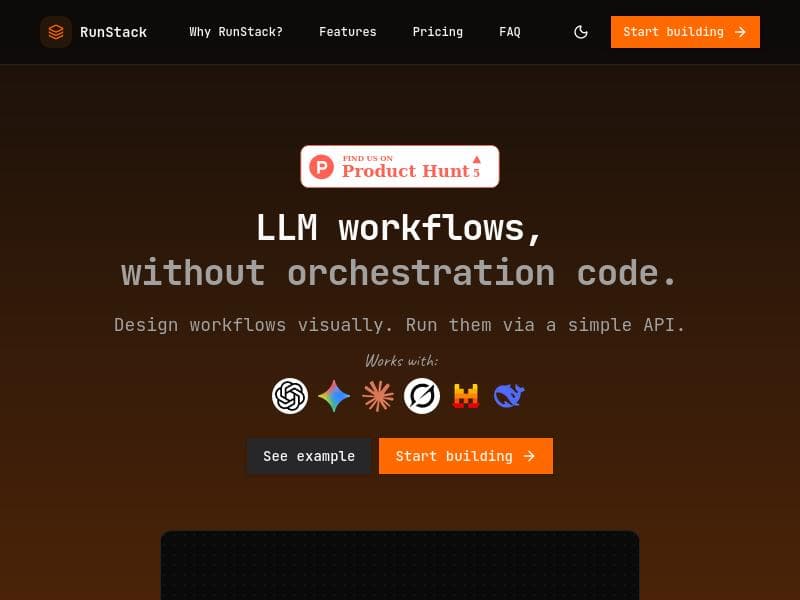
RunStack empowers users to visually design, test, and deploy AI workflows with ease, transforming complex AI processes into reusable API endpoints. Ideal for developers and product teams, it streamlines AI integration by combining a visual editor with powerful automation and model chaining capabilities.
RunStack is an innovative AI tool designed to simplify the creation, management, and deployment of AI workflows through an intuitive visual editor. At its core, RunStack enables users to design complex AI-driven processes by chaining together multiple prompts and models, adding variants for experimentation, and comparing outputs to optimize results. Once a workflow is finalized, it can be transformed into a reusable, production-ready API endpoint that integrates seamlessly with existing applications. This approach eliminates the need for extensive coding or manual orchestration, making it easier for developers, data scientists, and product teams to leverage AI capabilities effectively and efficiently. One of the standout features of RunStack is its visual workflow builder tailored specifically for large language models. This drag-and-drop interface allows users to construct multi-step AI processes without writing complex code, enabling rapid prototyping and iteration. Users can chain prompts to create logical sequences, add variants to test different inputs or model parameters, and compare the outputs side-by-side to identify the best-performing configurations. This level of control and flexibility is particularly valuable for fine-tuning AI responses and ensuring high-quality results. In addition to the visual builder, RunStack integrates seamlessly with various AI capabilities, allowing users to incorporate different models and services within a single workflow. This integration supports automation of complex processes, such as data enrichment, content generation, sentiment analysis, and more, streamlining operations that would otherwise require multiple tools or manual intervention. By automating these workflows, RunStack helps organizations reduce operational overhead, improve consistency, and accelerate time-to-market for AI-powered features. RunStack is best suited for developers, AI practitioners, and product teams who want to design and deploy AI workflows without deep expertise in AI model engineering or backend infrastructure. It is ideal for companies looking to embed AI functionalities into their applications quickly while maintaining control over the workflow logic and output quality. Use cases include customer support automation, content creation pipelines, data processing workflows, and any scenario where multiple AI tasks need to be orchestrated efficiently. Regarding pricing, RunStack offers a freemium model, allowing users to get started without upfront costs. This approach provides access to the core visual editor and basic workflow capabilities, making it accessible for individual developers and small teams. For more advanced features, higher usage limits, or enterprise-grade support, paid plans are available, though specific pricing details should be confirmed on their official website. Compared to alternatives, RunStack stands out by combining a visual workflow builder with direct API deployment, streamlining the entire process from design to production. While other platforms may offer AI model hosting or API access, few provide such an integrated environment for visually designing, testing, and shipping AI workflows. This makes RunStack particularly appealing for teams that prioritize rapid development and iteration without sacrificing production readiness. However, users should consider potential limitations such as the learning curve associated with designing complex workflows visually and the dependency on the supported AI models and integrations within RunStack’s ecosystem. Additionally, while the freemium plan is suitable for experimentation, scaling to high-volume production use may require investment in paid tiers. Overall, RunStack offers a powerful, user-friendly solution for building AI workflows that bridge the gap between experimentation and production deployment.

Description
RunStack empowers users to visually design, test, and deploy AI workflows with ease, transforming complex AI processes into reusable API endpoints. Ideal for developers and product teams, it streamlines AI integration by combining a visual editor with powerful automation and model chaining capabilities.
RunStack is an innovative AI tool designed to simplify the creation, management, and deployment of AI workflows through an intuitive visual editor. At its core, RunStack enables users to design complex AI-driven processes by chaining together multiple prompts and models, adding variants for experimentation, and comparing outputs to optimize results. Once a workflow is finalized, it can be transformed into a reusable, production-ready API endpoint that integrates seamlessly with existing applications. This approach eliminates the need for extensive coding or manual orchestration, making it easier for developers, data scientists, and product teams to leverage AI capabilities effectively and efficiently. One of the standout features of RunStack is its visual workflow builder tailored specifically for large language models. This drag-and-drop interface allows users to construct multi-step AI processes without writing complex code, enabling rapid prototyping and iteration. Users can chain prompts to create logical sequences, add variants to test different inputs or model parameters, and compare the outputs side-by-side to identify the best-performing configurations. This level of control and flexibility is particularly valuable for fine-tuning AI responses and ensuring high-quality results. In addition to the visual builder, RunStack integrates seamlessly with various AI capabilities, allowing users to incorporate different models and services within a single workflow. This integration supports automation of complex processes, such as data enrichment, content generation, sentiment analysis, and more, streamlining operations that would otherwise require multiple tools or manual intervention. By automating these workflows, RunStack helps organizations reduce operational overhead, improve consistency, and accelerate time-to-market for AI-powered features. RunStack is best suited for developers, AI practitioners, and product teams who want to design and deploy AI workflows without deep expertise in AI model engineering or backend infrastructure. It is ideal for companies looking to embed AI functionalities into their applications quickly while maintaining control over the workflow logic and output quality. Use cases include customer support automation, content creation pipelines, data processing workflows, and any scenario where multiple AI tasks need to be orchestrated efficiently. Regarding pricing, RunStack offers a freemium model, allowing users to get started without upfront costs. This approach provides access to the core visual editor and basic workflow capabilities, making it accessible for individual developers and small teams. For more advanced features, higher usage limits, or enterprise-grade support, paid plans are available, though specific pricing details should be confirmed on their official website. Compared to alternatives, RunStack stands out by combining a visual workflow builder with direct API deployment, streamlining the entire process from design to production. While other platforms may offer AI model hosting or API access, few provide such an integrated environment for visually designing, testing, and shipping AI workflows. This makes RunStack particularly appealing for teams that prioritize rapid development and iteration without sacrificing production readiness. However, users should consider potential limitations such as the learning curve associated with designing complex workflows visually and the dependency on the supported AI models and integrations within RunStack’s ecosystem. Additionally, while the freemium plan is suitable for experimentation, scaling to high-volume production use may require investment in paid tiers. Overall, RunStack offers a powerful, user-friendly solution for building AI workflows that bridge the gap between experimentation and production deployment.
Tool Features
- Visual workflow builder for large language models
- Integration with AI capabilities
- Automation of complex processes
Frequently Asked Questions
What is RunStack?
RunStack is an AI tool that allows users to design AI workflows using a visual editor and deploy them as reusable API endpoints. It enables chaining of prompts, adding variants, comparing outputs, and automating complex AI-driven processes.
How much does RunStack cost?
RunStack offers a freemium pricing model, providing free access to core features with limitations. Paid plans with advanced features and higher usage limits are available, with detailed pricing information accessible on their website.
Who is RunStack best for?
RunStack is best suited for developers, AI practitioners, and product teams who want to visually design and deploy AI workflows without extensive coding, enabling rapid prototyping and production-ready AI integration.
What are the main features of RunStack?
Key features include a visual workflow builder for large language models, the ability to chain prompts and add variants, output comparison tools, integration with various AI capabilities, and automation of complex AI processes.
Does RunStack offer a free trial?
Yes, RunStack’s freemium plan allows users to try the platform’s core features for free, enabling experimentation and initial workflow design without upfront costs.
What integrations does RunStack support?
RunStack supports integration with multiple AI models and capabilities, allowing users to incorporate different AI services within a single workflow. Specific integrations can be found on their website or documentation.
How does RunStack work?
Users create AI workflows visually by chaining prompts and adding variants within RunStack’s editor. Once finalized, workflows can be deployed as API endpoints, enabling seamless integration with applications and automation of AI-driven tasks.
Sponsored Tools































Reviews
No reviews yet. Be the first to share your experience.