Description
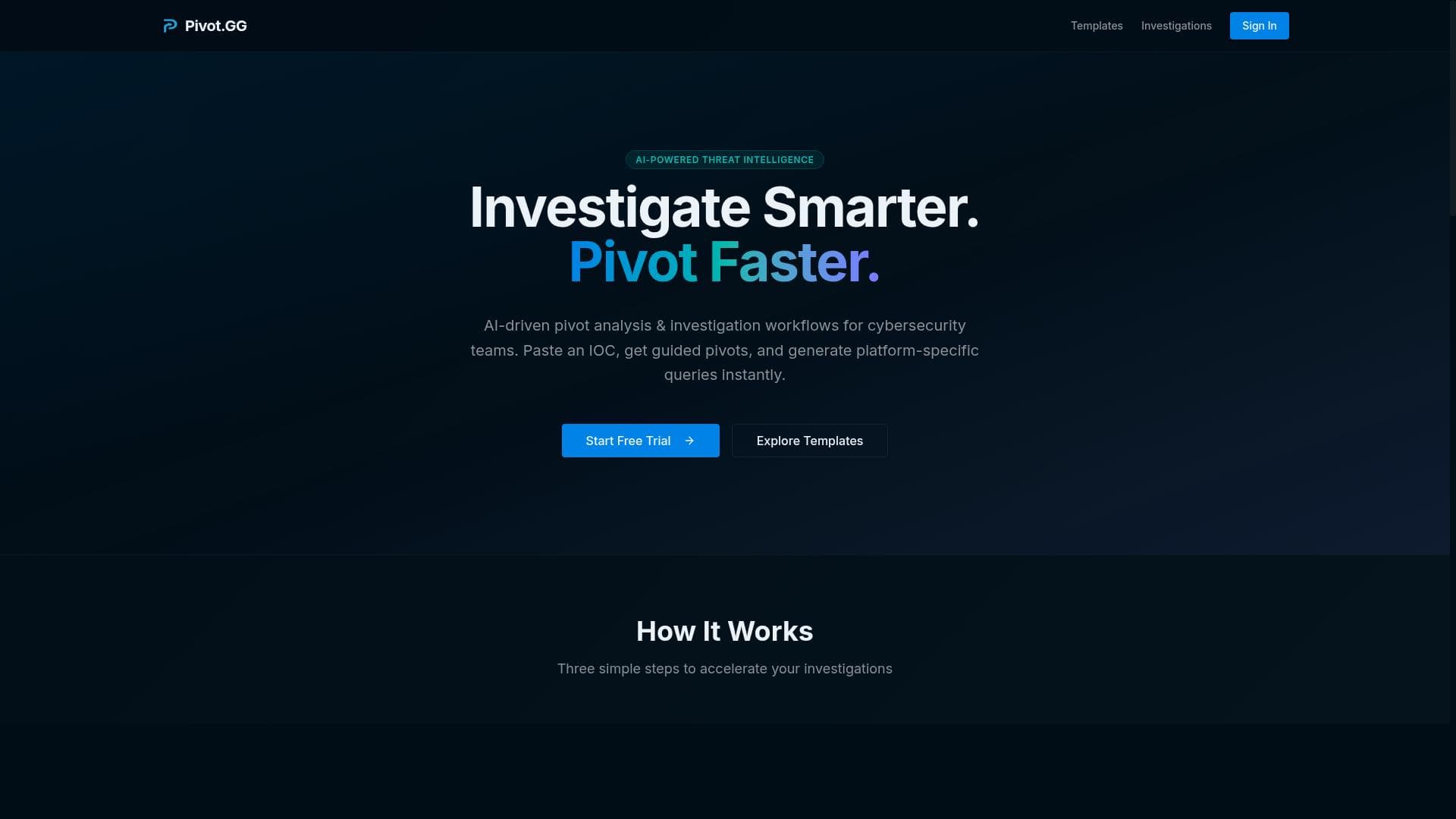
Pivot.GG leverages AI to transform single indicators of compromise into comprehensive, actionable insights through guided, automated investigation workflows. Ideal for SOC analysts and threat hunters, it accelerates incident response and detection engineering with platform-specific queries, YARA rule creation, and instant detection package generation—all accessible via a convenient browser-based SaaS platform.
Pivot.GG is a sophisticated cybersecurity investigation platform designed to empower security analysts by transforming a single indicator of compromise (IOC) into actionable intelligence with greater speed and accuracy. Its core purpose is to streamline and enhance the investigative process within Security Operations Centers (SOCs), incident response teams, and threat hunting units. By providing a browser-based Software-as-a-Service (SaaS) solution, Pivot.GG eliminates the need for complex local installations and enables analysts to access powerful, AI-driven workflows from anywhere. The platform’s primary goal is to reduce guesswork and manual effort, allowing security professionals to focus on critical decision-making and response activities. At the heart of Pivot.GG are its AI-driven pivot analysis and investigation workflows. These workflows guide analysts through context-aware steps that automate the triage of IOCs, threat analysis, scoping of incidents, and detection engineering. This automation accelerates the investigative lifecycle by generating platform-specific queries tailored to the environment under scrutiny, such as Splunk or Kusto Query Language (KQL) searches. Additionally, Pivot.GG can automatically create YARA rules, which are essential for identifying and classifying malware based on patterns, and instantly generate detection packages that can be deployed to security tools to catch similar threats in the future. The platform also supports exportable investigation reports, facilitating communication and documentation of findings within teams or for compliance purposes. Pivot.GG is best suited for SOC analysts, incident responders, and threat hunters who require efficient, guided workflows to manage complex investigations. Its AI-powered capabilities reduce the cognitive load on analysts by suggesting next steps and generating queries that would otherwise require deep expertise and manual effort. Use cases include rapid IOC triage during active incidents, threat hunting campaigns to uncover hidden adversaries, and detection engineering to enhance security monitoring capabilities. The platform’s browser-based SaaS delivery model makes it accessible for distributed teams and scalable for organizations of varying sizes. Regarding pricing, Pivot.GG offers a freemium model, allowing users to access basic features at no cost while providing options to upgrade for more advanced capabilities. This approach enables organizations to evaluate the platform’s value before committing financially, making it an attractive choice for teams with limited budgets or those seeking to pilot new investigative tools. Compared to alternative cybersecurity investigation platforms, Pivot.GG stands out due to its heavy integration of AI to automate and guide the investigative process. While many tools provide raw data or require manual query crafting, Pivot.GG’s AI-generated queries and detection rules significantly reduce the time and expertise needed to perform thorough investigations. Its focus on pivot workflows—moving from one IOC to related indicators and insights—provides a structured approach that many competitors lack. However, some alternatives may offer deeper integrations with specific SIEM or endpoint platforms, so organizations should evaluate compatibility based on their existing security stack. Notable limitations include the reliance on the quality and scope of input data; since Pivot.GG automates query generation and rule creation, incomplete or inaccurate IOCs may limit investigation effectiveness. Additionally, while the freemium model is beneficial for entry-level use, advanced features and enterprise-scale deployments likely require paid subscriptions. Organizations should also consider data privacy and compliance implications when using a cloud-based SaaS platform for sensitive cybersecurity investigations. In summary, Pivot.GG is a powerful, AI-driven cybersecurity investigation platform that accelerates and simplifies the process of turning IOCs into actionable intelligence. Its guided workflows, automated query and rule generation, and SaaS delivery make it an excellent choice for SOC analysts, incident responders, and threat hunters seeking to improve efficiency and accuracy in their investigations.

Description
Pivot.GG leverages AI to transform single indicators of compromise into comprehensive, actionable insights through guided, automated investigation workflows. Ideal for SOC analysts and threat hunters, it accelerates incident response and detection engineering with platform-specific queries, YARA rule creation, and instant detection package generation—all accessible via a convenient browser-based SaaS platform.
Pivot.GG is a sophisticated cybersecurity investigation platform designed to empower security analysts by transforming a single indicator of compromise (IOC) into actionable intelligence with greater speed and accuracy. Its core purpose is to streamline and enhance the investigative process within Security Operations Centers (SOCs), incident response teams, and threat hunting units. By providing a browser-based Software-as-a-Service (SaaS) solution, Pivot.GG eliminates the need for complex local installations and enables analysts to access powerful, AI-driven workflows from anywhere. The platform’s primary goal is to reduce guesswork and manual effort, allowing security professionals to focus on critical decision-making and response activities. At the heart of Pivot.GG are its AI-driven pivot analysis and investigation workflows. These workflows guide analysts through context-aware steps that automate the triage of IOCs, threat analysis, scoping of incidents, and detection engineering. This automation accelerates the investigative lifecycle by generating platform-specific queries tailored to the environment under scrutiny, such as Splunk or Kusto Query Language (KQL) searches. Additionally, Pivot.GG can automatically create YARA rules, which are essential for identifying and classifying malware based on patterns, and instantly generate detection packages that can be deployed to security tools to catch similar threats in the future. The platform also supports exportable investigation reports, facilitating communication and documentation of findings within teams or for compliance purposes. Pivot.GG is best suited for SOC analysts, incident responders, and threat hunters who require efficient, guided workflows to manage complex investigations. Its AI-powered capabilities reduce the cognitive load on analysts by suggesting next steps and generating queries that would otherwise require deep expertise and manual effort. Use cases include rapid IOC triage during active incidents, threat hunting campaigns to uncover hidden adversaries, and detection engineering to enhance security monitoring capabilities. The platform’s browser-based SaaS delivery model makes it accessible for distributed teams and scalable for organizations of varying sizes. Regarding pricing, Pivot.GG offers a freemium model, allowing users to access basic features at no cost while providing options to upgrade for more advanced capabilities. This approach enables organizations to evaluate the platform’s value before committing financially, making it an attractive choice for teams with limited budgets or those seeking to pilot new investigative tools. Compared to alternative cybersecurity investigation platforms, Pivot.GG stands out due to its heavy integration of AI to automate and guide the investigative process. While many tools provide raw data or require manual query crafting, Pivot.GG’s AI-generated queries and detection rules significantly reduce the time and expertise needed to perform thorough investigations. Its focus on pivot workflows—moving from one IOC to related indicators and insights—provides a structured approach that many competitors lack. However, some alternatives may offer deeper integrations with specific SIEM or endpoint platforms, so organizations should evaluate compatibility based on their existing security stack. Notable limitations include the reliance on the quality and scope of input data; since Pivot.GG automates query generation and rule creation, incomplete or inaccurate IOCs may limit investigation effectiveness. Additionally, while the freemium model is beneficial for entry-level use, advanced features and enterprise-scale deployments likely require paid subscriptions. Organizations should also consider data privacy and compliance implications when using a cloud-based SaaS platform for sensitive cybersecurity investigations. In summary, Pivot.GG is a powerful, AI-driven cybersecurity investigation platform that accelerates and simplifies the process of turning IOCs into actionable intelligence. Its guided workflows, automated query and rule generation, and SaaS delivery make it an excellent choice for SOC analysts, incident responders, and threat hunters seeking to improve efficiency and accuracy in their investigations.
Tool Features
- AI-driven pivot analysis and investigation workflows
- Generation of platform-specific queries
- Creation of YARA rules
- Instant detection package generation
- Guided pivot workflows for incident response
- AI-generated Splunk and KQL searches
- Exportable investigation reports
Frequently Asked Questions
What is PivotGG?
PivotGG is a cybersecurity investigation platform that helps security analysts quickly turn a single indicator of compromise (IOC) into actionable insights. It offers AI-driven, guided workflows for IOC triage, threat analysis, scoping, and detection engineering, delivered as a browser-based SaaS product.
How much does PivotGG cost?
PivotGG offers a freemium pricing model, allowing users to access basic features for free with options to upgrade for more advanced capabilities. Specific pricing details for paid plans can be obtained by contacting PivotGG directly or visiting their website.
Who is PivotGG best for?
PivotGG is best suited for SOC analysts, incident responders, and threat hunters who need efficient, AI-guided workflows to investigate cybersecurity incidents, triage IOCs, and engineer detections with less manual effort.
What are the main features of PivotGG?
Key features include AI-driven pivot analysis and investigation workflows, generation of platform-specific queries (such as Splunk and KQL), automatic creation of YARA rules, instant detection package generation, guided pivot workflows for incident response, and exportable investigation reports.
Does PivotGG offer a free trial?
PivotGG provides a freemium model, which allows users to access basic features for free. This enables potential users to try the platform before deciding to upgrade to paid plans for additional functionality.
What integrations does PivotGG support?
PivotGG supports generating queries for popular platforms like Splunk and Kusto Query Language (KQL) environments. While specific integrations depend on the user’s environment, the platform focuses on creating detection packages and queries compatible with common security tools.
How does PivotGG work?
PivotGG uses AI to guide analysts through context-aware investigation workflows starting from a single IOC. It automates IOC triage, generates platform-specific queries, creates YARA rules, and produces detection packages, enabling faster and more accurate cybersecurity investigations via a browser-based SaaS interface.
Sponsored Tools







































Reviews
No reviews yet. Be the first to share your experience.