Description
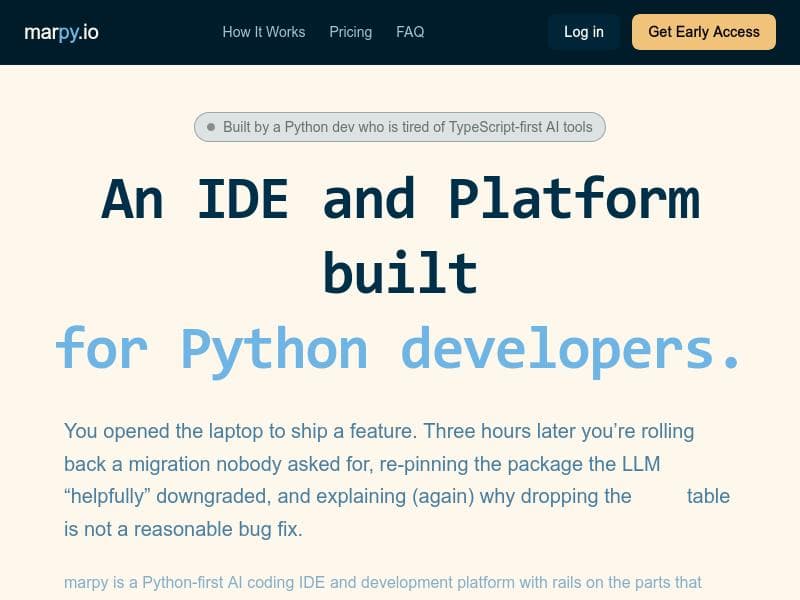
marpy.io is a Python-first AI-powered development environment tailored for Flask, FastAPI, MariaDB, Redis, Jinja, and Tailwind developers. It uniquely combines a browser-based IDE, persistent databases, Kubernetes deployment, and intelligent guardrails to prevent destructive operations, making it ideal for Python backend developers seeking safer, faster, and more reliable workflows.
marpy.io is a specialized AI-powered development environment designed specifically for Python developers working with the Flask, FastAPI, MariaDB, Redis, Jinja, and Tailwind CSS stack. Its core purpose is to streamline the entire development workflow by providing a browser-based integrated development environment (IDE) that combines coding, database management, and deployment into a single cohesive platform. By focusing on the Python ecosystem and its commonly used frameworks and tools, marpy.io aims to eliminate many of the common pain points developers face, such as managing database migrations, dependency conflicts, and deployment complexities, all while leveraging AI assistance to improve productivity and safety. At the heart of marpy.io is its browser-based Python IDE, which is tailored to support the Flask and FastAPI web frameworks, MariaDB and Redis databases, Jinja templating, and Tailwind CSS for styling. This environment allows developers to write and edit Python code directly in the browser without the need for local setup or configuration. One of the standout features is the persistent database integration, which ensures that data stored in MariaDB or Redis remains intact across deployments, preventing data loss and enabling continuous development cycles. Deployment is handled seamlessly through Kubernetes, with each project receiving a live URL for easy testing and sharing. A key differentiator of marpy.io is its AI assistant, which not only helps write code but also enforces guardrails to prevent destructive or unsafe operations. For example, the platform intercepts potentially dangerous commands such as destructive DDL statements (e.g., dropping columns or tables in production) and secret leaks (e.g., writing API keys directly into environment files). Instead of blindly executing these commands, marpy.io either blocks them or requires explicit manual confirmation, thereby reducing the risk of costly mistakes. The AI assistant also automatically resolves package versions to the latest stable releases and indexes documentation to ensure that code suggestions are accurate and up to date. Additional features include a shell-wrapped project terminal that restricts access to the project directory, preventing accidental or malicious file system changes outside the scope of the project. Database migrations are managed with Alembic, and marpy.io rewrites migration scripts to be reviewable and reversible, enhancing database change safety and auditability. These guardrails and safety features make marpy.io particularly valuable for teams and individual developers who want to maintain high code quality and operational reliability without sacrificing speed. marpy.io is best suited for Python developers building web applications or APIs using Flask or FastAPI who want an all-in-one platform that handles coding, database management, and deployment with minimal friction. It is ideal for startups, small teams, or solo developers who prefer a Python-first environment and want to avoid the overhead of managing local development environments, complex deployment pipelines, or database administration manually. The platform’s AI-powered guardrails also make it a strong choice for developers who prioritize safety and want to avoid common pitfalls like accidental data loss or security leaks. Regarding pricing, marpy.io offers an early access program, which suggests that it is currently in a pre-launch or beta phase with plans for future pricing tiers. Specific pricing details are not publicly disclosed, but interested users can join the waitlist to gain early access and receive updates on pricing and plans. This approach allows the team to gather user feedback and iterate on features before a full commercial release. Compared to alternatives, marpy.io stands out by focusing exclusively on the Python ecosystem with deep integrations for Flask, FastAPI, and related technologies, whereas many other AI-assisted coding tools are TypeScript or JavaScript-first. Its built-in guardrails and persistent database support differentiate it from generic cloud IDEs or AI coding assistants that lack deployment or database safety features. While platforms like GitHub Codespaces or Replit offer browser-based coding environments, marpy.io’s AI-driven safety mechanisms and Kubernetes deployment with live URLs provide a more robust and production-aware experience tailored for Python backend development. Some limitations to consider include the current focus on a specific technology stack, which may not suit developers working outside of Flask, FastAPI, or the MariaDB/Redis ecosystem. Additionally, as an early access product, marpy.io may still be evolving in terms of features, stability, and scalability. Users should also evaluate whether the browser-based IDE meets their performance and customization needs compared to local development setups. Finally, since pricing details are not yet finalized, organizations should monitor costs as the platform matures. In summary, marpy.io is a powerful, Python-first AI development environment that combines coding, database persistence, and Kubernetes deployment with intelligent guardrails to prevent common development disasters. It is designed to accelerate and safeguard backend Python development workflows, making it an excellent choice for developers who want a modern, integrated platform tailored to their stack.

Description
marpy.io is a Python-first AI-powered development environment tailored for Flask, FastAPI, MariaDB, Redis, Jinja, and Tailwind developers. It uniquely combines a browser-based IDE, persistent databases, Kubernetes deployment, and intelligent guardrails to prevent destructive operations, making it ideal for Python backend developers seeking safer, faster, and more reliable workflows.
marpy.io is a specialized AI-powered development environment designed specifically for Python developers working with the Flask, FastAPI, MariaDB, Redis, Jinja, and Tailwind CSS stack. Its core purpose is to streamline the entire development workflow by providing a browser-based integrated development environment (IDE) that combines coding, database management, and deployment into a single cohesive platform. By focusing on the Python ecosystem and its commonly used frameworks and tools, marpy.io aims to eliminate many of the common pain points developers face, such as managing database migrations, dependency conflicts, and deployment complexities, all while leveraging AI assistance to improve productivity and safety. At the heart of marpy.io is its browser-based Python IDE, which is tailored to support the Flask and FastAPI web frameworks, MariaDB and Redis databases, Jinja templating, and Tailwind CSS for styling. This environment allows developers to write and edit Python code directly in the browser without the need for local setup or configuration. One of the standout features is the persistent database integration, which ensures that data stored in MariaDB or Redis remains intact across deployments, preventing data loss and enabling continuous development cycles. Deployment is handled seamlessly through Kubernetes, with each project receiving a live URL for easy testing and sharing. A key differentiator of marpy.io is its AI assistant, which not only helps write code but also enforces guardrails to prevent destructive or unsafe operations. For example, the platform intercepts potentially dangerous commands such as destructive DDL statements (e.g., dropping columns or tables in production) and secret leaks (e.g., writing API keys directly into environment files). Instead of blindly executing these commands, marpy.io either blocks them or requires explicit manual confirmation, thereby reducing the risk of costly mistakes. The AI assistant also automatically resolves package versions to the latest stable releases and indexes documentation to ensure that code suggestions are accurate and up to date. Additional features include a shell-wrapped project terminal that restricts access to the project directory, preventing accidental or malicious file system changes outside the scope of the project. Database migrations are managed with Alembic, and marpy.io rewrites migration scripts to be reviewable and reversible, enhancing database change safety and auditability. These guardrails and safety features make marpy.io particularly valuable for teams and individual developers who want to maintain high code quality and operational reliability without sacrificing speed. marpy.io is best suited for Python developers building web applications or APIs using Flask or FastAPI who want an all-in-one platform that handles coding, database management, and deployment with minimal friction. It is ideal for startups, small teams, or solo developers who prefer a Python-first environment and want to avoid the overhead of managing local development environments, complex deployment pipelines, or database administration manually. The platform’s AI-powered guardrails also make it a strong choice for developers who prioritize safety and want to avoid common pitfalls like accidental data loss or security leaks. Regarding pricing, marpy.io offers an early access program, which suggests that it is currently in a pre-launch or beta phase with plans for future pricing tiers. Specific pricing details are not publicly disclosed, but interested users can join the waitlist to gain early access and receive updates on pricing and plans. This approach allows the team to gather user feedback and iterate on features before a full commercial release. Compared to alternatives, marpy.io stands out by focusing exclusively on the Python ecosystem with deep integrations for Flask, FastAPI, and related technologies, whereas many other AI-assisted coding tools are TypeScript or JavaScript-first. Its built-in guardrails and persistent database support differentiate it from generic cloud IDEs or AI coding assistants that lack deployment or database safety features. While platforms like GitHub Codespaces or Replit offer browser-based coding environments, marpy.io’s AI-driven safety mechanisms and Kubernetes deployment with live URLs provide a more robust and production-aware experience tailored for Python backend development. Some limitations to consider include the current focus on a specific technology stack, which may not suit developers working outside of Flask, FastAPI, or the MariaDB/Redis ecosystem. Additionally, as an early access product, marpy.io may still be evolving in terms of features, stability, and scalability. Users should also evaluate whether the browser-based IDE meets their performance and customization needs compared to local development setups. Finally, since pricing details are not yet finalized, organizations should monitor costs as the platform matures. In summary, marpy.io is a powerful, Python-first AI development environment that combines coding, database persistence, and Kubernetes deployment with intelligent guardrails to prevent common development disasters. It is designed to accelerate and safeguard backend Python development workflows, making it an excellent choice for developers who want a modern, integrated platform tailored to their stack.
Tool Features
- Browser-based Python IDE tailored for Flask, FastAPI, MariaDB, Redis, Jinja, and Tailwind
- Persistent database that survives between deploys
- Kubernetes deployment with live URL for projects
- AI assistant that helps write code and prevents destructive operations
- Guardrails that intercept unsafe commands like destructive DDL or secret leaks
- Automatic resolution of package versions and indexing of documentation
- Shell-wrapped project terminal restricting access outside project directory
- Alembic migration rewriting for reviewable and reversible database changes
Frequently Asked Questions
What is marpy.io?
marpy.io is an AI-powered, browser-based development environment specifically designed for Python developers using the Flask, FastAPI, MariaDB, Redis, Jinja, and Tailwind stack. It integrates coding, persistent database management, and Kubernetes deployment into a single platform with built-in safety guardrails.
How much does marpy.io cost?
Currently, marpy.io is in an early access phase and does not publicly disclose detailed pricing information. Interested users can join the waitlist to get early access and receive updates on pricing and plans as the platform evolves.
Who is marpy.io best for?
marpy.io is best suited for Python developers building web applications or APIs with Flask or FastAPI who want an integrated platform that handles coding, database persistence, and deployment. It is ideal for startups, small teams, and solo developers prioritizing safety and efficiency in Python backend development.
What are the main features of marpy.io?
Key features include a browser-based Python IDE tailored to Flask, FastAPI, MariaDB, Redis, Jinja, and Tailwind; persistent databases that survive between deploys; Kubernetes deployment with live project URLs; an AI assistant that helps write code and prevents destructive operations; guardrails blocking unsafe commands; automatic package version resolution and documentation indexing; a shell-wrapped project terminal; and Alembic migration rewriting for safer database changes.
Does marpy.io offer a free trial?
While there is no explicit mention of a free trial, marpy.io offers early access through a waitlist, allowing users to try the platform before its full commercial launch.
What integrations does marpy.io support?
marpy.io supports integrations with Python web frameworks Flask and FastAPI, databases MariaDB and Redis, templating with Jinja, and styling with Tailwind CSS. It also integrates Kubernetes for deployment and Alembic for database migrations.
How does marpy.io work?
marpy.io operates as a browser-based IDE where developers write Python code using their preferred stack. It attaches persistent databases that retain data across deployments and deploys projects via Kubernetes, providing live URLs. The AI assistant guides coding and enforces guardrails to block unsafe operations, while the terminal is restricted to the project directory to enhance security.
Sponsored Tools

































Reviews
No reviews yet. Be the first to share your experience.