Description
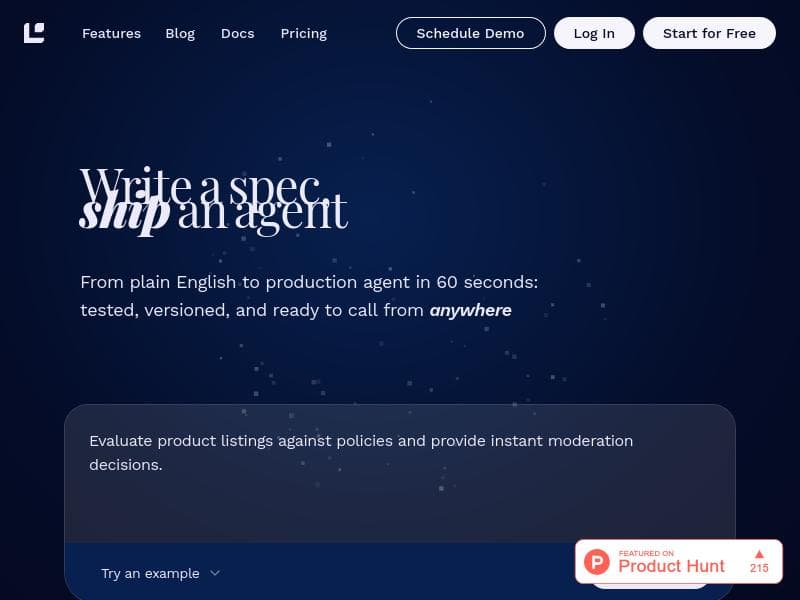
Logic revolutionizes AI agent deployment by turning complex prompt engineering, model routing, and evaluation into a seamless, fully managed experience. Ideal for developers and teams seeking to launch production-ready AI agents in under a minute, Logic combines speed, observability, and automation to accelerate AI integration without the usual overhead.
Logic is an advanced AI agent platform designed to dramatically simplify the deployment of production-ready AI agents. Traditionally, building and shipping a functional AI agent involves extensive manual work: wiring up prompts, handling retries, creating evaluation harnesses, implementing logging, and ensuring observability—all of which can take weeks or even months before the agent is ready for real-world use. Logic addresses these challenges by providing a fully managed environment where developers and teams can define their AI agents through a structured specification, eliminating much of the complexity and overhead associated with AI agent development. At its core, Logic enables users to write a detailed spec that describes the intended behavior and workflow of the AI agent. From this spec, Logic automatically generates a fully operational agent equipped with essential capabilities such as evaluation metrics, observability dashboards, model routing, and execution logging. This means that users can deploy production-grade AI agents in under 60 seconds, significantly accelerating time-to-market and reducing the engineering burden. Key features of Logic include sophisticated prompt engineering tools that help optimize how the AI interacts with inputs and generates outputs. The platform supports model orchestration and routing, allowing users to seamlessly switch between different AI models or combine them to achieve better performance and reliability. Automated testing and versioning ensure that each iteration of the agent is rigorously evaluated and tracked, facilitating continuous improvement and rollback capabilities. Logic also offers typed schemas and API generation, which provide strong typing guarantees and easy integration points for developers to embed AI agents into their applications or workflows. Execution logging and observability tools give users deep insights into agent behavior, performance, and potential issues, enabling proactive monitoring and debugging. Logic is particularly well-suited for AI developers, product teams, and enterprises looking to integrate intelligent agents into their products or services without investing heavily in the underlying infrastructure. Use cases span customer support automation, intelligent workflows, data querying agents, and custom AI-powered applications where reliable, maintainable, and scalable AI agents are critical. By abstracting away the complexity of prompt management, evaluation, and deployment, Logic empowers teams to focus on defining agent logic and improving user experience. The platform operates on a freemium pricing model, allowing users to get started with core features at no cost and scale up as their needs grow. This approach makes Logic accessible to startups, individual developers, and larger organizations alike. While specific pricing tiers and limits are not detailed here, the freemium model typically includes usage caps or feature restrictions that can be lifted through paid plans. Compared to alternatives, Logic stands out by offering an all-in-one managed solution that integrates prompt engineering, model routing, evaluation, and observability in a single platform. Many competing tools require stitching together multiple services or building custom infrastructure to achieve similar functionality. Logic’s structured spec approach and rapid deployment capabilities reduce development complexity and operational overhead, making it a compelling choice for teams seeking efficiency and reliability. However, potential users should consider that Logic’s abstraction might limit low-level customization for highly specialized AI workflows. Additionally, as a managed platform, users depend on Logic’s infrastructure and service availability. Organizations with strict compliance or data residency requirements should evaluate these factors carefully. Finally, while Logic accelerates deployment, understanding how to write effective structured specs and manage AI agent logic remains essential to fully leverage the platform’s benefits. In summary, Logic is a powerful platform that transforms the way AI agents are developed and deployed by providing a streamlined, fully managed environment. Its comprehensive feature set, rapid deployment, and focus on observability and evaluation make it an excellent choice for developers and businesses aiming to operationalize AI agents quickly and reliably.

Description
Logic revolutionizes AI agent deployment by turning complex prompt engineering, model routing, and evaluation into a seamless, fully managed experience. Ideal for developers and teams seeking to launch production-ready AI agents in under a minute, Logic combines speed, observability, and automation to accelerate AI integration without the usual overhead.
Logic is an advanced AI agent platform designed to dramatically simplify the deployment of production-ready AI agents. Traditionally, building and shipping a functional AI agent involves extensive manual work: wiring up prompts, handling retries, creating evaluation harnesses, implementing logging, and ensuring observability—all of which can take weeks or even months before the agent is ready for real-world use. Logic addresses these challenges by providing a fully managed environment where developers and teams can define their AI agents through a structured specification, eliminating much of the complexity and overhead associated with AI agent development. At its core, Logic enables users to write a detailed spec that describes the intended behavior and workflow of the AI agent. From this spec, Logic automatically generates a fully operational agent equipped with essential capabilities such as evaluation metrics, observability dashboards, model routing, and execution logging. This means that users can deploy production-grade AI agents in under 60 seconds, significantly accelerating time-to-market and reducing the engineering burden. Key features of Logic include sophisticated prompt engineering tools that help optimize how the AI interacts with inputs and generates outputs. The platform supports model orchestration and routing, allowing users to seamlessly switch between different AI models or combine them to achieve better performance and reliability. Automated testing and versioning ensure that each iteration of the agent is rigorously evaluated and tracked, facilitating continuous improvement and rollback capabilities. Logic also offers typed schemas and API generation, which provide strong typing guarantees and easy integration points for developers to embed AI agents into their applications or workflows. Execution logging and observability tools give users deep insights into agent behavior, performance, and potential issues, enabling proactive monitoring and debugging. Logic is particularly well-suited for AI developers, product teams, and enterprises looking to integrate intelligent agents into their products or services without investing heavily in the underlying infrastructure. Use cases span customer support automation, intelligent workflows, data querying agents, and custom AI-powered applications where reliable, maintainable, and scalable AI agents are critical. By abstracting away the complexity of prompt management, evaluation, and deployment, Logic empowers teams to focus on defining agent logic and improving user experience. The platform operates on a freemium pricing model, allowing users to get started with core features at no cost and scale up as their needs grow. This approach makes Logic accessible to startups, individual developers, and larger organizations alike. While specific pricing tiers and limits are not detailed here, the freemium model typically includes usage caps or feature restrictions that can be lifted through paid plans. Compared to alternatives, Logic stands out by offering an all-in-one managed solution that integrates prompt engineering, model routing, evaluation, and observability in a single platform. Many competing tools require stitching together multiple services or building custom infrastructure to achieve similar functionality. Logic’s structured spec approach and rapid deployment capabilities reduce development complexity and operational overhead, making it a compelling choice for teams seeking efficiency and reliability. However, potential users should consider that Logic’s abstraction might limit low-level customization for highly specialized AI workflows. Additionally, as a managed platform, users depend on Logic’s infrastructure and service availability. Organizations with strict compliance or data residency requirements should evaluate these factors carefully. Finally, while Logic accelerates deployment, understanding how to write effective structured specs and manage AI agent logic remains essential to fully leverage the platform’s benefits. In summary, Logic is a powerful platform that transforms the way AI agents are developed and deployed by providing a streamlined, fully managed environment. Its comprehensive feature set, rapid deployment, and focus on observability and evaluation make it an excellent choice for developers and businesses aiming to operationalize AI agents quickly and reliably.
Tool Features
- Handles prompt engineering
- Model orchestration and routing
- Automated testing and versioning
- Typed schemas and API generation
- Execution logging
- Deploy production AI agents in under 60 seconds
Frequently Asked Questions
What is Logic?
Logic is a managed AI agent platform that simplifies the creation, deployment, and monitoring of production-ready AI agents by allowing users to define agent behavior through structured specifications. It automates prompt engineering, model orchestration, evaluation, logging, and observability.
How much does Logic cost?
Logic offers a freemium pricing model, enabling users to start using core features for free with certain usage limits. Paid plans are available for higher usage and additional capabilities, though specific pricing details should be checked on their website.
Who is Logic best for?
Logic is best suited for AI developers, product teams, startups, and enterprises looking to quickly deploy and manage AI agents without building extensive infrastructure. It’s ideal for use cases like customer support bots, intelligent workflows, and custom AI applications.
What are the main features of Logic?
Key features include prompt engineering, model orchestration and routing, automated testing and versioning, typed schemas and API generation, execution logging, and the ability to deploy production AI agents in under 60 seconds.
Does Logic offer a free trial?
Yes, Logic operates on a freemium model that allows users to try the platform’s core features for free, providing an opportunity to evaluate its capabilities before committing to paid plans.
What integrations does Logic support?
Logic supports API generation based on typed schemas, enabling easy integration with various applications and services. While specific third-party integrations are not detailed, its API-first approach facilitates embedding AI agents into existing workflows.
How does Logic work?
Users write a structured specification describing the AI agent’s intended behavior. Logic then automatically builds a fully managed agent that handles prompt engineering, model routing, evaluation, logging, and observability, which can be deployed and called from anywhere.
Sponsored Tools
































Reviews
No reviews yet. Be the first to share your experience.