Gito: AI Code Reviewer
Description
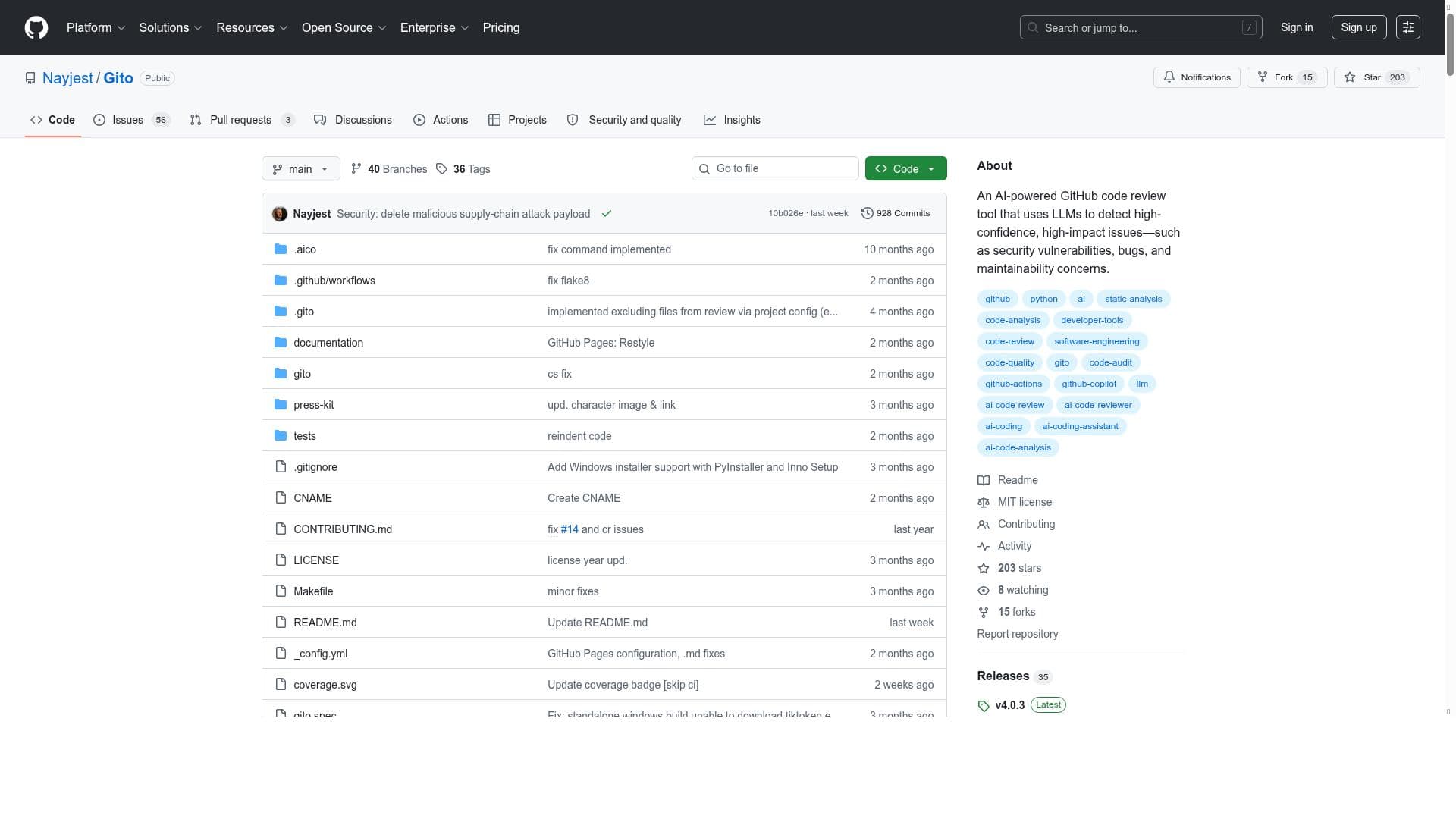
Gito: AI Code Reviewer is a free, open-source AI-powered tool that delivers instant, thorough code reviews across any programming language by integrating with any language model provider. Ideal for developers and teams seeking fast, reliable feedback without vendor lock-in, Gito streamlines code quality assurance and boosts productivity effortlessly.
Gito: AI Code Reviewer is an innovative open-source tool designed to automate and enhance the code review process by leveraging artificial intelligence. Its core purpose is to provide developers and teams with instant, reliable feedback on code changes, whether those changes are part of GitHub pull requests or local codebase modifications. By integrating seamlessly with any language model provider, Gito avoids vendor lock-in, giving users the flexibility to choose their preferred AI backend. This approach ensures that code reviews are consistent, thorough, and delivered in seconds, eliminating the delays often associated with human reviewers and accelerating development cycles. At the heart of Gito’s functionality is its AI-powered code review engine, which analyzes code for potential issues, bugs, inefficiencies, and style inconsistencies. It automatically generates actionable suggestions for code improvements, helping developers write cleaner, more maintainable code. The tool supports a wide array of programming languages by working with any language model, making it highly versatile for diverse development environments. Additionally, Gito streamlines the review process by integrating directly with GitHub workflows or local development setups, enabling developers to receive immediate feedback without disrupting their existing processes. Gito is particularly well-suited for individual developers, small to medium-sized teams, and open-source projects that require fast, reliable code reviews but may lack the resources for dedicated human reviewers. It is also valuable for organizations aiming to improve code quality and developer productivity by automating routine review tasks. Use cases include continuous integration pipelines where instant feedback on pull requests can prevent problematic code from merging, as well as local development environments where developers can proactively catch issues before pushing changes. One of the most compelling aspects of Gito is that it is completely free and open-source, removing any financial barriers to adoption. This makes it accessible to hobbyists, startups, and enterprises alike. Since it supports any language model provider, users can select from a range of AI services or even deploy their own models, tailoring the tool’s capabilities to their specific needs and budgets. This flexibility contrasts with many proprietary AI code reviewers that lock users into specific ecosystems or pricing tiers. Compared to alternative AI code review tools, Gito stands out due to its open-source nature and vendor-agnostic design. While other solutions may offer similar AI-powered insights, they often come with subscription fees, limited language support, or dependency on a single AI provider. Gito’s ability to integrate with any language model provider ensures broader compatibility and future-proofing. However, as an open-source project, it may require more initial setup and configuration compared to turnkey commercial products. Users should be comfortable managing integrations and possibly customizing the tool to fit their workflows. Notable limitations include the reliance on the quality and capabilities of the chosen language model provider; the accuracy and depth of code reviews depend heavily on the underlying AI’s training and sophistication. Additionally, while Gito accelerates code review, it is not a replacement for human judgment in complex or nuanced scenarios. Developers should consider it a powerful assistant rather than a complete substitute for manual reviews. Furthermore, as an open-source tool, ongoing community support and updates may vary, so users should evaluate their willingness to engage with the project’s ecosystem. In summary, Gito: AI Code Reviewer is a powerful, flexible, and cost-effective solution for automating code reviews across multiple languages and environments. Its open-source foundation and vendor-agnostic architecture empower developers to enhance code quality and productivity without being tied to specific AI providers or incurring costs. While it requires some technical setup and depends on the chosen AI model’s capabilities, Gito offers a compelling alternative to proprietary code review tools, making it an excellent choice for developers seeking fast, reliable, and customizable AI-driven code analysis.

Description
Gito: AI Code Reviewer is a free, open-source AI-powered tool that delivers instant, thorough code reviews across any programming language by integrating with any language model provider. Ideal for developers and teams seeking fast, reliable feedback without vendor lock-in, Gito streamlines code quality assurance and boosts productivity effortlessly.
Gito: AI Code Reviewer is an innovative open-source tool designed to automate and enhance the code review process by leveraging artificial intelligence. Its core purpose is to provide developers and teams with instant, reliable feedback on code changes, whether those changes are part of GitHub pull requests or local codebase modifications. By integrating seamlessly with any language model provider, Gito avoids vendor lock-in, giving users the flexibility to choose their preferred AI backend. This approach ensures that code reviews are consistent, thorough, and delivered in seconds, eliminating the delays often associated with human reviewers and accelerating development cycles. At the heart of Gito’s functionality is its AI-powered code review engine, which analyzes code for potential issues, bugs, inefficiencies, and style inconsistencies. It automatically generates actionable suggestions for code improvements, helping developers write cleaner, more maintainable code. The tool supports a wide array of programming languages by working with any language model, making it highly versatile for diverse development environments. Additionally, Gito streamlines the review process by integrating directly with GitHub workflows or local development setups, enabling developers to receive immediate feedback without disrupting their existing processes. Gito is particularly well-suited for individual developers, small to medium-sized teams, and open-source projects that require fast, reliable code reviews but may lack the resources for dedicated human reviewers. It is also valuable for organizations aiming to improve code quality and developer productivity by automating routine review tasks. Use cases include continuous integration pipelines where instant feedback on pull requests can prevent problematic code from merging, as well as local development environments where developers can proactively catch issues before pushing changes. One of the most compelling aspects of Gito is that it is completely free and open-source, removing any financial barriers to adoption. This makes it accessible to hobbyists, startups, and enterprises alike. Since it supports any language model provider, users can select from a range of AI services or even deploy their own models, tailoring the tool’s capabilities to their specific needs and budgets. This flexibility contrasts with many proprietary AI code reviewers that lock users into specific ecosystems or pricing tiers. Compared to alternative AI code review tools, Gito stands out due to its open-source nature and vendor-agnostic design. While other solutions may offer similar AI-powered insights, they often come with subscription fees, limited language support, or dependency on a single AI provider. Gito’s ability to integrate with any language model provider ensures broader compatibility and future-proofing. However, as an open-source project, it may require more initial setup and configuration compared to turnkey commercial products. Users should be comfortable managing integrations and possibly customizing the tool to fit their workflows. Notable limitations include the reliance on the quality and capabilities of the chosen language model provider; the accuracy and depth of code reviews depend heavily on the underlying AI’s training and sophistication. Additionally, while Gito accelerates code review, it is not a replacement for human judgment in complex or nuanced scenarios. Developers should consider it a powerful assistant rather than a complete substitute for manual reviews. Furthermore, as an open-source tool, ongoing community support and updates may vary, so users should evaluate their willingness to engage with the project’s ecosystem. In summary, Gito: AI Code Reviewer is a powerful, flexible, and cost-effective solution for automating code reviews across multiple languages and environments. Its open-source foundation and vendor-agnostic architecture empower developers to enhance code quality and productivity without being tied to specific AI providers or incurring costs. While it requires some technical setup and depends on the chosen AI model’s capabilities, Gito offers a compelling alternative to proprietary code review tools, making it an excellent choice for developers seeking fast, reliable, and customizable AI-driven code analysis.
Tool Features
- AI-powered code review
- Automatic suggestions for code improvements
- Enhances code quality
- Streamlines code review process
- Supports developer productivity
Frequently Asked Questions
What is Gito: AI Code Reviewer?
Gito: AI Code Reviewer is an open-source AI tool that automatically reviews code changes in GitHub pull requests or local codebases, providing instant feedback and suggestions to improve code quality without relying on any specific AI vendor.
How much does Gito: AI Code Reviewer cost?
Gito is completely free to use as it is an open-source project, allowing developers to access its full capabilities without any subscription or licensing fees.
Who is Gito: AI Code Reviewer best for?
Gito is best suited for individual developers, small to medium-sized teams, and open-source projects that need fast, consistent code reviews to improve code quality and accelerate development without depending on human reviewers.
What are the main features of Gito: AI Code Reviewer?
Key features include AI-powered code analysis, automatic suggestions for code improvements, support for any language model provider, integration with GitHub pull requests and local code changes, and tools to streamline the code review process and enhance developer productivity.
Does Gito: AI Code Reviewer offer a free trial?
Since Gito is open-source and free to use, there is no need for a free trial; users can immediately download, install, and start using the tool without any cost.
What integrations does Gito: AI Code Reviewer support?
Gito integrates directly with GitHub pull requests and can analyze local codebase changes. It is designed to work with any language model provider, offering flexibility to fit into various development workflows and AI ecosystems.
How does Gito: AI Code Reviewer work?
Gito analyzes code changes using AI models from any provider to detect issues and generate improvement suggestions. It processes GitHub pull requests or local code modifications instantly, delivering consistent, automated code reviews that help developers identify and fix problems quickly.
Sponsored Tools








































Reviews
No reviews yet. Be the first to share your experience.