Description
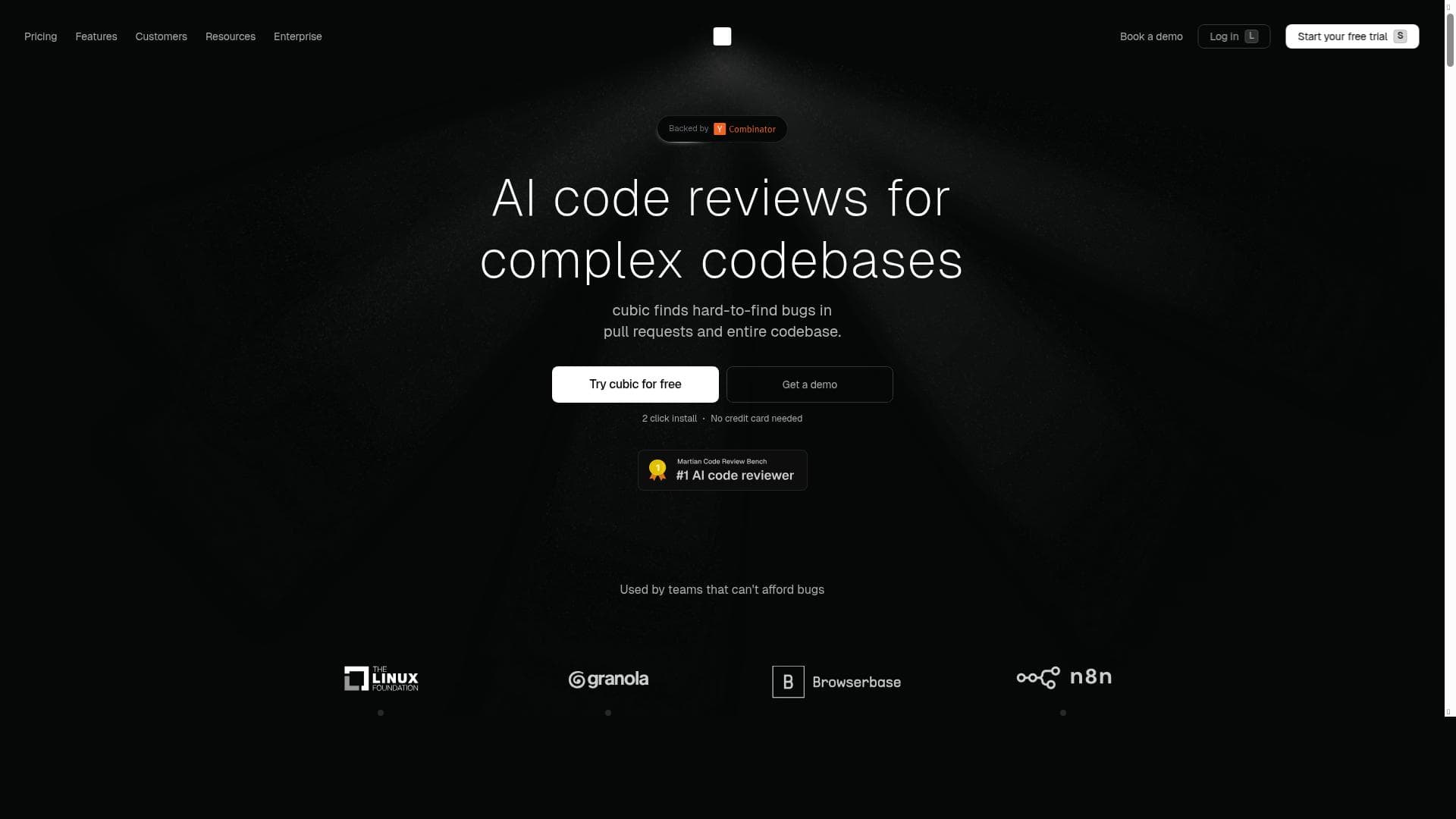
cubic 2.0 is a cutting-edge AI code review tool that delivers highly accurate, low-noise feedback to help teams confidently merge AI-generated code faster. Ideal for complex codebases and collaborative environments, it offers unique features like CLI integration, AI-generated documentation, and automated PR updates, making it a top choice for organizations seeking reliable AI-assisted code reviews.
cubic 2.0 is an advanced AI-powered code review tool designed to help development teams efficiently read, trust, and merge AI-generated code within real-world repositories. Over recent months, the cubic team has completely rebuilt their AI review engine, culminating in cubic 2.0, which stands out as one of the most accurate AI code reviewers available today. Its core purpose is to streamline the code review process by providing precise, low-noise feedback that accelerates pull request (PR) merges while maintaining high code quality and reliability. By integrating deeply into developers' workflows, cubic 2.0 addresses the growing need for trustworthy AI-assisted code reviews in complex codebases and collaborative environments. At the heart of cubic 2.0 are its key features that set it apart from traditional code review tools. It leverages state-of-the-art AI models to perform thorough code analysis, identifying bugs and potential issues early in the development cycle. Unlike generic linters or static analyzers, cubic 2.0 understands the context of AI-generated code and provides actionable insights that reduce false positives and minimize noise. It supports complex codebases, making it suitable for large-scale projects with intricate dependencies. Beyond inline PR comments, cubic 2.0 enhances the developer experience with a command-line interface (CLI) for seamless integration, AI-generated documentation to improve code understanding, and automated PR description updates that summarize changes and highlight important details. This holistic approach ensures that teams can trust the AI's recommendations and merge code faster without sacrificing quality. cubic 2.0 is ideal for software development teams that incorporate AI-generated code into their workflows and need a reliable way to review and validate it. It is particularly beneficial for organizations managing large or complex repositories where manual reviews can be time-consuming and error-prone. Teams at companies like Cal.com, n8n, Granola, and various Linux Foundation projects have adopted cubic 2.0 to improve their code review efficiency and accuracy. Use cases include accelerating pull request approvals, detecting subtle bugs introduced by AI code generation, and maintaining high standards of code quality in collaborative environments. It also suits open source projects and enterprises seeking to scale their development processes with AI assistance. Regarding pricing, cubic 2.0 offers a freemium model, allowing teams to start using the tool without upfront costs. This approach enables smaller teams or individual developers to experience its capabilities before committing to paid plans that likely offer enhanced features, higher usage limits, or enterprise-grade support. The freemium tier makes cubic 2.0 accessible to a broad audience, fostering adoption across various organization sizes and industries. When compared to alternative AI code review tools, cubic 2.0 distinguishes itself through its focus on accuracy and low noise, which are critical for developer trust and adoption. Many AI reviewers generate excessive or irrelevant comments, leading to alert fatigue; cubic 2.0's rebuilt engine prioritizes meaningful feedback that developers can act on confidently. Its support for complex codebases and integration beyond simple PR comments—such as CLI tools and AI-generated documentation—provides a more comprehensive solution. While some competitors may offer similar AI capabilities, cubic 2.0's combination of precision, usability, and integration depth makes it a compelling choice for teams serious about leveraging AI in their code review processes. Despite its strengths, users should consider certain limitations. As with any AI-driven tool, cubic 2.0's effectiveness depends on the quality and nature of the codebase and the AI models it employs. It may require initial configuration and tuning to align with specific coding standards or project requirements. Additionally, while the freemium model lowers the barrier to entry, advanced features or higher usage tiers may involve costs that organizations need to evaluate against their budgets. Finally, integration with existing CI/CD pipelines and developer tools may require some setup effort, although the provided CLI and documentation aim to simplify this process. In summary, cubic 2.0 is a powerful AI code review engine designed to enhance the accuracy, speed, and trustworthiness of reviewing AI-generated code. Its rich feature set, user-centric design, and adoption by notable organizations underscore its value for modern development teams aiming to harness AI effectively in their workflows.

Description
cubic 2.0 is a cutting-edge AI code review tool that delivers highly accurate, low-noise feedback to help teams confidently merge AI-generated code faster. Ideal for complex codebases and collaborative environments, it offers unique features like CLI integration, AI-generated documentation, and automated PR updates, making it a top choice for organizations seeking reliable AI-assisted code reviews.
cubic 2.0 is an advanced AI-powered code review tool designed to help development teams efficiently read, trust, and merge AI-generated code within real-world repositories. Over recent months, the cubic team has completely rebuilt their AI review engine, culminating in cubic 2.0, which stands out as one of the most accurate AI code reviewers available today. Its core purpose is to streamline the code review process by providing precise, low-noise feedback that accelerates pull request (PR) merges while maintaining high code quality and reliability. By integrating deeply into developers' workflows, cubic 2.0 addresses the growing need for trustworthy AI-assisted code reviews in complex codebases and collaborative environments. At the heart of cubic 2.0 are its key features that set it apart from traditional code review tools. It leverages state-of-the-art AI models to perform thorough code analysis, identifying bugs and potential issues early in the development cycle. Unlike generic linters or static analyzers, cubic 2.0 understands the context of AI-generated code and provides actionable insights that reduce false positives and minimize noise. It supports complex codebases, making it suitable for large-scale projects with intricate dependencies. Beyond inline PR comments, cubic 2.0 enhances the developer experience with a command-line interface (CLI) for seamless integration, AI-generated documentation to improve code understanding, and automated PR description updates that summarize changes and highlight important details. This holistic approach ensures that teams can trust the AI's recommendations and merge code faster without sacrificing quality. cubic 2.0 is ideal for software development teams that incorporate AI-generated code into their workflows and need a reliable way to review and validate it. It is particularly beneficial for organizations managing large or complex repositories where manual reviews can be time-consuming and error-prone. Teams at companies like Cal.com, n8n, Granola, and various Linux Foundation projects have adopted cubic 2.0 to improve their code review efficiency and accuracy. Use cases include accelerating pull request approvals, detecting subtle bugs introduced by AI code generation, and maintaining high standards of code quality in collaborative environments. It also suits open source projects and enterprises seeking to scale their development processes with AI assistance. Regarding pricing, cubic 2.0 offers a freemium model, allowing teams to start using the tool without upfront costs. This approach enables smaller teams or individual developers to experience its capabilities before committing to paid plans that likely offer enhanced features, higher usage limits, or enterprise-grade support. The freemium tier makes cubic 2.0 accessible to a broad audience, fostering adoption across various organization sizes and industries. When compared to alternative AI code review tools, cubic 2.0 distinguishes itself through its focus on accuracy and low noise, which are critical for developer trust and adoption. Many AI reviewers generate excessive or irrelevant comments, leading to alert fatigue; cubic 2.0's rebuilt engine prioritizes meaningful feedback that developers can act on confidently. Its support for complex codebases and integration beyond simple PR comments—such as CLI tools and AI-generated documentation—provides a more comprehensive solution. While some competitors may offer similar AI capabilities, cubic 2.0's combination of precision, usability, and integration depth makes it a compelling choice for teams serious about leveraging AI in their code review processes. Despite its strengths, users should consider certain limitations. As with any AI-driven tool, cubic 2.0's effectiveness depends on the quality and nature of the codebase and the AI models it employs. It may require initial configuration and tuning to align with specific coding standards or project requirements. Additionally, while the freemium model lowers the barrier to entry, advanced features or higher usage tiers may involve costs that organizations need to evaluate against their budgets. Finally, integration with existing CI/CD pipelines and developer tools may require some setup effort, although the provided CLI and documentation aim to simplify this process. In summary, cubic 2.0 is a powerful AI code review engine designed to enhance the accuracy, speed, and trustworthiness of reviewing AI-generated code. Its rich feature set, user-centric design, and adoption by notable organizations underscore its value for modern development teams aiming to harness AI effectively in their workflows.
Tool Features
- AI-powered code review
- Bug detection
- Faster pull request merges
- Supports complex codebases
- Used by teams like Cal.com and n8n
Frequently Asked Questions
What is cubic 2.0?
cubic 2.0 is an AI-powered code review tool designed to help development teams read, trust, and merge AI-generated code efficiently. It uses advanced AI models to detect bugs, provide accurate feedback, and streamline the pull request review process in real-world repositories.
How much does cubic 2.0 cost?
cubic 2.0 offers a freemium pricing model, allowing users to access core features for free with options to upgrade for additional capabilities, higher usage limits, or enterprise support. Specific pricing details for paid plans can be found on their website.
Who is cubic 2.0 best for?
It is best suited for software development teams working with AI-generated code, especially those managing complex codebases or large repositories. Organizations looking to accelerate pull request merges while maintaining code quality will benefit most.
What are the main features of cubic 2.0?
Key features include AI-powered code review with high accuracy and low noise, bug detection, support for complex codebases, faster pull request merges, a command-line interface (CLI), AI-generated documentation, and automated pull request description updates.
Does cubic 2.0 offer a free trial?
Yes, cubic 2.0 provides a freemium tier that allows users to try the tool’s core features at no cost, enabling teams to evaluate its capabilities before opting for paid plans.
What integrations does cubic 2.0 support?
cubic 2.0 integrates via a command-line interface (CLI) and works directly with pull requests in real repositories. While specific third-party integrations are not detailed, it is designed to fit into existing development workflows and CI/CD pipelines.
How does cubic 2.0 work?
cubic 2.0 analyzes AI-generated code changes using its rebuilt AI review engine to identify bugs and provide precise feedback. It enhances code review by adding comments, updating PR descriptions, generating documentation, and offering CLI tools to help teams merge code faster and with greater confidence.
Socials
Use ToolSponsored Tools











































Reviews
No reviews yet. Be the first to share your experience.