Description
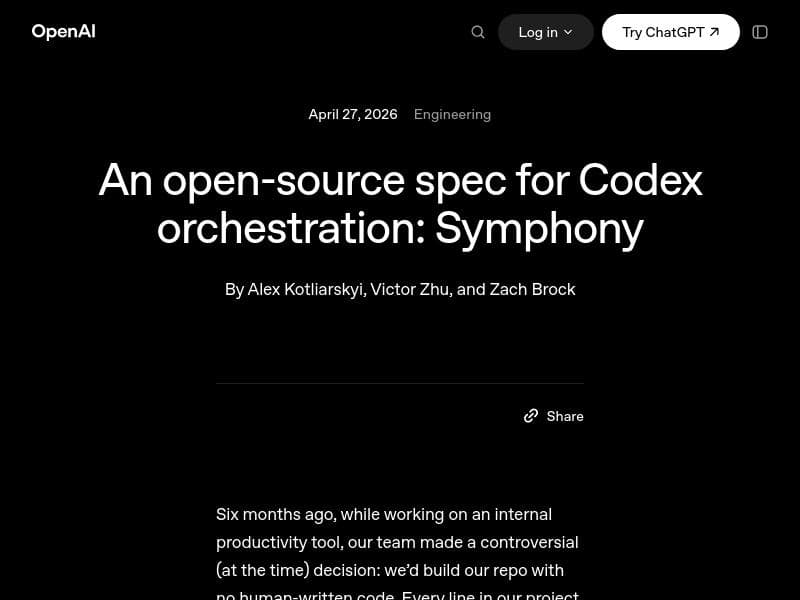
Symphony is an open-source Codex agent orchestrator that transforms issue trackers into intelligent, always-on systems, automating routine coding tasks and boosting engineering productivity. Ideal for development teams managing numerous open issues, it enables humans to focus on review and strategic direction while AI agents handle the rest.
Symphony is an innovative open-source agent orchestrator designed specifically for Codex, OpenAI's powerful AI coding assistant. Its core purpose is to revolutionize how development teams manage and resolve open issues by assigning a dedicated Codex agent to each task. This transforms traditional issue trackers into dynamic, always-on systems that autonomously handle agentic work, thereby allowing human developers to focus primarily on review, strategic direction, and higher-level decision-making. By automating routine coding tasks and issue management, Symphony aims to significantly boost engineering productivity and streamline development workflows. At its heart, Symphony provides an open-source specification for orchestrating Codex agents. This specification enables the seamless integration of AI agents directly into existing task tracking systems, such as GitHub Issues or Jira, turning them into intelligent hubs where each open issue is actively managed by an AI agent. These agents can autonomously analyze, update, and even resolve issues based on predefined parameters and ongoing interactions. Key features include the ability to reduce context switching by keeping agents continuously engaged with their assigned tasks, thus minimizing the cognitive load on developers who would otherwise need to juggle multiple issues manually. Additionally, Symphony’s design ensures smooth integration with existing development workflows, allowing teams to adopt the tool without overhauling their current processes. Symphony is particularly well-suited for engineering teams and software development organizations looking to enhance their productivity and efficiency. It benefits teams that manage large volumes of open issues or complex projects requiring constant attention and updates. By automating routine coding and issue management tasks, Symphony frees developers to concentrate on critical problem-solving and innovation. Use cases include continuous integration and deployment pipelines where issues need rapid triage and resolution, open-source projects with numerous contributors and issues, and enterprise environments aiming to scale their engineering output without proportional increases in headcount. One of Symphony’s most attractive aspects is its pricing model—being completely free and open-source. This makes it accessible to startups, individual developers, and large organizations alike, without the barrier of subscription fees or licensing costs. Users can download, customize, and deploy Symphony within their own infrastructure, ensuring full control over their development environment and data privacy. Compared to alternatives, Symphony stands out due to its open-source nature and its specific focus on Codex orchestration. While other AI tools may offer code generation or issue tracking enhancements, Symphony uniquely combines these capabilities by embedding AI agents directly into issue trackers and maintaining continuous engagement with open tasks. This approach contrasts with more static or manual AI-assisted coding tools, providing a more dynamic and autonomous system. However, as an open-source project, Symphony may require some technical expertise to set up and customize, which could be a consideration for teams without dedicated DevOps or AI engineering resources. Notable limitations include the reliance on Codex as the underlying AI model, which may have constraints related to language support, code complexity, or accuracy depending on the task. Additionally, while Symphony automates many aspects of issue management, human oversight remains crucial to ensure quality and correctness. Teams should also consider the integration effort required to connect Symphony with their existing issue trackers and workflows. Despite these considerations, Symphony represents a significant step forward in leveraging AI to augment software development processes, making it a compelling tool for forward-thinking engineering teams.

Description
Symphony is an open-source Codex agent orchestrator that transforms issue trackers into intelligent, always-on systems, automating routine coding tasks and boosting engineering productivity. Ideal for development teams managing numerous open issues, it enables humans to focus on review and strategic direction while AI agents handle the rest.
Symphony is an innovative open-source agent orchestrator designed specifically for Codex, OpenAI's powerful AI coding assistant. Its core purpose is to revolutionize how development teams manage and resolve open issues by assigning a dedicated Codex agent to each task. This transforms traditional issue trackers into dynamic, always-on systems that autonomously handle agentic work, thereby allowing human developers to focus primarily on review, strategic direction, and higher-level decision-making. By automating routine coding tasks and issue management, Symphony aims to significantly boost engineering productivity and streamline development workflows. At its heart, Symphony provides an open-source specification for orchestrating Codex agents. This specification enables the seamless integration of AI agents directly into existing task tracking systems, such as GitHub Issues or Jira, turning them into intelligent hubs where each open issue is actively managed by an AI agent. These agents can autonomously analyze, update, and even resolve issues based on predefined parameters and ongoing interactions. Key features include the ability to reduce context switching by keeping agents continuously engaged with their assigned tasks, thus minimizing the cognitive load on developers who would otherwise need to juggle multiple issues manually. Additionally, Symphony’s design ensures smooth integration with existing development workflows, allowing teams to adopt the tool without overhauling their current processes. Symphony is particularly well-suited for engineering teams and software development organizations looking to enhance their productivity and efficiency. It benefits teams that manage large volumes of open issues or complex projects requiring constant attention and updates. By automating routine coding and issue management tasks, Symphony frees developers to concentrate on critical problem-solving and innovation. Use cases include continuous integration and deployment pipelines where issues need rapid triage and resolution, open-source projects with numerous contributors and issues, and enterprise environments aiming to scale their engineering output without proportional increases in headcount. One of Symphony’s most attractive aspects is its pricing model—being completely free and open-source. This makes it accessible to startups, individual developers, and large organizations alike, without the barrier of subscription fees or licensing costs. Users can download, customize, and deploy Symphony within their own infrastructure, ensuring full control over their development environment and data privacy. Compared to alternatives, Symphony stands out due to its open-source nature and its specific focus on Codex orchestration. While other AI tools may offer code generation or issue tracking enhancements, Symphony uniquely combines these capabilities by embedding AI agents directly into issue trackers and maintaining continuous engagement with open tasks. This approach contrasts with more static or manual AI-assisted coding tools, providing a more dynamic and autonomous system. However, as an open-source project, Symphony may require some technical expertise to set up and customize, which could be a consideration for teams without dedicated DevOps or AI engineering resources. Notable limitations include the reliance on Codex as the underlying AI model, which may have constraints related to language support, code complexity, or accuracy depending on the task. Additionally, while Symphony automates many aspects of issue management, human oversight remains crucial to ensure quality and correctness. Teams should also consider the integration effort required to connect Symphony with their existing issue trackers and workflows. Despite these considerations, Symphony represents a significant step forward in leveraging AI to augment software development processes, making it a compelling tool for forward-thinking engineering teams.
Tool Features
- Open-source specification for Codex orchestration
- Transforms issue trackers into always-on agent systems
- Boosts engineering output
- Reduces context switching
- Integrates with existing development workflows
Frequently Asked Questions
What is Symphony?
Symphony is an open-source agent orchestrator for OpenAI's Codex that integrates AI agents into issue trackers, turning them into always-on systems that autonomously manage and resolve open development tasks.
How much does Symphony cost?
Symphony is completely free and open-source, allowing users to deploy and customize it without any licensing or subscription fees.
Who is Symphony best for?
Symphony is best suited for software development teams and engineering organizations that manage large volumes of open issues and want to boost productivity by automating routine coding and issue management tasks.
What are the main features of Symphony?
Key features include an open-source specification for Codex orchestration, transforming issue trackers into always-on agent systems, boosting engineering output, reducing context switching, and seamless integration with existing development workflows.
Does Symphony offer a free trial?
Since Symphony is open-source and free to use, there is no need for a free trial; users can immediately download and implement it.
What integrations does Symphony support?
Symphony integrates with existing development workflows and popular issue trackers, enabling AI agents to work directly within platforms like GitHub Issues or Jira, although specific integrations depend on user customization.
How does Symphony work?
Symphony assigns a dedicated Codex AI agent to each open issue in a task tracker, enabling continuous autonomous management and resolution of tasks, while developers focus on reviewing and directing the AI’s work.
Socials
Use ToolSponsored Tools







































Reviews
No reviews yet. Be the first to share your experience.