Description
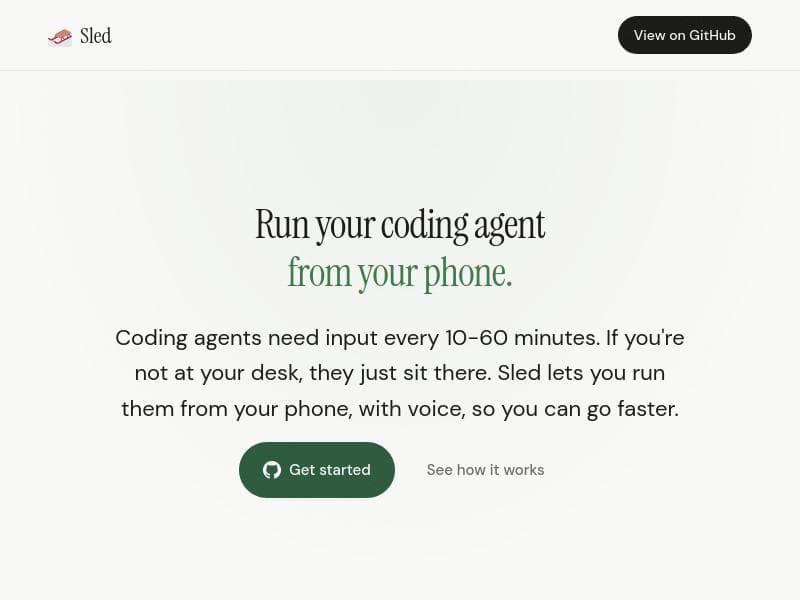
Sled transforms coding by enabling developers to control their local coding agents via voice from their phones, ensuring code privacy and hands-free productivity. Ideal for developers who want to stay productive away from their desks, it supports multiple AI coding agents and offers secure, open-source voice interaction.
Sled is an innovative AI tool designed to revolutionize the way developers interact with their coding agents by enabling voice-controlled operation directly from a mobile device. Its core purpose is to keep coding agents productive even when developers step away from their desks, addressing a common challenge where agents remain idle due to the need for frequent user input. By providing a seamless voice interface that securely connects to a local coding agent over Tailscale, Sled ensures that your code remains private and never leaves your machine. This local-first approach enhances security and privacy, while the voice interaction model allows developers to continue coding tasks hands-free, whether they are on the couch, in bed, or walking around. Compatible with popular coding agents like Claude Code, OpenAI Codex, and Gemini CLI, Sled offers a versatile and open-source solution for voice-driven coding workflows. Sled’s feature set is robust and tailored to optimize the developer experience. It provides real-time notifications when the coding agent completes a task or encounters a problem, keeping users informed without needing to check a screen constantly. The voice input system is sophisticated, capable of understanding programming-specific language nuances such as camelCase and function names, which are often challenging for voice recognition systems. This ensures accurate transcription of code-related commands. On the output side, Sled offers voice feedback with over 300 voices to choose from, allowing users to customize the voice assistant’s persona and tone. The tool supports hands-free operation, especially when paired with AirPods or similar wireless earbuds, enabling developers to interact with their coding agents without needing to look at or touch a screen. Security is a top priority; Sled uses secure tunneling methods like ngrok or Tailscale to connect your phone to your local machine, ensuring encrypted communication channels. Being fully open source, users have the freedom to fork, modify, and self-host the software, fostering transparency and community-driven improvements. Sled is best suited for developers and programmers who require continuous interaction with their coding agents but cannot always be at their desks. It is ideal for those who want to maintain productivity during breaks, multitask, or prefer voice-based workflows for accessibility reasons. Use cases include debugging code while away from the keyboard, dictating new functions or code snippets on the go, and receiving immediate verbal feedback on code execution or errors. It also benefits developers working remotely or in environments where screen time is limited, allowing them to keep their coding sessions active and efficient. The tool is available for free, making it accessible to individual developers and small teams without financial barriers. This pricing model encourages experimentation and adoption, especially for those interested in open-source solutions. There are no paid tiers or subscriptions mentioned, which simplifies access and usage. Compared to alternatives, Sled stands out by combining local code execution with a secure voice interface, a niche not widely addressed by other AI coding assistants. While many AI coding tools rely on cloud-based processing that can raise privacy concerns, Sled’s local-first approach ensures that sensitive code never leaves the user’s machine. Its integration with multiple coding agents and support for secure tunneling protocols further differentiates it. However, unlike some commercial AI assistants that offer extensive cloud-based features and integrations, Sled’s reliance on local infrastructure may require more technical setup and maintenance. Potential limitations include the need for users to configure secure tunnels and maintain their local coding agents, which might be challenging for less technical users. Voice recognition accuracy, while advanced, may still face challenges with complex code syntax or noisy environments. Additionally, since it is open source and free, users may not have access to dedicated customer support or advanced enterprise features found in paid solutions. Despite these considerations, Sled offers a compelling, privacy-conscious, and hands-free coding assistant experience that empowers developers to stay productive beyond their desks.

Description
Sled transforms coding by enabling developers to control their local coding agents via voice from their phones, ensuring code privacy and hands-free productivity. Ideal for developers who want to stay productive away from their desks, it supports multiple AI coding agents and offers secure, open-source voice interaction.
Sled is an innovative AI tool designed to revolutionize the way developers interact with their coding agents by enabling voice-controlled operation directly from a mobile device. Its core purpose is to keep coding agents productive even when developers step away from their desks, addressing a common challenge where agents remain idle due to the need for frequent user input. By providing a seamless voice interface that securely connects to a local coding agent over Tailscale, Sled ensures that your code remains private and never leaves your machine. This local-first approach enhances security and privacy, while the voice interaction model allows developers to continue coding tasks hands-free, whether they are on the couch, in bed, or walking around. Compatible with popular coding agents like Claude Code, OpenAI Codex, and Gemini CLI, Sled offers a versatile and open-source solution for voice-driven coding workflows. Sled’s feature set is robust and tailored to optimize the developer experience. It provides real-time notifications when the coding agent completes a task or encounters a problem, keeping users informed without needing to check a screen constantly. The voice input system is sophisticated, capable of understanding programming-specific language nuances such as camelCase and function names, which are often challenging for voice recognition systems. This ensures accurate transcription of code-related commands. On the output side, Sled offers voice feedback with over 300 voices to choose from, allowing users to customize the voice assistant’s persona and tone. The tool supports hands-free operation, especially when paired with AirPods or similar wireless earbuds, enabling developers to interact with their coding agents without needing to look at or touch a screen. Security is a top priority; Sled uses secure tunneling methods like ngrok or Tailscale to connect your phone to your local machine, ensuring encrypted communication channels. Being fully open source, users have the freedom to fork, modify, and self-host the software, fostering transparency and community-driven improvements. Sled is best suited for developers and programmers who require continuous interaction with their coding agents but cannot always be at their desks. It is ideal for those who want to maintain productivity during breaks, multitask, or prefer voice-based workflows for accessibility reasons. Use cases include debugging code while away from the keyboard, dictating new functions or code snippets on the go, and receiving immediate verbal feedback on code execution or errors. It also benefits developers working remotely or in environments where screen time is limited, allowing them to keep their coding sessions active and efficient. The tool is available for free, making it accessible to individual developers and small teams without financial barriers. This pricing model encourages experimentation and adoption, especially for those interested in open-source solutions. There are no paid tiers or subscriptions mentioned, which simplifies access and usage. Compared to alternatives, Sled stands out by combining local code execution with a secure voice interface, a niche not widely addressed by other AI coding assistants. While many AI coding tools rely on cloud-based processing that can raise privacy concerns, Sled’s local-first approach ensures that sensitive code never leaves the user’s machine. Its integration with multiple coding agents and support for secure tunneling protocols further differentiates it. However, unlike some commercial AI assistants that offer extensive cloud-based features and integrations, Sled’s reliance on local infrastructure may require more technical setup and maintenance. Potential limitations include the need for users to configure secure tunnels and maintain their local coding agents, which might be challenging for less technical users. Voice recognition accuracy, while advanced, may still face challenges with complex code syntax or noisy environments. Additionally, since it is open source and free, users may not have access to dedicated customer support or advanced enterprise features found in paid solutions. Despite these considerations, Sled offers a compelling, privacy-conscious, and hands-free coding assistant experience that empowers developers to stay productive beyond their desks.
Tool Features
- Notifications when agent finishes a task or hits a wall
- Voice input that handles camelCase and function names
- Voice output with 300+ voices to choose from
- Works away from your desk (couch, bed, walking around)
- Hands-free operation with AirPods and no screen needed
- Code stays local on your machine, never leaves
- Secure tunneling with ngrok or Tailscale
- Open source: fork, modify, and self-host
Frequently Asked Questions
What is Sled?
Sled is an open-source AI tool that lets developers run and interact with their local coding agents using voice commands from their phones. It connects securely over Tailscale or ngrok, allowing hands-free coding without the code ever leaving the user's machine.
How much does Sled cost?
Sled is completely free to use, with no paid plans or subscriptions required.
Who is Sled best for?
Sled is best suited for developers and programmers who want to maintain productivity with their coding agents while away from their desks, prefer voice-driven workflows, or need a secure, local-first coding assistant.
What are the main features of Sled?
Key features include voice input that understands camelCase and function names, voice output with over 300 voices, notifications for task completion or issues, hands-free operation with AirPods, secure tunneling via ngrok or Tailscale, and full open-source availability.
Does Sled offer a free trial?
Since Sled is free and open source, there is no need for a free trial; users can download and use it immediately without cost.
What integrations does Sled support?
Sled works with popular coding agents such as Claude Code, OpenAI Codex, and Gemini CLI, enabling voice interaction with these AI coding models.
How does Sled work?
Sled connects your phone to your local coding agent using secure tunneling (Tailscale or ngrok). You speak commands or code snippets, which the local agent processes, and then Sled reads back the results, allowing hands-free and private coding interactions.
Sponsored Tools





























Reviews
No reviews yet. Be the first to share your experience.