Description
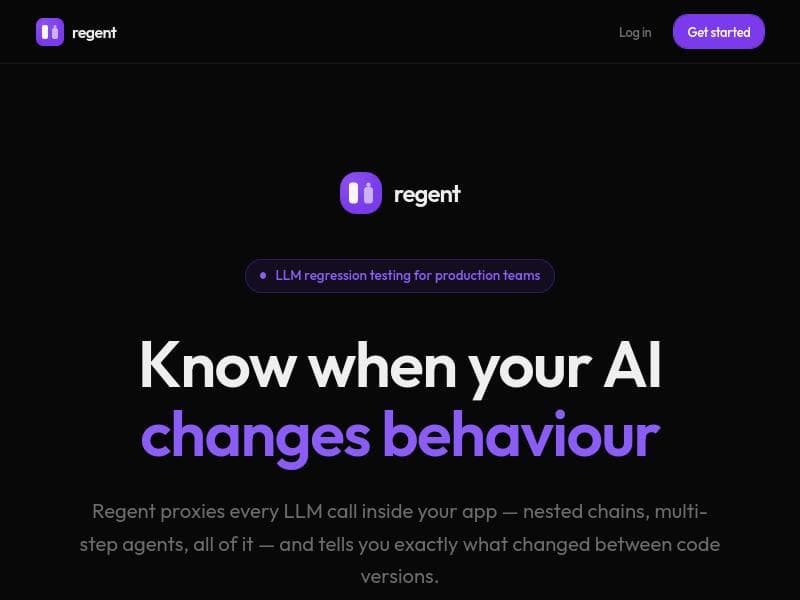
Regent is the first regression testing tool designed specifically for agentic AI applications, enabling developers to detect semantic changes and regressions in LLM-driven workflows before merging code. Ideal for AI teams focused on reliability, it offers deep execution trace analysis and GitHub integration to ensure AI products perform consistently and predictably.
Regent is a pioneering AI tool designed to enhance the reliability of agentic AI applications by introducing a regression testing layer specifically tailored for large language model (LLM) based apps. While many existing observability tools focus on logging what happened during an AI app’s execution, Regent goes a step further by identifying what has changed between versions, enabling developers to catch regressions and unexpected behavior before deploying updates. This proactive approach is critical as AI applications move beyond minimum viable products (MVPs) into fully-fledged, production-ready software where reliability and consistency are paramount. At its core, Regent automates the process of capturing a baseline of your AI agent’s behavior synchronized with your main code branch. This baseline serves as a reference point for future comparisons, allowing the tool to run semantic diffs on the agent’s entire execution trace for any critical inputs. This means that every nested call, multi-step agent interaction, and LLM invocation is analyzed in detail. Developers receive comprehensive insights into how changes in code affect the AI’s outputs, including subtle shifts in parameters such as confidence levels, tone, word count, and even department-specific outputs. This granular visibility helps teams detect drift in AI model outputs and verify pass/fail statuses before merging pull requests, effectively preventing regressions from reaching end users. Regent’s features include automatic baseline capture that stays in sync with the main branch, ensuring that comparisons are always relevant and up to date. It offers full call chain visibility, which is crucial for complex AI workflows involving nested or multi-agent chains. Detailed change detection highlights differences between code versions specifically for LLM calls, providing actionable information on how updates impact AI behavior. The tool also detects drift and pass statuses in model outputs, helping teams maintain consistent performance and reliability. Additionally, Regent provides insights into changes in output parameters such as department, confidence, tone, and word count, which are often critical for business applications that rely on nuanced AI responses. This tool is particularly well-suited for AI developers, data scientists, and product teams working on agentic AI applications that require high reliability and consistency. Use cases include AI-driven customer support agents, multi-step decision-making workflows, and any application where LLM outputs directly influence business outcomes. By integrating Regent into their development pipelines, teams can catch regressions early, reduce the risk of deploying faulty AI behavior, and improve overall product quality. Regent offers a freemium pricing model, making it accessible for teams to start using the tool without upfront costs. The freemium plan provides essential features for baseline capture and regression testing, while premium plans likely offer advanced capabilities and higher usage limits, although specific details are not provided. This pricing approach allows small teams and startups to benefit from Regent’s capabilities while scaling up as their needs grow. Compared to traditional observability tools that mainly log AI app behavior, Regent’s unique value lies in its regression testing focus and semantic diffing of execution traces. This makes it a standout solution for teams looking to move beyond reactive monitoring to proactive quality assurance in AI development. While other tools may provide some level of output monitoring or logging, Regent’s integration with GitHub and its ability to post detailed test results directly in pull requests streamline developer workflows and enhance collaboration. One consideration when adopting Regent is that it is specialized for agentic AI applications and LLM-based workflows, so teams working with simpler AI models or non-agentic architectures may find less benefit. Additionally, as a relatively new tool in the AI reliability space, some users may need to invest time in integrating it into their existing CI/CD pipelines and adapting their testing strategies. However, the potential gains in preventing regressions and improving AI product stability make these efforts worthwhile for many organizations. In summary, Regent is a cutting-edge regression testing platform that addresses a critical gap in AI app development by providing semantic diffs and detailed change detection for agentic AI workflows. Its comprehensive feature set, seamless GitHub integration, and focus on proactive quality assurance position it as an essential tool for teams aiming to deliver reliable, production-grade AI applications.

Description
Regent is the first regression testing tool designed specifically for agentic AI applications, enabling developers to detect semantic changes and regressions in LLM-driven workflows before merging code. Ideal for AI teams focused on reliability, it offers deep execution trace analysis and GitHub integration to ensure AI products perform consistently and predictably.
Regent is a pioneering AI tool designed to enhance the reliability of agentic AI applications by introducing a regression testing layer specifically tailored for large language model (LLM) based apps. While many existing observability tools focus on logging what happened during an AI app’s execution, Regent goes a step further by identifying what has changed between versions, enabling developers to catch regressions and unexpected behavior before deploying updates. This proactive approach is critical as AI applications move beyond minimum viable products (MVPs) into fully-fledged, production-ready software where reliability and consistency are paramount. At its core, Regent automates the process of capturing a baseline of your AI agent’s behavior synchronized with your main code branch. This baseline serves as a reference point for future comparisons, allowing the tool to run semantic diffs on the agent’s entire execution trace for any critical inputs. This means that every nested call, multi-step agent interaction, and LLM invocation is analyzed in detail. Developers receive comprehensive insights into how changes in code affect the AI’s outputs, including subtle shifts in parameters such as confidence levels, tone, word count, and even department-specific outputs. This granular visibility helps teams detect drift in AI model outputs and verify pass/fail statuses before merging pull requests, effectively preventing regressions from reaching end users. Regent’s features include automatic baseline capture that stays in sync with the main branch, ensuring that comparisons are always relevant and up to date. It offers full call chain visibility, which is crucial for complex AI workflows involving nested or multi-agent chains. Detailed change detection highlights differences between code versions specifically for LLM calls, providing actionable information on how updates impact AI behavior. The tool also detects drift and pass statuses in model outputs, helping teams maintain consistent performance and reliability. Additionally, Regent provides insights into changes in output parameters such as department, confidence, tone, and word count, which are often critical for business applications that rely on nuanced AI responses. This tool is particularly well-suited for AI developers, data scientists, and product teams working on agentic AI applications that require high reliability and consistency. Use cases include AI-driven customer support agents, multi-step decision-making workflows, and any application where LLM outputs directly influence business outcomes. By integrating Regent into their development pipelines, teams can catch regressions early, reduce the risk of deploying faulty AI behavior, and improve overall product quality. Regent offers a freemium pricing model, making it accessible for teams to start using the tool without upfront costs. The freemium plan provides essential features for baseline capture and regression testing, while premium plans likely offer advanced capabilities and higher usage limits, although specific details are not provided. This pricing approach allows small teams and startups to benefit from Regent’s capabilities while scaling up as their needs grow. Compared to traditional observability tools that mainly log AI app behavior, Regent’s unique value lies in its regression testing focus and semantic diffing of execution traces. This makes it a standout solution for teams looking to move beyond reactive monitoring to proactive quality assurance in AI development. While other tools may provide some level of output monitoring or logging, Regent’s integration with GitHub and its ability to post detailed test results directly in pull requests streamline developer workflows and enhance collaboration. One consideration when adopting Regent is that it is specialized for agentic AI applications and LLM-based workflows, so teams working with simpler AI models or non-agentic architectures may find less benefit. Additionally, as a relatively new tool in the AI reliability space, some users may need to invest time in integrating it into their existing CI/CD pipelines and adapting their testing strategies. However, the potential gains in preventing regressions and improving AI product stability make these efforts worthwhile for many organizations. In summary, Regent is a cutting-edge regression testing platform that addresses a critical gap in AI app development by providing semantic diffs and detailed change detection for agentic AI workflows. Its comprehensive feature set, seamless GitHub integration, and focus on proactive quality assurance position it as an essential tool for teams aiming to deliver reliable, production-grade AI applications.
Tool Features
- Automatic baseline capture with main branch synchronization
- Full call chain visibility including nested chains and multi-step agents
- Detailed change detection between code versions for LLM calls
- Detection of drift and pass statuses in AI model outputs
- Insight into changes in output parameters such as department, confidence, tone, and word count
Frequently Asked Questions
What is Regent?
Regent is a regression testing tool for agentic AI applications that analyzes semantic differences in AI execution traces to detect changes and regressions before code is merged, helping ensure AI reliability.
How much does Regent cost?
Regent offers a freemium pricing model, allowing users to access essential features for free, with premium plans likely available for advanced capabilities and higher usage.
Who is Regent best for?
Regent is best suited for AI developers, data scientists, and product teams working on complex agentic AI applications and LLM-based workflows that require high reliability and regression testing.
What are the main features of Regent?
Key features include automatic baseline capture synchronized with the main branch, full call chain visibility including nested and multi-step agents, detailed change detection for LLM calls, drift and pass/fail detection in AI outputs, and insights into output parameters such as confidence, tone, and word count.
Does Regent offer a free trial?
Yes, Regent provides a freemium plan that allows users to try core features without cost, effectively serving as a free trial for basic usage.
What integrations does Regent support?
Regent integrates directly with GitHub, posting regression test results in pull requests to streamline developer workflows and collaboration.
How does Regent work?
Regent captures a baseline of your AI agent’s execution trace synchronized with your main branch, then runs semantic diffs on new code changes to detect any regressions or output changes before merging, providing detailed reports in GitHub.
Socials
Use ToolSponsored Tools

































Reviews
No reviews yet. Be the first to share your experience.