Pipedream MCP
Description
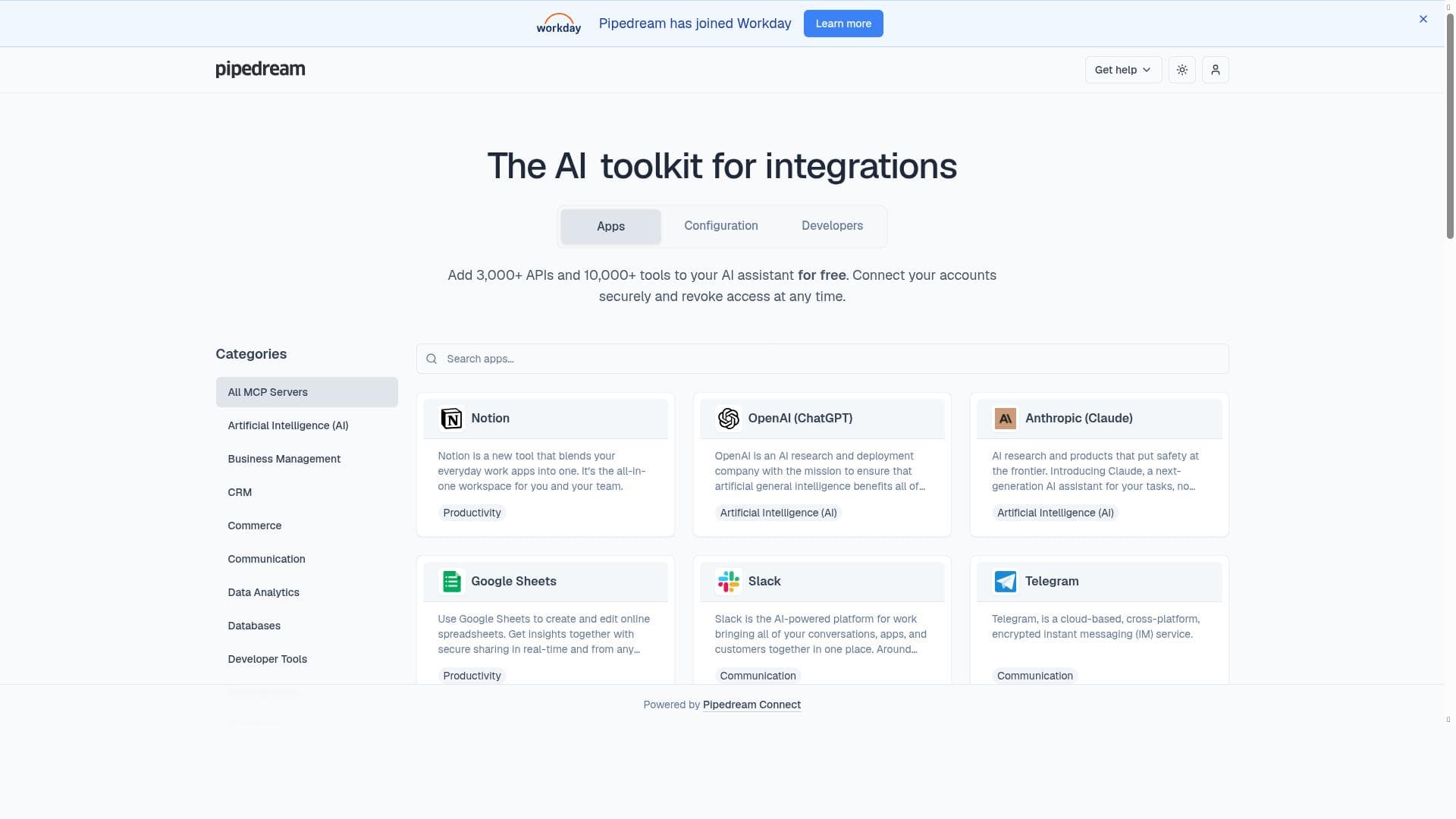
Pipedream MCP revolutionizes AI assistant capabilities by providing secure, standardized access to over 3,000 APIs via dedicated MCP servers. Ideal for developers and enterprises, it simplifies complex integrations with a vast library of prebuilt tools and seamless workflow automation, accelerating AI-powered application development.
Pipedream MCP is a cutting-edge platform designed to streamline and enhance the way AI assistants and developers interact with a vast ecosystem of APIs. At its core, Pipedream MCP leverages dedicated Model Context Protocol (MCP) servers to provide secure, standardized access to over 3,000 APIs across more than 2,500 integrated applications. This innovative approach enables AI models like Claude and Cursor to seamlessly connect with thousands of APIs through a unified protocol, simplifying the complexity traditionally associated with API integrations. By acting as an intermediary layer, Pipedream MCP abstracts the intricacies of individual API authentication, rate limiting, and data formatting, allowing AI assistants and developers to focus on building intelligent workflows and applications without worrying about backend connectivity challenges. One of the standout features of Pipedream MCP is its extensive library of over 10,000 prebuilt tools and connectors. These tools facilitate rapid development and deployment of automated workflows by providing ready-made components that can be easily customized and combined. The platform supports a wide range of API connectors, covering diverse domains such as cloud services, databases, messaging platforms, analytics, and more. This breadth of integration options empowers users to automate complex multi-step processes, orchestrate data flows, and enable real-time interactions between disparate systems. Additionally, Pipedream MCP is designed with developers in mind, offering a developer-friendly environment that includes comprehensive documentation, SDKs, and an intuitive interface for managing API connections and workflows. Pipedream MCP is ideally suited for AI developers, data scientists, and enterprises looking to enhance their AI assistants' capabilities by granting them secure and scalable access to a multitude of APIs. Use cases range from building conversational AI that can perform actions across various SaaS platforms, to automating business processes that require interaction with multiple cloud services, to creating intelligent data pipelines that integrate and transform data from heterogeneous sources. Its ability to standardize API interactions makes it particularly valuable for organizations aiming to reduce integration overhead and accelerate time-to-market for AI-powered applications. The platform operates on a freemium pricing model, allowing users to get started with basic access and features at no cost. This approach lowers the barrier to entry and encourages experimentation and prototyping. For users with more demanding requirements, such as higher API usage limits, advanced security features, or enterprise-grade support, paid plans are available. These plans are designed to scale with the needs of growing teams and organizations, ensuring that Pipedream MCP remains a cost-effective solution regardless of usage volume. When compared to alternative API integration platforms, Pipedream MCP stands out due to its unique focus on enabling AI assistants through the Model Context Protocol. While many integration tools offer connectors and automation capabilities, Pipedream MCP's protocol-centric architecture provides a standardized and secure method specifically optimized for AI-driven interactions. This specialization allows it to handle complex conversational and contextual workflows more efficiently than general-purpose integration platforms. However, users should consider that the platform's reliance on MCP servers means that it may introduce some latency compared to direct API calls, and its ecosystem is still evolving, which may affect the availability of connectors for niche or emerging APIs. In summary, Pipedream MCP offers a powerful, developer-friendly solution for unlocking the potential of AI assistants by providing seamless, secure access to thousands of APIs through a standardized protocol. Its extensive library of prebuilt tools, broad integration support, and scalable pricing make it an attractive choice for organizations looking to build sophisticated AI-powered workflows and applications. While it excels in facilitating AI-contextual API interactions, prospective users should evaluate their specific latency and integration needs to ensure it aligns with their project requirements.

Description
Pipedream MCP revolutionizes AI assistant capabilities by providing secure, standardized access to over 3,000 APIs via dedicated MCP servers. Ideal for developers and enterprises, it simplifies complex integrations with a vast library of prebuilt tools and seamless workflow automation, accelerating AI-powered application development.
Pipedream MCP is a cutting-edge platform designed to streamline and enhance the way AI assistants and developers interact with a vast ecosystem of APIs. At its core, Pipedream MCP leverages dedicated Model Context Protocol (MCP) servers to provide secure, standardized access to over 3,000 APIs across more than 2,500 integrated applications. This innovative approach enables AI models like Claude and Cursor to seamlessly connect with thousands of APIs through a unified protocol, simplifying the complexity traditionally associated with API integrations. By acting as an intermediary layer, Pipedream MCP abstracts the intricacies of individual API authentication, rate limiting, and data formatting, allowing AI assistants and developers to focus on building intelligent workflows and applications without worrying about backend connectivity challenges. One of the standout features of Pipedream MCP is its extensive library of over 10,000 prebuilt tools and connectors. These tools facilitate rapid development and deployment of automated workflows by providing ready-made components that can be easily customized and combined. The platform supports a wide range of API connectors, covering diverse domains such as cloud services, databases, messaging platforms, analytics, and more. This breadth of integration options empowers users to automate complex multi-step processes, orchestrate data flows, and enable real-time interactions between disparate systems. Additionally, Pipedream MCP is designed with developers in mind, offering a developer-friendly environment that includes comprehensive documentation, SDKs, and an intuitive interface for managing API connections and workflows. Pipedream MCP is ideally suited for AI developers, data scientists, and enterprises looking to enhance their AI assistants' capabilities by granting them secure and scalable access to a multitude of APIs. Use cases range from building conversational AI that can perform actions across various SaaS platforms, to automating business processes that require interaction with multiple cloud services, to creating intelligent data pipelines that integrate and transform data from heterogeneous sources. Its ability to standardize API interactions makes it particularly valuable for organizations aiming to reduce integration overhead and accelerate time-to-market for AI-powered applications. The platform operates on a freemium pricing model, allowing users to get started with basic access and features at no cost. This approach lowers the barrier to entry and encourages experimentation and prototyping. For users with more demanding requirements, such as higher API usage limits, advanced security features, or enterprise-grade support, paid plans are available. These plans are designed to scale with the needs of growing teams and organizations, ensuring that Pipedream MCP remains a cost-effective solution regardless of usage volume. When compared to alternative API integration platforms, Pipedream MCP stands out due to its unique focus on enabling AI assistants through the Model Context Protocol. While many integration tools offer connectors and automation capabilities, Pipedream MCP's protocol-centric architecture provides a standardized and secure method specifically optimized for AI-driven interactions. This specialization allows it to handle complex conversational and contextual workflows more efficiently than general-purpose integration platforms. However, users should consider that the platform's reliance on MCP servers means that it may introduce some latency compared to direct API calls, and its ecosystem is still evolving, which may affect the availability of connectors for niche or emerging APIs. In summary, Pipedream MCP offers a powerful, developer-friendly solution for unlocking the potential of AI assistants by providing seamless, secure access to thousands of APIs through a standardized protocol. Its extensive library of prebuilt tools, broad integration support, and scalable pricing make it an attractive choice for organizations looking to build sophisticated AI-powered workflows and applications. While it excels in facilitating AI-contextual API interactions, prospective users should evaluate their specific latency and integration needs to ensure it aligns with their project requirements.
Tool Features
- Access to more than 3,000 APIs
- 10,000 prebuilt tools available
- Integration and automation of workflows
- Developer-friendly platform
- Supports a wide range of API connectors
Frequently Asked Questions
What is Pipedream MCP?
Pipedream MCP is a platform that uses dedicated Model Context Protocol (MCP) servers to enable AI assistants and developers to securely access and interact with thousands of APIs through a standardized protocol, simplifying API integrations and workflow automation.
How much does Pipedream MCP cost?
Pipedream MCP offers a freemium pricing model, allowing users to start with free access to basic features and API usage. Paid plans with higher limits, advanced features, and enterprise support are available for users with greater needs.
Who is Pipedream MCP best for?
Pipedream MCP is best suited for AI developers, data scientists, and enterprises seeking to enhance AI assistants with secure, scalable API access. It’s ideal for those building conversational AI, automating workflows, or integrating complex multi-API systems.
What are the main features of Pipedream MCP?
Key features include access to over 3,000 APIs, more than 10,000 prebuilt tools, support for a wide range of API connectors, workflow integration and automation capabilities, and a developer-friendly platform with comprehensive documentation and SDKs.
Does Pipedream MCP offer a free trial?
Yes, Pipedream MCP operates on a freemium model, which effectively allows users to try the platform for free with access to basic features and API calls before upgrading to paid plans.
What integrations does Pipedream MCP support?
Pipedream MCP supports integrations with over 2,500 apps and more than 3,000 APIs across various domains including cloud platforms, databases, messaging services, analytics tools, and many other SaaS applications.
How does Pipedream MCP work?
Pipedream MCP works by using dedicated MCP servers that act as intermediaries between AI assistants and APIs. These servers standardize and secure API access using the Model Context Protocol, enabling AI models to interact with multiple APIs seamlessly and reliably.
Sponsored Tools




































Reviews
No reviews yet. Be the first to share your experience.