Description
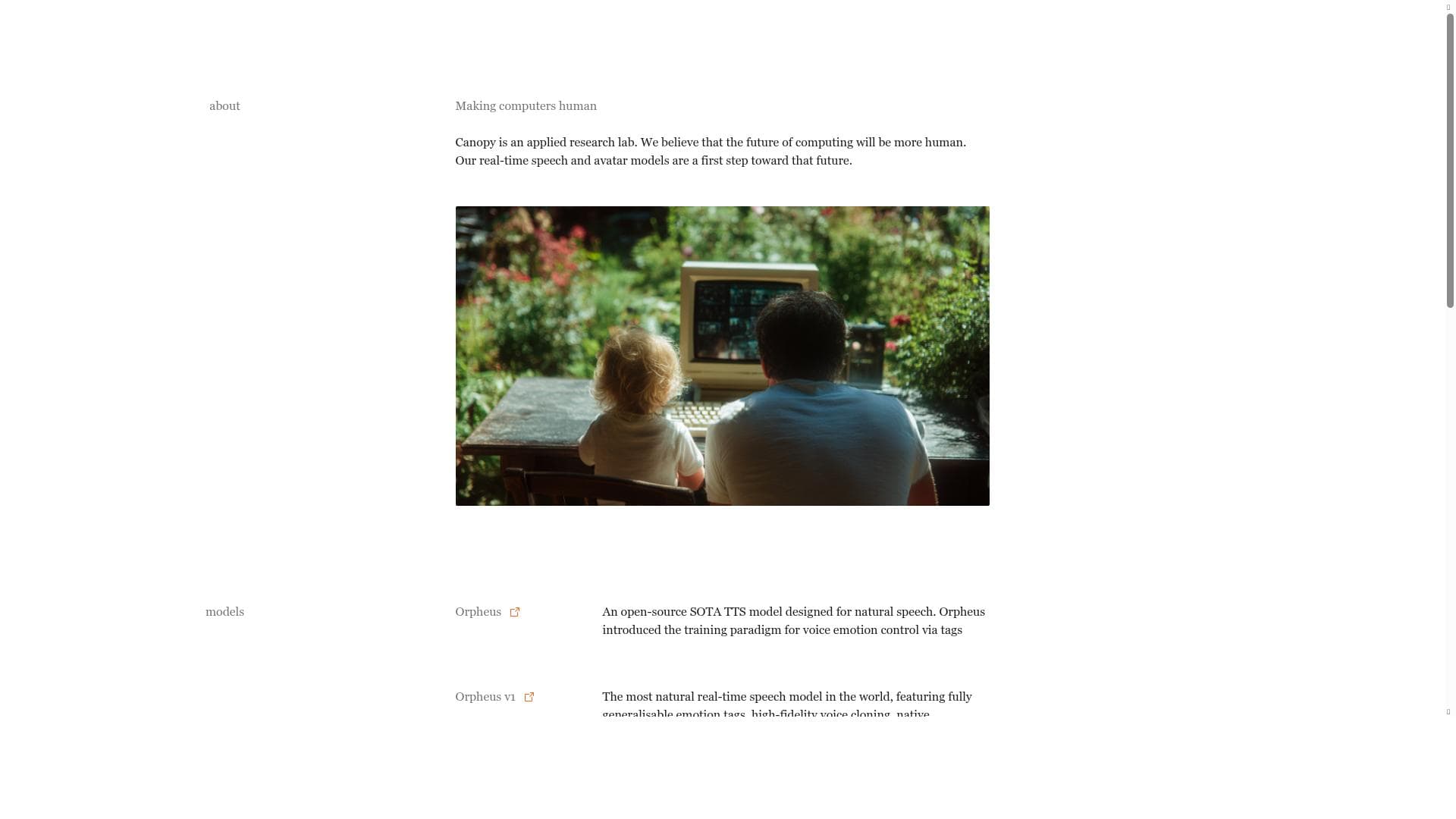
Orpheus TTS is an open-source text-to-speech model powered by Llama-3b, delivering human-like speech with natural emotion and intonation. Its unique zero-shot voice cloning, guided emotion control, and real-time streaming capabilities make it ideal for developers and businesses seeking expressive, multilingual, and interactive voice solutions without cost barriers.
Orpheus TTS is a cutting-edge open-source text-to-speech (TTS) system built on the powerful Llama-3b backbone, designed to generate highly natural and human-like speech. Its core purpose is to deliver expressive, emotionally rich, and contextually nuanced voice synthesis that goes beyond traditional TTS capabilities. By leveraging advanced machine learning techniques, Orpheus TTS produces speech with natural intonation and emotion, making it ideal for applications requiring lifelike vocal interactions. The model supports zero-shot voice cloning, allowing users to replicate voices with minimal data, and it operates with low latency, enabling real-time streaming of speech and avatar interactions. This makes Orpheus TTS a versatile tool for developers, content creators, and businesses seeking to enhance user engagement through realistic audio experiences. One of the standout features of Orpheus TTS is its open-source nature, which encourages community collaboration and customization. The system incorporates a novel training paradigm that uses emotion tags to control voice emotion dynamically, allowing users to guide the emotional tone of the generated speech with precision. This real-time speech model supports fully generalizable emotion tags, meaning it can adapt to a wide range of emotional expressions without retraining. Additionally, Orpheus TTS offers high-fidelity voice cloning capabilities, enabling the creation of personalized voices that maintain naturalness and clarity. Its native multilingual support allows seamless switching between languages, making it suitable for global applications. Another innovative aspect is the realistic streaming avatar model, which can interact over video in real time, combining visual and auditory elements for immersive communication. Orpheus TTS is best suited for developers, AI researchers, and enterprises working on conversational AI, virtual assistants, gaming, audiobooks, accessibility tools, and multimedia content creation. Its ability to produce emotionally expressive speech with low latency makes it ideal for live applications such as customer support bots, interactive storytelling, and real-time dubbing. The multilingual and voice cloning features expand its utility for global brands and personalized user experiences. Because it is open-source and free, it also appeals to academic institutions and hobbyists interested in experimenting with state-of-the-art TTS technology without licensing constraints. Regarding pricing, Orpheus TTS is offered completely free of charge, reflecting its open-source commitment. Users can access the model and its features without subscription fees or usage limits imposed by the developers. This makes it an attractive option for budget-conscious projects and those wanting to integrate advanced TTS capabilities without financial barriers. When compared to alternative TTS solutions, Orpheus TTS stands out due to its combination of open-source availability, emotional voice control, and real-time streaming with avatar interaction. Many commercial TTS services offer high-quality voices but lack the flexibility of open-source customization or the nuanced emotion control provided by Orpheus. Its zero-shot cloning capability is also a significant advantage over models requiring extensive voice data. However, as an open-source project, it may require more technical expertise to deploy and optimize than turnkey commercial platforms. Additionally, while it supports multiple languages natively, the breadth of language coverage and dialects may not yet match some specialized commercial offerings. Potential limitations include the need for computational resources to run the Llama-3b backbone efficiently, which might be a barrier for some users. Also, while the emotion tagging system is powerful, it may require experimentation to achieve desired expressive effects. The real-time avatar streaming feature, though innovative, may depend on additional infrastructure for video integration. Users should also consider that as an open-source tool, ongoing support and updates depend on community involvement rather than dedicated commercial support teams. Nonetheless, Orpheus TTS represents a significant advancement in accessible, emotionally intelligent TTS technology, providing a robust platform for diverse voice synthesis applications.

Description
Orpheus TTS is an open-source text-to-speech model powered by Llama-3b, delivering human-like speech with natural emotion and intonation. Its unique zero-shot voice cloning, guided emotion control, and real-time streaming capabilities make it ideal for developers and businesses seeking expressive, multilingual, and interactive voice solutions without cost barriers.
Orpheus TTS is a cutting-edge open-source text-to-speech (TTS) system built on the powerful Llama-3b backbone, designed to generate highly natural and human-like speech. Its core purpose is to deliver expressive, emotionally rich, and contextually nuanced voice synthesis that goes beyond traditional TTS capabilities. By leveraging advanced machine learning techniques, Orpheus TTS produces speech with natural intonation and emotion, making it ideal for applications requiring lifelike vocal interactions. The model supports zero-shot voice cloning, allowing users to replicate voices with minimal data, and it operates with low latency, enabling real-time streaming of speech and avatar interactions. This makes Orpheus TTS a versatile tool for developers, content creators, and businesses seeking to enhance user engagement through realistic audio experiences. One of the standout features of Orpheus TTS is its open-source nature, which encourages community collaboration and customization. The system incorporates a novel training paradigm that uses emotion tags to control voice emotion dynamically, allowing users to guide the emotional tone of the generated speech with precision. This real-time speech model supports fully generalizable emotion tags, meaning it can adapt to a wide range of emotional expressions without retraining. Additionally, Orpheus TTS offers high-fidelity voice cloning capabilities, enabling the creation of personalized voices that maintain naturalness and clarity. Its native multilingual support allows seamless switching between languages, making it suitable for global applications. Another innovative aspect is the realistic streaming avatar model, which can interact over video in real time, combining visual and auditory elements for immersive communication. Orpheus TTS is best suited for developers, AI researchers, and enterprises working on conversational AI, virtual assistants, gaming, audiobooks, accessibility tools, and multimedia content creation. Its ability to produce emotionally expressive speech with low latency makes it ideal for live applications such as customer support bots, interactive storytelling, and real-time dubbing. The multilingual and voice cloning features expand its utility for global brands and personalized user experiences. Because it is open-source and free, it also appeals to academic institutions and hobbyists interested in experimenting with state-of-the-art TTS technology without licensing constraints. Regarding pricing, Orpheus TTS is offered completely free of charge, reflecting its open-source commitment. Users can access the model and its features without subscription fees or usage limits imposed by the developers. This makes it an attractive option for budget-conscious projects and those wanting to integrate advanced TTS capabilities without financial barriers. When compared to alternative TTS solutions, Orpheus TTS stands out due to its combination of open-source availability, emotional voice control, and real-time streaming with avatar interaction. Many commercial TTS services offer high-quality voices but lack the flexibility of open-source customization or the nuanced emotion control provided by Orpheus. Its zero-shot cloning capability is also a significant advantage over models requiring extensive voice data. However, as an open-source project, it may require more technical expertise to deploy and optimize than turnkey commercial platforms. Additionally, while it supports multiple languages natively, the breadth of language coverage and dialects may not yet match some specialized commercial offerings. Potential limitations include the need for computational resources to run the Llama-3b backbone efficiently, which might be a barrier for some users. Also, while the emotion tagging system is powerful, it may require experimentation to achieve desired expressive effects. The real-time avatar streaming feature, though innovative, may depend on additional infrastructure for video integration. Users should also consider that as an open-source tool, ongoing support and updates depend on community involvement rather than dedicated commercial support teams. Nonetheless, Orpheus TTS represents a significant advancement in accessible, emotionally intelligent TTS technology, providing a robust platform for diverse voice synthesis applications.
Tool Features
- Open-source state-of-the-art text-to-speech model designed for natural speech
- Training paradigm for voice emotion control via tags
- Real-time speech model with fully generalisable emotion tags
- High-fidelity voice cloning
- Native multilinguality
- Realistic streaming avatar model that interacts over video in real time
Frequently Asked Questions
What is Orpheus TTS?
Orpheus TTS is an open-source text-to-speech system that uses the Llama-3b backbone to generate natural, human-like speech with emotional intonation and real-time streaming capabilities.
How much does Orpheus TTS cost?
Orpheus TTS is completely free to use as it is an open-source project, with no subscription fees or usage charges.
Who is Orpheus TTS best for?
It is best suited for developers, AI researchers, content creators, and enterprises needing expressive, multilingual, and low-latency voice synthesis for applications like virtual assistants, gaming, audiobooks, and accessibility tools.
What are the main features of Orpheus TTS?
Key features include open-source state-of-the-art TTS, voice emotion control via tags, zero-shot high-fidelity voice cloning, native multilingual support, low latency real-time streaming, and a realistic streaming avatar model for video interaction.
Does Orpheus TTS offer a free trial?
Since Orpheus TTS is open-source and free, there is no need for a trial period; users can access and use the full capabilities immediately.
What integrations does Orpheus TTS support?
Orpheus TTS supports integration into applications requiring real-time speech synthesis and avatar video streaming, though specific integration options depend on user implementation since it is open-source.
How does Orpheus TTS work?
It uses a Llama-3b based neural network to synthesize speech from text, employing emotion tags to guide expressive intonation and zero-shot voice cloning to replicate voices, all optimized for low latency to enable real-time streaming and avatar interaction.
Socials
Use ToolSponsored Tools































Reviews
No reviews yet. Be the first to share your experience.