OpenAI WebSocket Mode for Responses API
Description
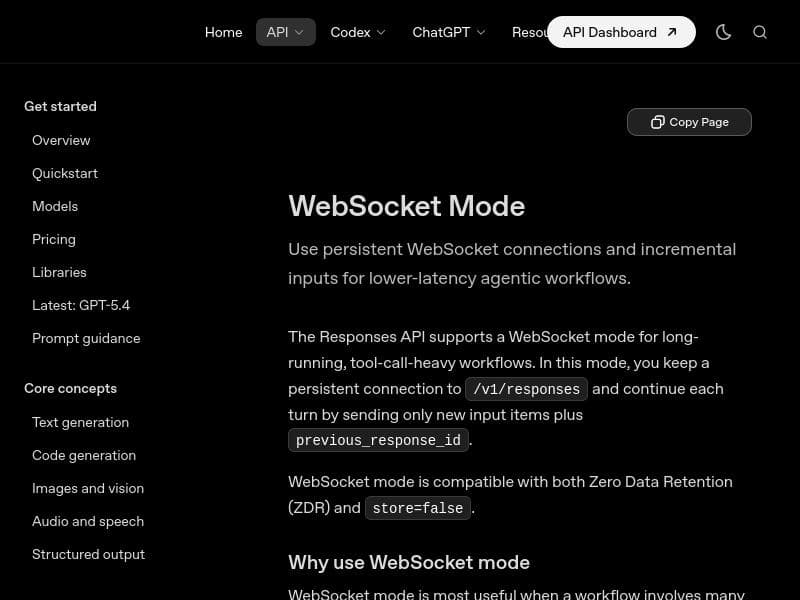
OpenAI WebSocket Mode for Responses API revolutionizes conversational AI by maintaining a persistent connection that sends only incremental inputs, cutting latency by up to 40% in heavy workflows. Ideal for developers building real-time, multi-turn AI applications, it enables faster, more efficient interactions without resending full context every turn.
OpenAI WebSocket Mode for Responses API is a specialized interface designed to optimize the interaction between AI agents and the OpenAI Responses API by maintaining a persistent WebSocket connection. Traditionally, each agent turn in conversational AI workflows requires resending the entire context, which can quickly become inefficient and introduce significant latency, especially in complex or heavy tool-call environments. This tool addresses that inefficiency by keeping a continuous connection open, allowing incremental inputs to be sent rather than the full context repeatedly. This architectural improvement reduces the end-to-end latency by up to 40%, making it a highly effective solution for real-time, interactive AI applications. At its core, the WebSocket Mode for Responses API supports real-time streaming of AI-generated responses, enabling developers to receive partial outputs as soon as they are generated rather than waiting for the entire response to complete. This streaming capability is crucial for applications requiring immediate feedback or dynamic user interaction, such as chatbots, virtual assistants, or live data processing tools. The API also supports the use of response.create, a method that facilitates generating new responses within the persistent connection framework. Additionally, it manages conversational context efficiently through the previous_response_id parameter, which allows the API to maintain continuity across multiple turns without resending the entire conversation history. This tool is particularly well-suited for developers and organizations building conversational AI systems, customer support bots, interactive agents, or any application where reducing latency and improving throughput is critical. Use cases include complex multi-turn dialogues, real-time collaboration tools, and AI-driven workflows that involve frequent tool calls or require rapid response times. By minimizing the overhead of context resending, the WebSocket Mode enhances scalability and responsiveness, making it ideal for high-demand environments where performance directly impacts user experience. OpenAI offers this WebSocket Mode for Responses API free of charge, making it accessible for experimentation, development, and production use without upfront costs. This pricing model encourages adoption by startups, independent developers, and enterprises alike, enabling them to leverage advanced WebSocket capabilities without financial barriers. While the API itself is free, users should consider any associated costs related to the underlying OpenAI models or infrastructure usage that may apply depending on their broader integration. Compared to traditional RESTful API calls that require repeated full context transmissions, the WebSocket Mode stands out by significantly reducing network overhead and latency. This persistent connection approach is more efficient and scalable, particularly in scenarios involving continuous or rapid exchanges. While other streaming APIs exist, OpenAI’s implementation is tightly integrated with its Responses API, offering seamless context management and response generation capabilities that are optimized for conversational AI. However, developers should be aware that WebSocket connections require stable network conditions and may involve additional complexity in connection management compared to stateless HTTP requests. Notable considerations include the need for robust error handling and reconnection logic to maintain persistent WebSocket connections in production environments. Additionally, while the tool reduces latency and overhead, it is essential to architect client applications to handle incremental data streams properly. Users should also evaluate their specific use cases to determine if the WebSocket Mode’s benefits align with their performance and scalability requirements. Overall, OpenAI WebSocket Mode for Responses API offers a powerful, efficient, and cost-effective solution for enhancing conversational AI workflows through persistent, incremental communication.

Description
OpenAI WebSocket Mode for Responses API revolutionizes conversational AI by maintaining a persistent connection that sends only incremental inputs, cutting latency by up to 40% in heavy workflows. Ideal for developers building real-time, multi-turn AI applications, it enables faster, more efficient interactions without resending full context every turn.
OpenAI WebSocket Mode for Responses API is a specialized interface designed to optimize the interaction between AI agents and the OpenAI Responses API by maintaining a persistent WebSocket connection. Traditionally, each agent turn in conversational AI workflows requires resending the entire context, which can quickly become inefficient and introduce significant latency, especially in complex or heavy tool-call environments. This tool addresses that inefficiency by keeping a continuous connection open, allowing incremental inputs to be sent rather than the full context repeatedly. This architectural improvement reduces the end-to-end latency by up to 40%, making it a highly effective solution for real-time, interactive AI applications. At its core, the WebSocket Mode for Responses API supports real-time streaming of AI-generated responses, enabling developers to receive partial outputs as soon as they are generated rather than waiting for the entire response to complete. This streaming capability is crucial for applications requiring immediate feedback or dynamic user interaction, such as chatbots, virtual assistants, or live data processing tools. The API also supports the use of response.create, a method that facilitates generating new responses within the persistent connection framework. Additionally, it manages conversational context efficiently through the previous_response_id parameter, which allows the API to maintain continuity across multiple turns without resending the entire conversation history. This tool is particularly well-suited for developers and organizations building conversational AI systems, customer support bots, interactive agents, or any application where reducing latency and improving throughput is critical. Use cases include complex multi-turn dialogues, real-time collaboration tools, and AI-driven workflows that involve frequent tool calls or require rapid response times. By minimizing the overhead of context resending, the WebSocket Mode enhances scalability and responsiveness, making it ideal for high-demand environments where performance directly impacts user experience. OpenAI offers this WebSocket Mode for Responses API free of charge, making it accessible for experimentation, development, and production use without upfront costs. This pricing model encourages adoption by startups, independent developers, and enterprises alike, enabling them to leverage advanced WebSocket capabilities without financial barriers. While the API itself is free, users should consider any associated costs related to the underlying OpenAI models or infrastructure usage that may apply depending on their broader integration. Compared to traditional RESTful API calls that require repeated full context transmissions, the WebSocket Mode stands out by significantly reducing network overhead and latency. This persistent connection approach is more efficient and scalable, particularly in scenarios involving continuous or rapid exchanges. While other streaming APIs exist, OpenAI’s implementation is tightly integrated with its Responses API, offering seamless context management and response generation capabilities that are optimized for conversational AI. However, developers should be aware that WebSocket connections require stable network conditions and may involve additional complexity in connection management compared to stateless HTTP requests. Notable considerations include the need for robust error handling and reconnection logic to maintain persistent WebSocket connections in production environments. Additionally, while the tool reduces latency and overhead, it is essential to architect client applications to handle incremental data streams properly. Users should also evaluate their specific use cases to determine if the WebSocket Mode’s benefits align with their performance and scalability requirements. Overall, OpenAI WebSocket Mode for Responses API offers a powerful, efficient, and cost-effective solution for enhancing conversational AI workflows through persistent, incremental communication.
Tool Features
- Supports Responses API WebSocket mode
- Enables real-time streaming of responses
- Allows use of response.create for generating responses
- Supports previous_response_id for conversational context management
Frequently Asked Questions
What is OpenAI WebSocket Mode for Responses API?
It is an API mode that maintains a persistent WebSocket connection to the OpenAI Responses API, allowing incremental input sending and real-time streaming of AI responses to reduce latency and improve efficiency in conversational AI workflows.
How much does OpenAI WebSocket Mode for Responses API cost?
The WebSocket Mode for Responses API is offered free of charge by OpenAI, though users should consider any costs associated with the underlying AI model usage or infrastructure.
Who is OpenAI WebSocket Mode for Responses API best for?
It is best suited for developers and organizations building conversational AI systems, chatbots, virtual assistants, or any applications requiring low-latency, multi-turn interactions and heavy tool-call workflows.
What are the main features of OpenAI WebSocket Mode for Responses API?
Key features include support for persistent WebSocket connections, real-time streaming of responses, use of response.create for generating replies, and previous_response_id for efficient conversational context management.
Does OpenAI WebSocket Mode for Responses API offer a free trial?
Yes, the WebSocket Mode for Responses API is free to use, effectively serving as a free trial and production-ready tool without additional charges.
What integrations does OpenAI WebSocket Mode for Responses API support?
It integrates directly with the OpenAI Responses API and can be used in any application or system that supports WebSocket connections and requires conversational AI capabilities.
How does OpenAI WebSocket Mode for Responses API work?
It works by establishing a persistent WebSocket connection between the client and the API, allowing incremental inputs to be sent and streaming partial responses back in real-time, reducing the need to resend full conversation context each turn.
Socials
Use ToolSponsored Tools


































Reviews
No reviews yet. Be the first to share your experience.