Description
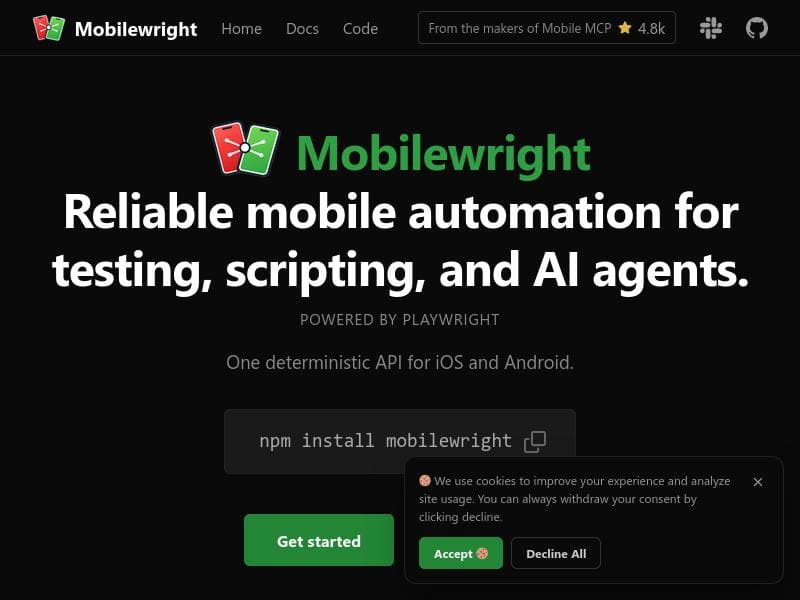
Mobilewright is a revolutionary mobile automation tool offering a unified API for iOS and Android, enabling developers and AI agents to automate real devices, simulators, and emulators with zero configuration and no flakiness. Its deterministic, auto-waiting execution makes it ideal for seamless, reliable mobile testing and automation across platforms.
Mobilewright is a cutting-edge automation tool designed specifically for iOS and Android platforms, offering developers and AI agents a unified, seamless experience for automating mobile applications across real devices, simulators, and emulators. At its core, Mobilewright serves as a Playwright equivalent for mobile environments, providing a single, consistent API that abstracts away the complexities of platform-specific automation. This unified approach simplifies the development and testing workflows by enabling users to write automation scripts that work reliably across both iOS and Android without the need for separate codebases or configurations. Mobilewright’s deterministic execution model and built-in auto-waiting mechanisms ensure that scripts run smoothly and predictably, eliminating common issues such as flaky tests or timing-related failures that often plague mobile automation efforts. One of Mobilewright’s standout features is its zero-configuration setup, which significantly lowers the barrier to entry for mobile automation. Users can start automating tests or interactions immediately without spending time on complex environment setups, device provisioning, or emulator configurations. This plug-and-play nature is particularly valuable for teams seeking rapid iteration cycles and continuous integration pipelines. The tool’s cross-platform support means that the same script can be executed on both iOS and Android devices, whether physical or virtual, providing comprehensive coverage and reducing maintenance overhead. Additionally, Mobilewright’s deterministic and auto-waiting execution ensures that commands are executed only when the target elements are ready, which enhances script stability and reduces flakiness, a common pain point in mobile testing. Mobilewright is ideal for mobile app developers, QA engineers, and AI agents who need reliable automation across multiple device types and operating systems. It is especially beneficial for teams adopting continuous integration and continuous deployment (CI/CD) practices, as it enables automated testing that integrates seamlessly into development pipelines. AI agents leveraging Mobilewright can automate complex workflows on mobile devices, enabling advanced use cases such as automated app testing, UI validation, and interaction simulation. Because it supports real devices, simulators, and emulators, Mobilewright caters to a wide range of testing environments, from local development setups to cloud-based device farms. In terms of pricing, Mobilewright is offered completely free of charge, making it accessible to individual developers, startups, and enterprises alike. This pricing model encourages widespread adoption and experimentation without financial barriers. Compared to other mobile automation frameworks like Appium or Espresso, Mobilewright’s unified API and zero-config approach provide a more streamlined and developer-friendly experience. While Appium requires more setup and can suffer from flaky tests, and Espresso is limited to Android, Mobilewright’s cross-platform deterministic execution and auto-waiting capabilities offer a more robust and efficient alternative. Despite its many advantages, users should consider that Mobilewright is a relatively new tool and may not yet have the extensive community or third-party integrations that more established frameworks possess. Additionally, while it supports a broad range of devices and emulators, some edge cases or highly customized device environments might require additional configuration or troubleshooting. However, its design focus on zero configuration and reliability positions it as a promising solution for mobile automation challenges. Overall, Mobilewright represents a significant advancement in mobile automation technology by combining the power of Playwright’s automation philosophy with the unique demands of iOS and Android platforms. Its unified API, deterministic execution, and zero-config setup make it an indispensable tool for developers and AI agents aiming to automate mobile workflows efficiently and reliably.

Description
Mobilewright is a revolutionary mobile automation tool offering a unified API for iOS and Android, enabling developers and AI agents to automate real devices, simulators, and emulators with zero configuration and no flakiness. Its deterministic, auto-waiting execution makes it ideal for seamless, reliable mobile testing and automation across platforms.
Mobilewright is a cutting-edge automation tool designed specifically for iOS and Android platforms, offering developers and AI agents a unified, seamless experience for automating mobile applications across real devices, simulators, and emulators. At its core, Mobilewright serves as a Playwright equivalent for mobile environments, providing a single, consistent API that abstracts away the complexities of platform-specific automation. This unified approach simplifies the development and testing workflows by enabling users to write automation scripts that work reliably across both iOS and Android without the need for separate codebases or configurations. Mobilewright’s deterministic execution model and built-in auto-waiting mechanisms ensure that scripts run smoothly and predictably, eliminating common issues such as flaky tests or timing-related failures that often plague mobile automation efforts. One of Mobilewright’s standout features is its zero-configuration setup, which significantly lowers the barrier to entry for mobile automation. Users can start automating tests or interactions immediately without spending time on complex environment setups, device provisioning, or emulator configurations. This plug-and-play nature is particularly valuable for teams seeking rapid iteration cycles and continuous integration pipelines. The tool’s cross-platform support means that the same script can be executed on both iOS and Android devices, whether physical or virtual, providing comprehensive coverage and reducing maintenance overhead. Additionally, Mobilewright’s deterministic and auto-waiting execution ensures that commands are executed only when the target elements are ready, which enhances script stability and reduces flakiness, a common pain point in mobile testing. Mobilewright is ideal for mobile app developers, QA engineers, and AI agents who need reliable automation across multiple device types and operating systems. It is especially beneficial for teams adopting continuous integration and continuous deployment (CI/CD) practices, as it enables automated testing that integrates seamlessly into development pipelines. AI agents leveraging Mobilewright can automate complex workflows on mobile devices, enabling advanced use cases such as automated app testing, UI validation, and interaction simulation. Because it supports real devices, simulators, and emulators, Mobilewright caters to a wide range of testing environments, from local development setups to cloud-based device farms. In terms of pricing, Mobilewright is offered completely free of charge, making it accessible to individual developers, startups, and enterprises alike. This pricing model encourages widespread adoption and experimentation without financial barriers. Compared to other mobile automation frameworks like Appium or Espresso, Mobilewright’s unified API and zero-config approach provide a more streamlined and developer-friendly experience. While Appium requires more setup and can suffer from flaky tests, and Espresso is limited to Android, Mobilewright’s cross-platform deterministic execution and auto-waiting capabilities offer a more robust and efficient alternative. Despite its many advantages, users should consider that Mobilewright is a relatively new tool and may not yet have the extensive community or third-party integrations that more established frameworks possess. Additionally, while it supports a broad range of devices and emulators, some edge cases or highly customized device environments might require additional configuration or troubleshooting. However, its design focus on zero configuration and reliability positions it as a promising solution for mobile automation challenges. Overall, Mobilewright represents a significant advancement in mobile automation technology by combining the power of Playwright’s automation philosophy with the unique demands of iOS and Android platforms. Its unified API, deterministic execution, and zero-config setup make it an indispensable tool for developers and AI agents aiming to automate mobile workflows efficiently and reliably.
Tool Features
- Unified API for iOS and Android automation
- Deterministic and auto-waiting execution
- Cross-platform support
- Zero configuration required
- No flakiness in automation scripts
- Built for developers and AI agents
Frequently Asked Questions
What is Mobilewright?
Mobilewright is an automation framework designed for iOS and Android that provides a single unified API to automate real devices, simulators, and emulators. It focuses on deterministic execution, auto-waiting, and zero configuration, making mobile automation reliable and easy for developers and AI agents.
How much does Mobilewright cost?
Mobilewright is completely free to use, allowing developers and teams to automate mobile applications without any licensing fees or subscription costs.
Who is Mobilewright best for?
Mobilewright is best suited for mobile app developers, QA engineers, and AI agents who need a reliable, cross-platform automation tool that works seamlessly on both iOS and Android devices, including real devices, simulators, and emulators.
What are the main features of Mobilewright?
Key features include a unified API for iOS and Android automation, deterministic and auto-waiting execution to prevent flaky tests, cross-platform support, zero configuration setup, and compatibility with real devices, simulators, and emulators.
Does Mobilewright offer a free trial?
Yes, Mobilewright is free to use with no trial limitations, allowing users to start automating mobile devices immediately without any cost.
What integrations does Mobilewright support?
While Mobilewright primarily focuses on providing a unified API for mobile automation, it can be integrated into existing development and CI/CD pipelines. Specific third-party integrations depend on the user’s environment and tooling but it is designed to work well with developer workflows and AI agents.
How does Mobilewright work?
Mobilewright works by providing a single, unified API that interacts with iOS and Android devices, simulators, and emulators. It uses deterministic execution and auto-waiting to ensure commands are executed only when the target elements are ready, eliminating flakiness and enabling reliable automation without requiring complex configuration.
Socials
Use ToolSponsored Tools







































Reviews
No reviews yet. Be the first to share your experience.