Description
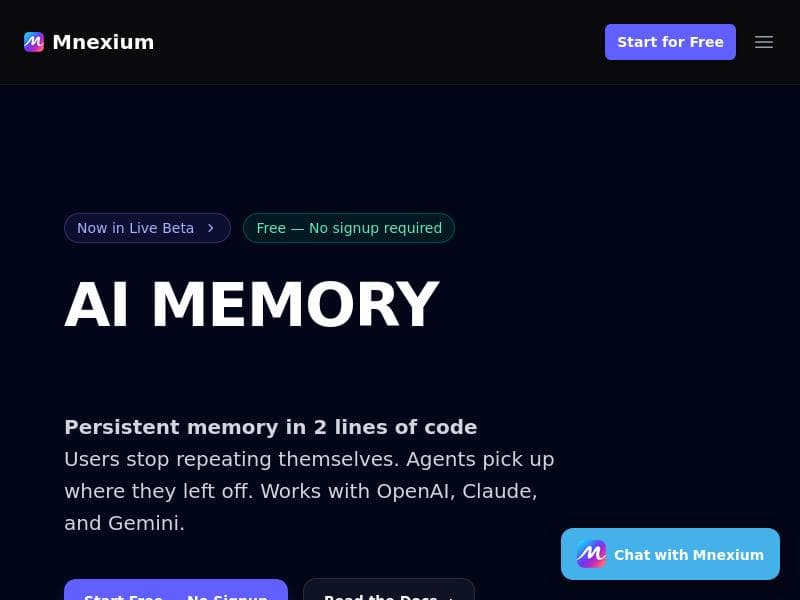
Mnexium AI empowers large language models with persistent, long-term memory through a simple API, eliminating the need for complex vector databases or retrieval pipelines. Ideal for developers building conversational AI and virtual assistants, it offers seamless chat history, semantic recall, and user memory across major AI providers.
Mnexium AI is a cutting-edge tool designed to enhance large language models (LLMs) by providing them with persistent, long-term memory capabilities. Unlike traditional approaches that rely heavily on vector databases, complex retrieval pipelines, or intricate logic to manage context, Mnexium AI simplifies this process with a straightforward API. By integrating a single mnx object into AI requests, developers can effortlessly enable chat history retention, semantic recall, and durable user memory. This persistent memory functionality allows AI applications to maintain context over extended interactions, improving coherence, personalization, and overall user experience. At its core, Mnexium AI focuses on storing, scoring, and recalling long-term context, which is critical for applications that require continuity across multiple sessions or interactions. Its schema-backed records system supports deterministic application data management, enabling precise control over stored information. The platform supports full CRUD (Create, Read, Update, Delete) operations on records within the model context, allowing dynamic and flexible data manipulation. Additionally, Mnexium AI can extract user profiles, manage agent states, and summarize chat conversations, all of which contribute to richer, more intelligent AI interactions. One of Mnexium AI’s standout features is its cross-provider memory compatibility. It seamlessly integrates with major AI providers such as OpenAI, Anthropic, and Google, ensuring that developers can maintain consistent memory functionality regardless of the underlying AI model. The tool also incorporates semantic memory search capabilities, enabling AI systems to retrieve relevant information based on meaning rather than just keywords. Memory decay and scoring mechanisms help prioritize and manage stored data effectively, ensuring that the most relevant context is surfaced during interactions. Mnexium AI is particularly well-suited for developers building conversational AI applications, virtual assistants, customer support bots, and any AI-driven system that benefits from maintaining long-term user context. Use cases include personalized tutoring systems that remember student progress, customer service agents that recall previous interactions, and complex multi-turn dialogue systems requiring stateful memory. Its simple API integration reduces development complexity, making it accessible for startups and enterprises alike. The pricing model for Mnexium AI is freemium, allowing users to start with a free tier to explore core functionalities before scaling up to paid plans that offer enhanced features and higher usage limits. This approach makes it easy for developers to experiment and validate the tool’s benefits without upfront costs. Compared to alternatives that often require managing separate vector databases or constructing elaborate retrieval pipelines, Mnexium AI stands out by abstracting these complexities away. Its schema-backed approach and built-in memory scoring provide a more deterministic and manageable way to handle AI memory. However, as a relatively specialized tool, it may not cover every niche use case requiring custom memory architectures, and users should evaluate its fit based on specific application needs. In summary, Mnexium AI offers a powerful, developer-friendly solution for adding persistent, semantic memory to AI applications. Its comprehensive feature set, cross-provider support, and simple API make it an attractive choice for anyone looking to build smarter, context-aware AI systems that remember and learn over time.

Description
Mnexium AI empowers large language models with persistent, long-term memory through a simple API, eliminating the need for complex vector databases or retrieval pipelines. Ideal for developers building conversational AI and virtual assistants, it offers seamless chat history, semantic recall, and user memory across major AI providers.
Mnexium AI is a cutting-edge tool designed to enhance large language models (LLMs) by providing them with persistent, long-term memory capabilities. Unlike traditional approaches that rely heavily on vector databases, complex retrieval pipelines, or intricate logic to manage context, Mnexium AI simplifies this process with a straightforward API. By integrating a single mnx object into AI requests, developers can effortlessly enable chat history retention, semantic recall, and durable user memory. This persistent memory functionality allows AI applications to maintain context over extended interactions, improving coherence, personalization, and overall user experience. At its core, Mnexium AI focuses on storing, scoring, and recalling long-term context, which is critical for applications that require continuity across multiple sessions or interactions. Its schema-backed records system supports deterministic application data management, enabling precise control over stored information. The platform supports full CRUD (Create, Read, Update, Delete) operations on records within the model context, allowing dynamic and flexible data manipulation. Additionally, Mnexium AI can extract user profiles, manage agent states, and summarize chat conversations, all of which contribute to richer, more intelligent AI interactions. One of Mnexium AI’s standout features is its cross-provider memory compatibility. It seamlessly integrates with major AI providers such as OpenAI, Anthropic, and Google, ensuring that developers can maintain consistent memory functionality regardless of the underlying AI model. The tool also incorporates semantic memory search capabilities, enabling AI systems to retrieve relevant information based on meaning rather than just keywords. Memory decay and scoring mechanisms help prioritize and manage stored data effectively, ensuring that the most relevant context is surfaced during interactions. Mnexium AI is particularly well-suited for developers building conversational AI applications, virtual assistants, customer support bots, and any AI-driven system that benefits from maintaining long-term user context. Use cases include personalized tutoring systems that remember student progress, customer service agents that recall previous interactions, and complex multi-turn dialogue systems requiring stateful memory. Its simple API integration reduces development complexity, making it accessible for startups and enterprises alike. The pricing model for Mnexium AI is freemium, allowing users to start with a free tier to explore core functionalities before scaling up to paid plans that offer enhanced features and higher usage limits. This approach makes it easy for developers to experiment and validate the tool’s benefits without upfront costs. Compared to alternatives that often require managing separate vector databases or constructing elaborate retrieval pipelines, Mnexium AI stands out by abstracting these complexities away. Its schema-backed approach and built-in memory scoring provide a more deterministic and manageable way to handle AI memory. However, as a relatively specialized tool, it may not cover every niche use case requiring custom memory architectures, and users should evaluate its fit based on specific application needs. In summary, Mnexium AI offers a powerful, developer-friendly solution for adding persistent, semantic memory to AI applications. Its comprehensive feature set, cross-provider support, and simple API make it an attractive choice for anyone looking to build smarter, context-aware AI systems that remember and learn over time.
Tool Features
- Long-term AI memory
- Conversation history persistence
- Schema-backed records for deterministic app data
- Record CRUD and retrieval in model context
- User profile extraction
- Agent state management
- Chat summarization
- Cross-provider memory (OpenAI, Anthropic, Google)
- Semantic memory search
- Memory decay and scoring
Frequently Asked Questions
What is Mnexium AI?
Mnexium AI is a platform that provides persistent long-term memory capabilities to large language models by storing, scoring, and recalling context through a simple API, enabling enhanced chat history, semantic recall, and durable user memory.
How much does Mnexium AI cost?
Mnexium AI offers a freemium pricing model, allowing users to access basic features for free with options to upgrade to paid plans for additional capabilities and higher usage limits.
Who is Mnexium AI best for?
Mnexium AI is best suited for developers and organizations building conversational AI applications, virtual assistants, customer support bots, and other AI systems that require persistent memory and context continuity.
What are the main features of Mnexium AI?
Key features include long-term AI memory, conversation history persistence, schema-backed records, record CRUD and retrieval within model context, user profile extraction, agent state management, chat summarization, semantic memory search, memory decay and scoring, and cross-provider memory support.
Does Mnexium AI offer a free trial?
Yes, Mnexium AI provides a free tier under its freemium pricing model, allowing users to try core features without any upfront cost.
What integrations does Mnexium AI support?
Mnexium AI supports cross-provider memory integration with major AI platforms including OpenAI, Anthropic, and Google.
How does Mnexium AI work?
Mnexium AI works by adding a single mnx object to AI requests, which enables the platform to store, score, and recall long-term context and chat history without requiring vector databases or complex retrieval pipelines, simplifying persistent memory management for AI applications.
Sponsored Tools































Reviews
No reviews yet. Be the first to share your experience.