Description
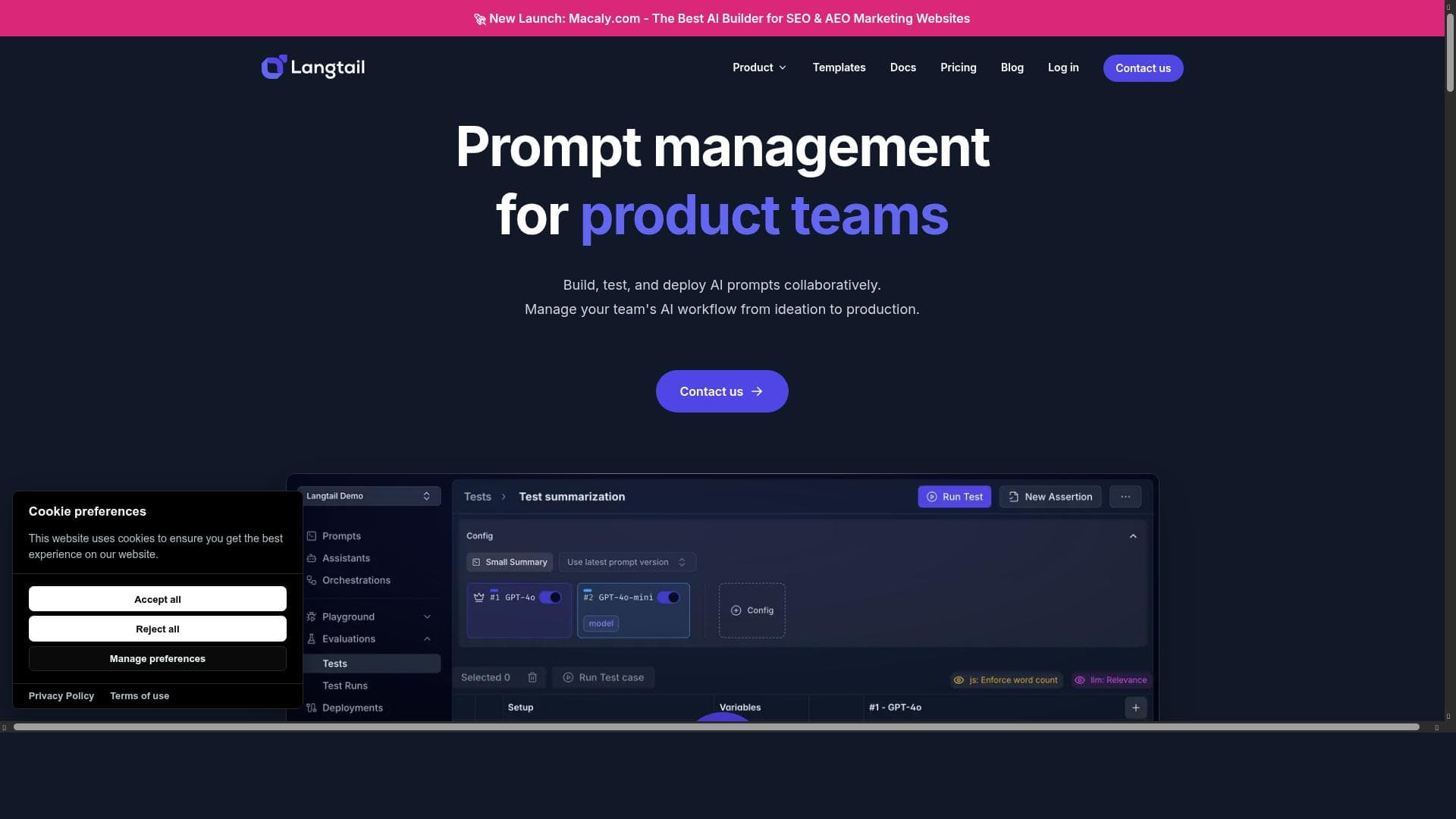
Langtail 1.0 revolutionizes LLM testing with its intuitive spreadsheet-like interface, enabling teams to score, optimize, and deploy AI prompts collaboratively and efficiently. Ideal for product teams and AI developers, it combines flexible scoring methods, version control, and seamless deployment to streamline the entire AI prompt workflow.
Langtail 1.0 is a specialized AI tool designed to simplify and enhance the process of testing large language models (LLMs) through an intuitive spreadsheet-like interface. Its core purpose is to enable product teams, AI developers, and prompt engineers to build, test, and deploy AI prompts efficiently while gaining deep insights from test results and analytics. By offering a familiar, tabular format for managing test cases and scoring outputs, Langtail 1.0 bridges the gap between complex LLM evaluation and user-friendly workflows, making it accessible even to those without extensive coding expertise. One of the standout features of Langtail 1.0 is its flexible scoring system. Users can evaluate LLM outputs using natural language criteria, pattern matching techniques, or custom code snippets, allowing for highly customizable and precise test assessments. This flexibility supports a wide range of testing scenarios, from simple correctness checks to complex behavioral evaluations. Additionally, Langtail 1.0 supports collaborative prompt engineering, enabling multiple team members to co-develop and refine prompts in real-time. This collaboration is further enhanced by built-in version control, which tracks prompt changes over time, ensuring that teams can manage iterations systematically and revert to previous versions if needed. Seamless deployment of AI prompts is another critical capability of Langtail 1.0. Once prompts are tested and optimized, teams can deploy them directly within their AI applications without switching platforms, streamlining the workflow from development to production. The tool also allows experimentation with different models, parameters, and prompt variations, empowering users to optimize LLM performance based on empirical test results. Comprehensive analytics and reporting features provide actionable insights, helping teams understand model behavior, identify weaknesses, and make data-driven improvements. Langtail 1.0 is best suited for product teams, AI researchers, prompt engineers, and developers who work extensively with LLMs and need a robust yet user-friendly environment for prompt testing and optimization. It is particularly valuable for organizations aiming to integrate AI-driven language capabilities into their products while maintaining high quality and reliability. Use cases include chatbot development, content generation, automated customer support, and any application requiring precise control over LLM outputs. Regarding pricing, Langtail 1.0 offers a freemium model, allowing users to access core features at no cost with options to upgrade for advanced capabilities and higher usage limits. This pricing strategy makes it accessible to startups and individual developers while scaling to meet enterprise needs. Compared to alternatives, Langtail 1.0 stands out due to its spreadsheet-like interface that lowers the barrier to entry for LLM testing, its comprehensive version control for prompts, and its end-to-end workflow integration from testing to deployment. While other tools may focus solely on prompt management or analytics, Langtail combines these elements with collaborative features and flexible scoring methods, delivering a more holistic solution. However, potential limitations include the learning curve associated with mastering advanced scoring techniques and the reliance on spreadsheet paradigms, which may not suit all users’ preferences. Additionally, while the freemium model is generous, some advanced features may require paid plans, which organizations should evaluate based on their scale and needs. Overall, Langtail 1.0 offers a powerful, user-centric platform for anyone looking to rigorously test and optimize LLM prompts within a collaborative and streamlined environment.

Description
Langtail 1.0 revolutionizes LLM testing with its intuitive spreadsheet-like interface, enabling teams to score, optimize, and deploy AI prompts collaboratively and efficiently. Ideal for product teams and AI developers, it combines flexible scoring methods, version control, and seamless deployment to streamline the entire AI prompt workflow.
Langtail 1.0 is a specialized AI tool designed to simplify and enhance the process of testing large language models (LLMs) through an intuitive spreadsheet-like interface. Its core purpose is to enable product teams, AI developers, and prompt engineers to build, test, and deploy AI prompts efficiently while gaining deep insights from test results and analytics. By offering a familiar, tabular format for managing test cases and scoring outputs, Langtail 1.0 bridges the gap between complex LLM evaluation and user-friendly workflows, making it accessible even to those without extensive coding expertise. One of the standout features of Langtail 1.0 is its flexible scoring system. Users can evaluate LLM outputs using natural language criteria, pattern matching techniques, or custom code snippets, allowing for highly customizable and precise test assessments. This flexibility supports a wide range of testing scenarios, from simple correctness checks to complex behavioral evaluations. Additionally, Langtail 1.0 supports collaborative prompt engineering, enabling multiple team members to co-develop and refine prompts in real-time. This collaboration is further enhanced by built-in version control, which tracks prompt changes over time, ensuring that teams can manage iterations systematically and revert to previous versions if needed. Seamless deployment of AI prompts is another critical capability of Langtail 1.0. Once prompts are tested and optimized, teams can deploy them directly within their AI applications without switching platforms, streamlining the workflow from development to production. The tool also allows experimentation with different models, parameters, and prompt variations, empowering users to optimize LLM performance based on empirical test results. Comprehensive analytics and reporting features provide actionable insights, helping teams understand model behavior, identify weaknesses, and make data-driven improvements. Langtail 1.0 is best suited for product teams, AI researchers, prompt engineers, and developers who work extensively with LLMs and need a robust yet user-friendly environment for prompt testing and optimization. It is particularly valuable for organizations aiming to integrate AI-driven language capabilities into their products while maintaining high quality and reliability. Use cases include chatbot development, content generation, automated customer support, and any application requiring precise control over LLM outputs. Regarding pricing, Langtail 1.0 offers a freemium model, allowing users to access core features at no cost with options to upgrade for advanced capabilities and higher usage limits. This pricing strategy makes it accessible to startups and individual developers while scaling to meet enterprise needs. Compared to alternatives, Langtail 1.0 stands out due to its spreadsheet-like interface that lowers the barrier to entry for LLM testing, its comprehensive version control for prompts, and its end-to-end workflow integration from testing to deployment. While other tools may focus solely on prompt management or analytics, Langtail combines these elements with collaborative features and flexible scoring methods, delivering a more holistic solution. However, potential limitations include the learning curve associated with mastering advanced scoring techniques and the reliance on spreadsheet paradigms, which may not suit all users’ preferences. Additionally, while the freemium model is generous, some advanced features may require paid plans, which organizations should evaluate based on their scale and needs. Overall, Langtail 1.0 offers a powerful, user-centric platform for anyone looking to rigorously test and optimize LLM prompts within a collaborative and streamlined environment.
Tool Features
- Collaborative prompt engineering
- Version control for AI prompts
- Seamless deployment of AI prompts
- Streamlined AI workflow
- Empowers product teams to build, test, and deploy AI prompts
Frequently Asked Questions
What is Langtail 1.0?
Langtail 1.0 is an AI tool designed to simplify testing and optimizing large language models (LLMs) using a spreadsheet-like interface. It allows users to score tests with natural language, pattern matching, or code, and supports collaborative prompt engineering, version control, and seamless deployment.
How much does Langtail 1.0 cost?
Langtail 1.0 operates on a freemium pricing model, providing free access to core features with options to upgrade for advanced functionalities and higher usage limits.
Who is Langtail 1.0 best for?
Langtail 1.0 is best suited for product teams, AI developers, prompt engineers, and researchers who need to build, test, and deploy AI prompts efficiently, especially those working on applications involving large language models.
What are the main features of Langtail 1.0?
Key features include a spreadsheet-like interface for LLM testing, flexible scoring methods (natural language, pattern matching, code), collaborative prompt engineering, version control for prompts, seamless prompt deployment, streamlined AI workflows, and detailed analytics for test results.
Does Langtail 1.0 offer a free trial?
Yes, Langtail 1.0 offers a freemium plan that allows users to access essential features at no cost, effectively serving as a free trial with the option to upgrade for additional capabilities.
What integrations does Langtail 1.0 support?
While specific integrations are not detailed, Langtail 1.0 supports seamless deployment of AI prompts within AI applications, suggesting compatibility with common LLM platforms and workflows. For precise integration options, users should consult the official website.
How does Langtail 1.0 work?
Langtail 1.0 works by providing a spreadsheet-like interface where users can input test cases and score LLM outputs using natural language criteria, pattern matching, or custom code. It enables collaborative prompt development with version control and allows users to experiment with different models and parameters to optimize AI prompt performance before deploying them directly.
Socials
Use ToolSponsored Tools


































Reviews
No reviews yet. Be the first to share your experience.