Codex Subagents
Description
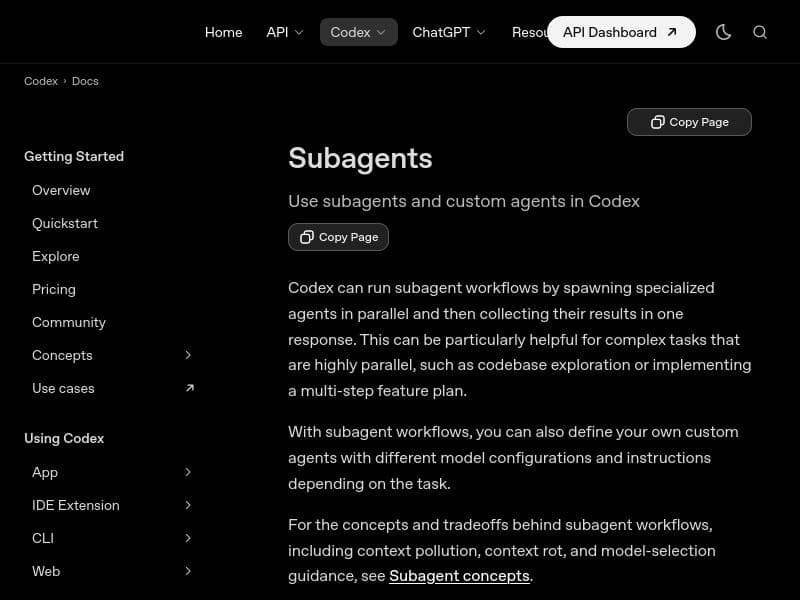
Codex Subagents revolutionizes AI-assisted coding by enabling the creation of specialized, parallel AI workers that collaborate on complex tasks without losing context. Ideal for developers and teams tackling multi-step workflows, it offers customizable, modular agents that streamline coding processes and improve efficiency—all available for free.
Codex Subagents is an advanced extension of OpenAI's Codex platform designed to enhance the efficiency and scalability of AI-assisted coding workflows. At its core, Codex Subagents enables developers to spawn multiple specialized AI workers, or "subagents," that operate in parallel with distinct, isolated roles. This modular approach allows complex programming tasks to be broken down into manageable components, each handled by a dedicated subagent. By defining these subagents through custom TOML configuration files, users can precisely tailor the behavior and responsibilities of each AI worker, such as explorers that gather information and reviewers that validate code quality. This architecture effectively mitigates the common problem of context rot—where an AI model loses track of earlier conversation or task context during multi-step processes—ensuring more reliable and coherent execution of intricate coding workflows. Key features of Codex Subagents include the ability to seamlessly integrate subagents within the Codex environment, empowering users to create custom agents with clearly defined roles and responsibilities. This flexibility supports the design of modular AI workflows that can be orchestrated to perform complex, multi-stage programming tasks such as code exploration, generation, review, and refinement. The use of TOML files for agent configuration provides a human-readable and easily maintainable method for specifying agent behavior, promoting transparency and adaptability. Additionally, the parallel operation of subagents allows for faster task completion and improved resource utilization, as different aspects of a coding project can be processed simultaneously without interference. Codex Subagents is particularly well-suited for software developers, engineering teams, and AI researchers who require sophisticated AI assistance for large-scale or multi-faceted coding projects. It benefits those looking to automate complex workflows that involve multiple stages of code analysis, generation, and validation. For example, a development team working on a large codebase can deploy explorer subagents to analyze different modules concurrently, while reviewer subagents ensure code quality and adherence to standards. This division of labor not only accelerates development cycles but also enhances code reliability. Furthermore, educators and coding bootcamps may find value in using Codex Subagents to demonstrate modular AI workflows and parallel task execution. In terms of pricing, Codex Subagents is currently offered free of charge, making it accessible for individual developers and organizations to experiment with and integrate into their existing Codex-powered applications. This free availability encourages widespread adoption and innovation around modular AI coding assistants without the barrier of upfront costs. When compared to alternative AI coding tools, Codex Subagents stands out due to its unique support for parallel, role-specific AI workers within a single workflow. While many AI coding assistants focus on single-threaded interactions or monolithic models, Codex Subagents introduces a level of modularity and specialization that improves task management and context retention. This makes it particularly advantageous for complex projects that require multi-step reasoning and collaboration between AI components. However, users should consider that the setup and configuration of custom TOML agents may require a learning curve, especially for those unfamiliar with defining AI roles or managing parallel workflows. Notable limitations include the current need for users to manually define and manage subagent configurations, which may introduce complexity for smaller projects or less technical users. Additionally, as a relatively new feature within the Codex ecosystem, community resources and third-party integrations may be limited compared to more established AI coding tools. Users should also be mindful of potential resource consumption when running multiple subagents in parallel, which could impact performance depending on their computing environment. Despite these considerations, Codex Subagents offers a powerful and flexible framework for enhancing AI-assisted coding through modular, parallel workflows that address many challenges inherent in multi-step programming tasks.

Description
Codex Subagents revolutionizes AI-assisted coding by enabling the creation of specialized, parallel AI workers that collaborate on complex tasks without losing context. Ideal for developers and teams tackling multi-step workflows, it offers customizable, modular agents that streamline coding processes and improve efficiency—all available for free.
Codex Subagents is an advanced extension of OpenAI's Codex platform designed to enhance the efficiency and scalability of AI-assisted coding workflows. At its core, Codex Subagents enables developers to spawn multiple specialized AI workers, or "subagents," that operate in parallel with distinct, isolated roles. This modular approach allows complex programming tasks to be broken down into manageable components, each handled by a dedicated subagent. By defining these subagents through custom TOML configuration files, users can precisely tailor the behavior and responsibilities of each AI worker, such as explorers that gather information and reviewers that validate code quality. This architecture effectively mitigates the common problem of context rot—where an AI model loses track of earlier conversation or task context during multi-step processes—ensuring more reliable and coherent execution of intricate coding workflows. Key features of Codex Subagents include the ability to seamlessly integrate subagents within the Codex environment, empowering users to create custom agents with clearly defined roles and responsibilities. This flexibility supports the design of modular AI workflows that can be orchestrated to perform complex, multi-stage programming tasks such as code exploration, generation, review, and refinement. The use of TOML files for agent configuration provides a human-readable and easily maintainable method for specifying agent behavior, promoting transparency and adaptability. Additionally, the parallel operation of subagents allows for faster task completion and improved resource utilization, as different aspects of a coding project can be processed simultaneously without interference. Codex Subagents is particularly well-suited for software developers, engineering teams, and AI researchers who require sophisticated AI assistance for large-scale or multi-faceted coding projects. It benefits those looking to automate complex workflows that involve multiple stages of code analysis, generation, and validation. For example, a development team working on a large codebase can deploy explorer subagents to analyze different modules concurrently, while reviewer subagents ensure code quality and adherence to standards. This division of labor not only accelerates development cycles but also enhances code reliability. Furthermore, educators and coding bootcamps may find value in using Codex Subagents to demonstrate modular AI workflows and parallel task execution. In terms of pricing, Codex Subagents is currently offered free of charge, making it accessible for individual developers and organizations to experiment with and integrate into their existing Codex-powered applications. This free availability encourages widespread adoption and innovation around modular AI coding assistants without the barrier of upfront costs. When compared to alternative AI coding tools, Codex Subagents stands out due to its unique support for parallel, role-specific AI workers within a single workflow. While many AI coding assistants focus on single-threaded interactions or monolithic models, Codex Subagents introduces a level of modularity and specialization that improves task management and context retention. This makes it particularly advantageous for complex projects that require multi-step reasoning and collaboration between AI components. However, users should consider that the setup and configuration of custom TOML agents may require a learning curve, especially for those unfamiliar with defining AI roles or managing parallel workflows. Notable limitations include the current need for users to manually define and manage subagent configurations, which may introduce complexity for smaller projects or less technical users. Additionally, as a relatively new feature within the Codex ecosystem, community resources and third-party integrations may be limited compared to more established AI coding tools. Users should also be mindful of potential resource consumption when running multiple subagents in parallel, which could impact performance depending on their computing environment. Despite these considerations, Codex Subagents offers a powerful and flexible framework for enhancing AI-assisted coding through modular, parallel workflows that address many challenges inherent in multi-step programming tasks.
Tool Features
- Use subagents in Codex
- Create custom agents
- Modular AI workflows
Frequently Asked Questions
What is Codex Subagents?
Codex Subagents is an extension of OpenAI's Codex platform that allows users to spawn multiple specialized AI workers, called subagents, which operate in parallel with isolated roles to handle complex coding tasks through modular workflows.
How much does Codex Subagents cost?
Codex Subagents is currently available for free, allowing developers and organizations to use and experiment with its features without any cost.
Who is Codex Subagents best for?
It is best suited for software developers, engineering teams, AI researchers, and educators who need to manage complex, multi-step coding workflows and want to leverage specialized AI agents working in parallel.
What are the main features of Codex Subagents?
Key features include the ability to use subagents within Codex, create custom agents with isolated roles via TOML configuration, and build modular AI workflows that enable parallel processing of coding tasks.
Does Codex Subagents offer a free trial?
Yes, Codex Subagents is offered free of charge, so users can access its full capabilities without needing a trial period.
What integrations does Codex Subagents support?
Codex Subagents integrates within the OpenAI Codex environment and supports custom agent configurations via TOML files, allowing it to be incorporated into existing Codex-powered coding workflows and applications.
How does Codex Subagents work?
Users define custom subagents with specific roles using TOML configuration files. These subagents then operate in parallel within Codex, each handling different parts of a complex coding task, which helps prevent context loss and enables multi-step workflows to be executed efficiently.
Socials
Use ToolSponsored Tools































Reviews
No reviews yet. Be the first to share your experience.