Description
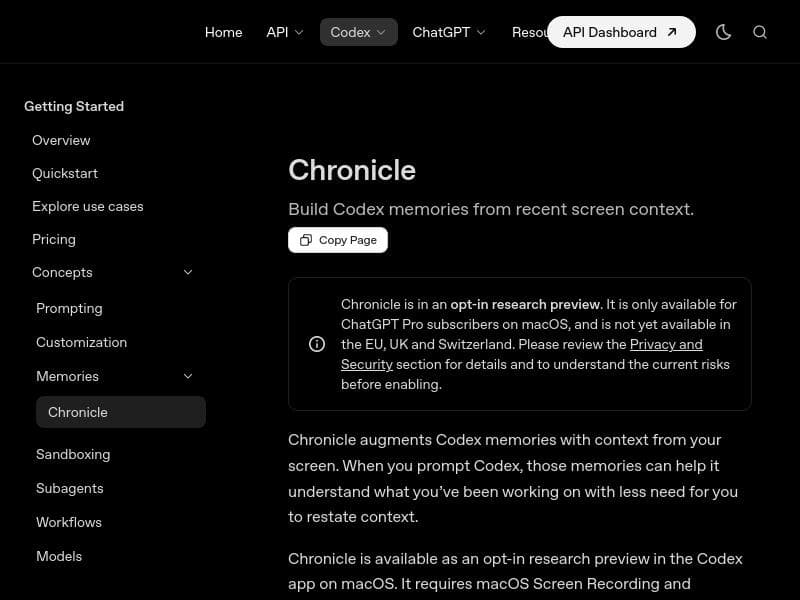
Chronicle uniquely enhances OpenAI's Codex by building dynamic memories from recent screen context, enabling more accurate and context-aware coding assistance. Ideal for developers and AI researchers, it streamlines workflows by providing Codex with richer, up-to-date contextual information—all offered free of charge.
Chronicle is an innovative AI tool designed to enhance the capabilities of OpenAI's Codex by building and maintaining contextual memories derived from recent screen content. Its core purpose is to provide Codex with a richer understanding of the user's current environment and workflow, enabling more accurate, relevant, and context-aware responses. By capturing and integrating recent screen context, Chronicle effectively extends Codex's memory beyond isolated prompts, allowing for a more seamless and intelligent coding assistant experience. At its heart, Chronicle focuses on constructing dynamic Codex memories from the user's immediate screen context. This means it continuously analyzes the visible information—such as code snippets, documentation, or other relevant data—and incorporates this into Codex's knowledge base. This process significantly enhances Codex's ability to generate responses that are not only syntactically correct but also contextually appropriate. Key features include the automatic extraction and integration of screen content into Codex's memory, which helps maintain continuity across coding sessions and reduces the need for repetitive context input. Additionally, Chronicle improves the overall accuracy and relevance of Codex-generated outputs by providing a richer, up-to-date contextual backdrop. Chronicle is particularly valuable for software developers, programmers, and AI researchers who rely heavily on Codex for code generation, debugging, and automation tasks. For developers working on complex projects or switching between multiple codebases, Chronicle ensures that Codex remains aware of the current context without manual intervention. This results in more efficient workflows, fewer errors, and a more intuitive interaction with AI coding assistants. Use cases include real-time code completion that respects the current project state, context-aware code refactoring suggestions, and improved natural language queries about existing code structures. One of the most attractive aspects of Chronicle is its pricing model—it is offered free of charge. This makes it accessible to individual developers, startups, and enterprises alike, encouraging widespread adoption and experimentation without financial barriers. Users can integrate Chronicle directly with their Codex-powered applications to immediately benefit from enhanced contextual memory capabilities. When compared to alternative tools, Chronicle stands out due to its seamless integration with Codex and its focus on leveraging recent screen context as a memory source. While other AI assistants may rely solely on prompt engineering or static context inputs, Chronicle dynamically updates Codex's memory, resulting in more fluid and contextually aware interactions. This approach reduces the cognitive load on users, who no longer need to manually provide extensive context for each query. However, unlike some comprehensive AI development platforms, Chronicle is specialized and does not offer a broad suite of AI services beyond Codex memory enhancement. Despite its advantages, users should consider certain limitations. Since Chronicle depends on capturing recent screen content, its effectiveness is tied to the quality and relevance of the visible information. In scenarios where the screen context is sparse or unrelated to the coding task, the memory built may be less useful. Additionally, privacy-conscious users should evaluate how screen data is processed and stored, ensuring compliance with organizational policies. Finally, as a free tool primarily designed to augment Codex, Chronicle may require technical familiarity with OpenAI's developer ecosystem for optimal integration and use. In summary, Chronicle is a powerful, free AI tool that significantly boosts Codex's contextual understanding by building memories from recent screen content. It is ideal for developers seeking smarter, context-aware coding assistance and offers a unique approach that differentiates it from other AI coding tools. While it has some contextual and privacy considerations, its benefits in improving accuracy and relevance make it a valuable addition to any Codex-powered development workflow.

Description
Chronicle uniquely enhances OpenAI's Codex by building dynamic memories from recent screen context, enabling more accurate and context-aware coding assistance. Ideal for developers and AI researchers, it streamlines workflows by providing Codex with richer, up-to-date contextual information—all offered free of charge.
Chronicle is an innovative AI tool designed to enhance the capabilities of OpenAI's Codex by building and maintaining contextual memories derived from recent screen content. Its core purpose is to provide Codex with a richer understanding of the user's current environment and workflow, enabling more accurate, relevant, and context-aware responses. By capturing and integrating recent screen context, Chronicle effectively extends Codex's memory beyond isolated prompts, allowing for a more seamless and intelligent coding assistant experience. At its heart, Chronicle focuses on constructing dynamic Codex memories from the user's immediate screen context. This means it continuously analyzes the visible information—such as code snippets, documentation, or other relevant data—and incorporates this into Codex's knowledge base. This process significantly enhances Codex's ability to generate responses that are not only syntactically correct but also contextually appropriate. Key features include the automatic extraction and integration of screen content into Codex's memory, which helps maintain continuity across coding sessions and reduces the need for repetitive context input. Additionally, Chronicle improves the overall accuracy and relevance of Codex-generated outputs by providing a richer, up-to-date contextual backdrop. Chronicle is particularly valuable for software developers, programmers, and AI researchers who rely heavily on Codex for code generation, debugging, and automation tasks. For developers working on complex projects or switching between multiple codebases, Chronicle ensures that Codex remains aware of the current context without manual intervention. This results in more efficient workflows, fewer errors, and a more intuitive interaction with AI coding assistants. Use cases include real-time code completion that respects the current project state, context-aware code refactoring suggestions, and improved natural language queries about existing code structures. One of the most attractive aspects of Chronicle is its pricing model—it is offered free of charge. This makes it accessible to individual developers, startups, and enterprises alike, encouraging widespread adoption and experimentation without financial barriers. Users can integrate Chronicle directly with their Codex-powered applications to immediately benefit from enhanced contextual memory capabilities. When compared to alternative tools, Chronicle stands out due to its seamless integration with Codex and its focus on leveraging recent screen context as a memory source. While other AI assistants may rely solely on prompt engineering or static context inputs, Chronicle dynamically updates Codex's memory, resulting in more fluid and contextually aware interactions. This approach reduces the cognitive load on users, who no longer need to manually provide extensive context for each query. However, unlike some comprehensive AI development platforms, Chronicle is specialized and does not offer a broad suite of AI services beyond Codex memory enhancement. Despite its advantages, users should consider certain limitations. Since Chronicle depends on capturing recent screen content, its effectiveness is tied to the quality and relevance of the visible information. In scenarios where the screen context is sparse or unrelated to the coding task, the memory built may be less useful. Additionally, privacy-conscious users should evaluate how screen data is processed and stored, ensuring compliance with organizational policies. Finally, as a free tool primarily designed to augment Codex, Chronicle may require technical familiarity with OpenAI's developer ecosystem for optimal integration and use. In summary, Chronicle is a powerful, free AI tool that significantly boosts Codex's contextual understanding by building memories from recent screen content. It is ideal for developers seeking smarter, context-aware coding assistance and offers a unique approach that differentiates it from other AI coding tools. While it has some contextual and privacy considerations, its benefits in improving accuracy and relevance make it a valuable addition to any Codex-powered development workflow.
Tool Features
- Build Codex memories from recent screen context
- Enhance Codex capabilities with contextual information
- Improve accuracy and relevance of Codex responses
Frequently Asked Questions
What is Chronicle?
Chronicle is an AI tool that builds and maintains contextual memories for OpenAI's Codex by capturing recent screen content, enhancing Codex's ability to provide accurate and relevant coding assistance.
How much does Chronicle cost?
Chronicle is available for free, allowing users to integrate it with their Codex-powered applications without any cost.
Who is Chronicle best for?
Chronicle is best suited for software developers, programmers, and AI researchers who use Codex for coding tasks and want improved context awareness and accuracy in AI-generated code.
What are the main features of Chronicle?
The main features include building Codex memories from recent screen context, enhancing Codex's capabilities with contextual information, and improving the accuracy and relevance of Codex responses.
Does Chronicle offer a free trial?
Chronicle is offered entirely for free, so there is no need for a separate free trial.
What integrations does Chronicle support?
Chronicle is designed to integrate directly with OpenAI's Codex platform, enhancing its memory capabilities by utilizing recent screen context.
How does Chronicle work?
Chronicle works by continuously capturing and analyzing the user's recent screen content, then building this information into Codex's memory to provide more contextually aware and accurate AI responses.
Socials
Use ToolSponsored Tools




































Reviews
No reviews yet. Be the first to share your experience.