Description
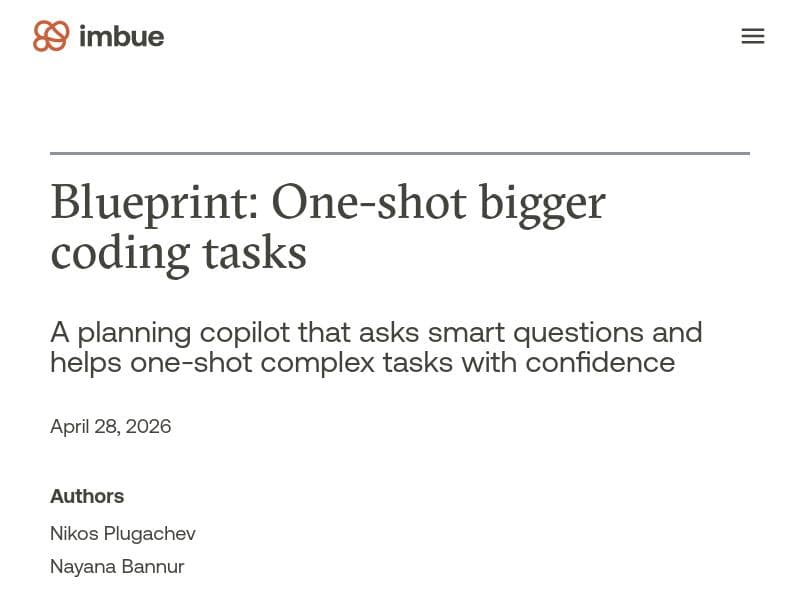
Blueprint revolutionizes AI-assisted coding by transforming ambiguous tasks into clear, executable plans through grounded questioning and code analysis. Ideal for developers handling complex codebases or multi-language projects, it ensures AI agents deliver precise results in one shot, boosting efficiency and reducing errors.
Blueprint is an innovative AI-powered tool designed to enhance the coding process by addressing a common challenge faced by coding agents: premature assumptions and rushed coding on ambiguous tasks. Traditional coding agents often jump to conclusions, creating code or plans that seem plausible but ultimately miss the user's true intent. Blueprint tackles this problem by thoroughly analyzing your existing codebase and generating grounded, relevant questions that clarify the task at hand. This approach ensures that any AI agent using Blueprint receives a well-formed, executable plan that aligns closely with the user's actual needs, reducing errors and rework. The core purpose of Blueprint is to bridge the gap between ambiguous user requests and precise code execution, enabling more reliable and efficient coding workflows. One of Blueprint's standout features is its ability to handle large coding tasks in a single, one-shot execution. This capability is particularly valuable for complex projects where iterative back-and-forth can be time-consuming. Blueprint also excels in agent-based code porting, allowing seamless translation of code between different programming languages and engines. This makes it an indispensable tool for developers working across diverse technology stacks or migrating legacy codebases. Additionally, Blueprint supports complex codebase translation, ensuring that even intricate dependencies and structures are correctly interpreted and adapted. For game developers, Blueprint facilitates integration with popular game engines like Godot, streamlining the process of adapting or extending game code. Overall, Blueprint improves efficiency in code adaptation by minimizing guesswork and maximizing clarity in task execution. Blueprint is best suited for software developers, AI researchers, and teams dealing with complex or ambiguous coding challenges. It is particularly beneficial for those involved in multi-language projects, codebase migrations, or game development, where precise understanding and translation of code are critical. Use cases include porting applications between languages, refactoring large codebases, integrating AI agents into development workflows, and enhancing productivity in game development environments. Its open-source nature and availability as extensions for popular editors like VS Code, Cursor, and Windsurf make it accessible and easy to integrate into existing development setups. Regarding pricing, Blueprint follows a freemium model. The core tool is free and open source, allowing developers to leverage its powerful capabilities without upfront costs. This approach encourages widespread adoption and community contributions. While the free tier offers substantial functionality, there may be premium features or enterprise-level support available through paid plans, although specific details are not explicitly stated. This pricing structure makes Blueprint an attractive option for individual developers and organizations looking to enhance their coding agents without significant financial investment. Compared to alternative coding assistant tools, Blueprint distinguishes itself by focusing on the planning and question-asking phase rather than just code generation. Many AI coding tools generate code directly from prompts, often leading to inaccuracies when the task is ambiguous. Blueprint's method of reading existing code and eliciting clarifying questions ensures that the AI agent receives a more accurate and executable plan. This reduces trial-and-error cycles and improves the quality of output. Furthermore, its support for complex codebase translation and integration with game engines sets it apart from more generic coding assistants that may lack these specialized capabilities. Despite its strengths, users should consider some limitations. Blueprint relies on the quality and completeness of the input code and context; insufficient information may still lead to suboptimal plans. Additionally, while it supports integration with several editors and platforms, users working outside these environments may face challenges incorporating Blueprint into their workflows. As an open-source project, ongoing development and community support are crucial for feature enhancements and bug fixes. Users should also be aware that the freemium model may limit access to advanced features unless they opt for paid plans. In summary, Blueprint is a powerful, open-source AI tool that enhances coding agents by improving task understanding through grounded questioning and precise planning. Its capabilities in one-shot task handling, code porting, and complex translation make it invaluable for developers facing ambiguous or large-scale coding challenges. With its accessible pricing and integration options, Blueprint offers a unique solution that elevates the effectiveness of AI-assisted coding workflows.

Description
Blueprint revolutionizes AI-assisted coding by transforming ambiguous tasks into clear, executable plans through grounded questioning and code analysis. Ideal for developers handling complex codebases or multi-language projects, it ensures AI agents deliver precise results in one shot, boosting efficiency and reducing errors.
Blueprint is an innovative AI-powered tool designed to enhance the coding process by addressing a common challenge faced by coding agents: premature assumptions and rushed coding on ambiguous tasks. Traditional coding agents often jump to conclusions, creating code or plans that seem plausible but ultimately miss the user's true intent. Blueprint tackles this problem by thoroughly analyzing your existing codebase and generating grounded, relevant questions that clarify the task at hand. This approach ensures that any AI agent using Blueprint receives a well-formed, executable plan that aligns closely with the user's actual needs, reducing errors and rework. The core purpose of Blueprint is to bridge the gap between ambiguous user requests and precise code execution, enabling more reliable and efficient coding workflows. One of Blueprint's standout features is its ability to handle large coding tasks in a single, one-shot execution. This capability is particularly valuable for complex projects where iterative back-and-forth can be time-consuming. Blueprint also excels in agent-based code porting, allowing seamless translation of code between different programming languages and engines. This makes it an indispensable tool for developers working across diverse technology stacks or migrating legacy codebases. Additionally, Blueprint supports complex codebase translation, ensuring that even intricate dependencies and structures are correctly interpreted and adapted. For game developers, Blueprint facilitates integration with popular game engines like Godot, streamlining the process of adapting or extending game code. Overall, Blueprint improves efficiency in code adaptation by minimizing guesswork and maximizing clarity in task execution. Blueprint is best suited for software developers, AI researchers, and teams dealing with complex or ambiguous coding challenges. It is particularly beneficial for those involved in multi-language projects, codebase migrations, or game development, where precise understanding and translation of code are critical. Use cases include porting applications between languages, refactoring large codebases, integrating AI agents into development workflows, and enhancing productivity in game development environments. Its open-source nature and availability as extensions for popular editors like VS Code, Cursor, and Windsurf make it accessible and easy to integrate into existing development setups. Regarding pricing, Blueprint follows a freemium model. The core tool is free and open source, allowing developers to leverage its powerful capabilities without upfront costs. This approach encourages widespread adoption and community contributions. While the free tier offers substantial functionality, there may be premium features or enterprise-level support available through paid plans, although specific details are not explicitly stated. This pricing structure makes Blueprint an attractive option for individual developers and organizations looking to enhance their coding agents without significant financial investment. Compared to alternative coding assistant tools, Blueprint distinguishes itself by focusing on the planning and question-asking phase rather than just code generation. Many AI coding tools generate code directly from prompts, often leading to inaccuracies when the task is ambiguous. Blueprint's method of reading existing code and eliciting clarifying questions ensures that the AI agent receives a more accurate and executable plan. This reduces trial-and-error cycles and improves the quality of output. Furthermore, its support for complex codebase translation and integration with game engines sets it apart from more generic coding assistants that may lack these specialized capabilities. Despite its strengths, users should consider some limitations. Blueprint relies on the quality and completeness of the input code and context; insufficient information may still lead to suboptimal plans. Additionally, while it supports integration with several editors and platforms, users working outside these environments may face challenges incorporating Blueprint into their workflows. As an open-source project, ongoing development and community support are crucial for feature enhancements and bug fixes. Users should also be aware that the freemium model may limit access to advanced features unless they opt for paid plans. In summary, Blueprint is a powerful, open-source AI tool that enhances coding agents by improving task understanding through grounded questioning and precise planning. Its capabilities in one-shot task handling, code porting, and complex translation make it invaluable for developers facing ambiguous or large-scale coding challenges. With its accessible pricing and integration options, Blueprint offers a unique solution that elevates the effectiveness of AI-assisted coding workflows.
Tool Features
- One-shot handling of large coding tasks
- Agent-based code porting between languages and engines
- Supports complex codebase translation
- Facilitates integration with game engines like Godot
- Improves efficiency in code adaptation
Frequently Asked Questions
What is Blueprint?
Blueprint is an AI-powered tool that enhances coding agents by reading your code, asking relevant clarifying questions, and providing a precise plan for the agent to execute, especially on ambiguous or complex coding tasks.
How much does Blueprint cost?
Blueprint operates on a freemium model, offering its core features for free as an open-source tool, with potential premium features or support available through paid plans.
Who is Blueprint best for?
Blueprint is ideal for software developers, AI researchers, and teams working on complex coding projects, codebase migrations, multi-language development, or game development requiring precise code adaptation.
What are the main features of Blueprint?
Key features include one-shot handling of large coding tasks, agent-based code porting between languages and engines, support for complex codebase translation, integration with game engines like Godot, and improved efficiency in code adaptation.
Does Blueprint offer a free trial?
Blueprint is free to use as an open-source tool, so there is no need for a trial; users can access and utilize its core capabilities without cost.
What integrations does Blueprint support?
Blueprint is available as agent skills or extensions for popular development environments such as Cursor, Windsurf, and Visual Studio Code, facilitating easy integration into existing workflows.
How does Blueprint work?
Blueprint works by analyzing your existing code, generating grounded questions to clarify ambiguous tasks, and producing a detailed, executable plan that AI agents can follow to deliver accurate coding results in one attempt.
Socials
Use ToolSponsored Tools






























Reviews
No reviews yet. Be the first to share your experience.