Agent Memory System
Description
Agent Memory System uniquely equips AI agents with a durable, structured memory layer that preserves context across evolving codebases and multiple AI assistants. Ideal for developers and teams leveraging AI in software projects, it ensures seamless collaboration, accurate code understanding, and efficient handoffs—all for free.
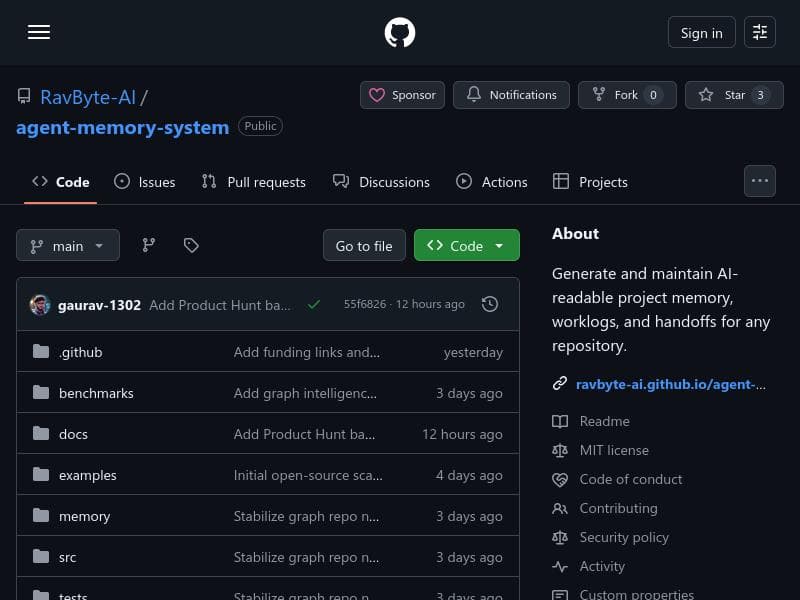
Agent Memory System is an innovative tool designed to enhance the functionality and efficiency of AI agents working within software repositories by providing a durable and structured memory layer. Its core purpose is to enable AI assistants to access a comprehensive understanding of a codebase before performing any tasks, thereby improving accuracy, reducing redundant work, and preserving context across different AI tools. By scanning the entire codebase, Agent Memory System generates a structured Markdown memory representation that is both human-readable and machine-readable. This memory layer acts as a persistent knowledge base that AI agents can consult to gain insights into the project’s structure, key components, and recent changes. Additionally, the system creates a machine-readable topic index that organizes the information logically, making it easier for AI agents to navigate and retrieve relevant data efficiently. One of the standout capabilities of Agent Memory System is its ability to track structural changes within the repository. This means that as the code evolves, the memory layer updates accordingly, ensuring that AI agents always work with the most current context. Moreover, it records handoffs between different AI assistants such as Antigravity, Codex, Claude, Cursor, or others, preserving the continuity of work and preventing loss of information when switching between tools. This feature is particularly valuable in collaborative environments where multiple AI agents may be involved in different stages of development or review. The key features of Agent Memory System include generating AI-readable project memory that captures the essence and structure of the repository, maintaining detailed worklogs that document changes and activities within the project, and facilitating seamless handoffs that allow multiple AI assistants to collaborate without losing context. These features collectively streamline the development process, reduce onboarding time for new AI agents, and enhance the overall quality of automated code analysis and generation. Agent Memory System is best suited for software development teams, AI researchers, and organizations that rely heavily on AI-driven coding assistants. It is particularly useful for projects with complex codebases or those that require frequent collaboration between different AI tools. Use cases include automated code review, continuous integration workflows, AI-assisted debugging, and knowledge management within large repositories. By providing a persistent memory layer, the tool helps teams maintain consistency and improve productivity when leveraging AI for software development. The tool is offered completely free of charge, making it accessible to individual developers, startups, and enterprises alike. This pricing model encourages widespread adoption and experimentation without financial barriers. Compared to alternatives, Agent Memory System stands out due to its focus on creating a durable, structured memory that is both human and machine-readable, its ability to track changes dynamically, and its support for cross-agent handoffs. While other tools might offer code analysis or AI assistance, few provide a persistent memory layer that integrates seamlessly with multiple AI assistants and adapts to evolving codebases. However, some considerations include the need for initial setup and integration within existing workflows, which may require technical expertise. Additionally, as an open-source project hosted on GitHub, users should evaluate community support and ongoing maintenance to ensure it fits their long-term needs. Overall, Agent Memory System represents a significant advancement in AI-assisted software development by bridging the gap between static code repositories and dynamic AI understanding, enabling smarter, context-aware automation.

Description
Agent Memory System uniquely equips AI agents with a durable, structured memory layer that preserves context across evolving codebases and multiple AI assistants. Ideal for developers and teams leveraging AI in software projects, it ensures seamless collaboration, accurate code understanding, and efficient handoffs—all for free.
Agent Memory System is an innovative tool designed to enhance the functionality and efficiency of AI agents working within software repositories by providing a durable and structured memory layer. Its core purpose is to enable AI assistants to access a comprehensive understanding of a codebase before performing any tasks, thereby improving accuracy, reducing redundant work, and preserving context across different AI tools. By scanning the entire codebase, Agent Memory System generates a structured Markdown memory representation that is both human-readable and machine-readable. This memory layer acts as a persistent knowledge base that AI agents can consult to gain insights into the project’s structure, key components, and recent changes. Additionally, the system creates a machine-readable topic index that organizes the information logically, making it easier for AI agents to navigate and retrieve relevant data efficiently. One of the standout capabilities of Agent Memory System is its ability to track structural changes within the repository. This means that as the code evolves, the memory layer updates accordingly, ensuring that AI agents always work with the most current context. Moreover, it records handoffs between different AI assistants such as Antigravity, Codex, Claude, Cursor, or others, preserving the continuity of work and preventing loss of information when switching between tools. This feature is particularly valuable in collaborative environments where multiple AI agents may be involved in different stages of development or review. The key features of Agent Memory System include generating AI-readable project memory that captures the essence and structure of the repository, maintaining detailed worklogs that document changes and activities within the project, and facilitating seamless handoffs that allow multiple AI assistants to collaborate without losing context. These features collectively streamline the development process, reduce onboarding time for new AI agents, and enhance the overall quality of automated code analysis and generation. Agent Memory System is best suited for software development teams, AI researchers, and organizations that rely heavily on AI-driven coding assistants. It is particularly useful for projects with complex codebases or those that require frequent collaboration between different AI tools. Use cases include automated code review, continuous integration workflows, AI-assisted debugging, and knowledge management within large repositories. By providing a persistent memory layer, the tool helps teams maintain consistency and improve productivity when leveraging AI for software development. The tool is offered completely free of charge, making it accessible to individual developers, startups, and enterprises alike. This pricing model encourages widespread adoption and experimentation without financial barriers. Compared to alternatives, Agent Memory System stands out due to its focus on creating a durable, structured memory that is both human and machine-readable, its ability to track changes dynamically, and its support for cross-agent handoffs. While other tools might offer code analysis or AI assistance, few provide a persistent memory layer that integrates seamlessly with multiple AI assistants and adapts to evolving codebases. However, some considerations include the need for initial setup and integration within existing workflows, which may require technical expertise. Additionally, as an open-source project hosted on GitHub, users should evaluate community support and ongoing maintenance to ensure it fits their long-term needs. Overall, Agent Memory System represents a significant advancement in AI-assisted software development by bridging the gap between static code repositories and dynamic AI understanding, enabling smarter, context-aware automation.
Tool Features
- Generate AI-readable project memory
- Maintain worklogs for repositories
- Facilitate handoffs for any repository
Frequently Asked Questions
What is Agent Memory System?
Agent Memory System is a tool that adds a durable, structured memory layer to software repositories, enabling AI agents to read and understand the codebase context before working. It scans code, generates Markdown memory, tracks changes, and facilitates seamless handoffs between different AI assistants.
How much does Agent Memory System cost?
Agent Memory System is completely free to use.
Who is Agent Memory System best for?
It is best suited for software development teams, AI researchers, and organizations that use AI-driven coding assistants and require persistent context and collaboration across multiple AI tools.
What are the main features of Agent Memory System?
Its main features include generating AI-readable project memory, maintaining detailed worklogs for repositories, tracking structural changes, and facilitating handoffs between various AI assistants such as Antigravity, Codex, Claude, and Cursor.
Does Agent Memory System offer a free trial?
Since Agent Memory System is free to use, there is no need for a trial period.
What integrations does Agent Memory System support?
Agent Memory System supports integration with multiple AI assistants including Antigravity, Codex, Claude, Cursor, and potentially others, enabling smooth handoffs and context preservation across these tools.
How does Agent Memory System work?
It works by scanning the codebase to generate a structured Markdown memory and a machine-readable topic index, tracking changes over time, and recording handoffs between AI agents to maintain context and continuity throughout the development process.
Socials
Use ToolSponsored Tools





































Reviews
No reviews yet. Be the first to share your experience.