
Últimas Noticias de IA

Workday Launches Work Intelligence to Help Companies Prepare Jobs for AI
The new tool provides a task-level view to help companies decide where AI can support work and where employees need to develop new skills.
View

IIT Kanpur to Invest in AI, Quantum Computing and Semiconductors Through $1 Bn Campaign
The campaign brings alumni, donors, companies and government partners together to fund these projects.
View

TCS Launches Industrial Intelligence Foundry for Manufacturing AI
The offering targets product development, production, asset performance and quality management, with TCS projecting productivity gains of up to 25%.
View

Gartner Warns $3.5 Trillion of AI Infra Spending Vulnerable to Diminishing by 2030-End
The research firm warns AI infrastructure spending could outpace revenue, which exposes trillions in assets to write-down risk and consolidates the neocloud market.
View

US-Based Reflect Orbital Books 2 Skyroot Launches for Its Spacecraft
The agreement expands Skyroot Aerospace’s commercial launch pipeline as Reflect Orbital develops satellite-based lighting services.
View

Figma Research Finds AI Speeds up Product Building, Raises Quality Concerns
A survey of more than 500 Indian respondents found growing adoption of design AI, faster workflows, and rising concerns about generic AI output.
View

The 20 Cypher 2026 Talks That Got People Talking
From Vijay Shekhar Sharma’s call to make India the LLM capital of the world to Sarvam AI’s land records breakthrough, 1,540 LinkedIn posts reveal the Cypher 2026 talks and ideas that resonated long after the event ended.
View
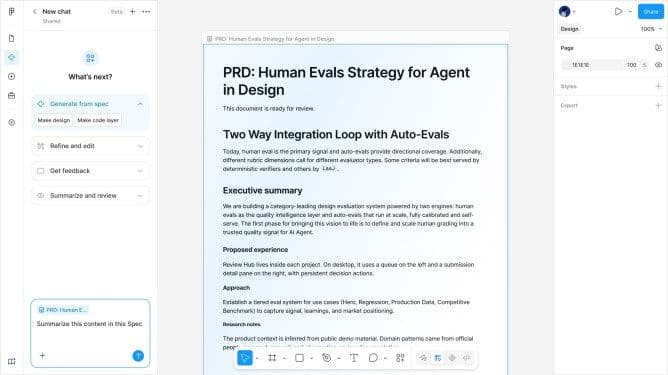
Figma announces new features to define how agents work on its platform
Design platform Figma announced a new Markdown-based editor to help define a company’s design, bring in design and code libraries, and integrate with the Payload headless content management system during the company’s first Config event in India. Through some of these features, the company aims to provide a definition for its own and third-party agents to adhere to a brand’s design rules better while creating with AI. The company debuted a new feature called Figma Specs, which is a markdown editor that lets users define their design language in a simple way. The document can serve as a reference for teams and agents while designing in Figma. Specs can exist as a standalone file in Figma or can co-exist within the canvas. Apart from acting as a text editor, users can reference other Figma elements, such as elements on the canvas and embed FigJam diagrams, code layers, and designs. What’s more, teams can bring in more context about design, including design libraries, code libraries, and guidelines to manage context for the design system. Agents can also refer to this centralized system to adhere to rules. In the past week, the company made its agent on canvas available to a wider user base. However, given the non-deterministic nature of AI, the company is providing tools to steer it towards more predictable outcomes. Figma also made its code layers feature, which adds coding to designs on canvas for more interactive prototypes. The companyannounced this featurein private beta back in June. At its India event this week, the company is making the function available in public beta to let more users test it out. Users can also ask the agent to turn a design into code or change a part of the code to iterate on a prototype. “We see Figma as the place where software teams come to decide what they build and ship. And so for that, I think one of the key things to keep in mind about what AI has changed and what it made available is the ability to build,” Figma’s chief design officer Loredana Crisan told TechCrunch. “There are 17-times more lines of code being produced today than in the past. But when you’re looking at releases, only 1.3-times more releases. A lot of that code actually is not necessarily built to ship, but really built to discover what the product is. It’s built to design.” The company said it is also supporting over 20 new tools with its MCP, including Open Code, Dia, Grok Bot, and Indian AI startup Sarvam. Last year, Figma acquiredopen-source headless CMS Payload. Now, the company is integrating it with its Figma Make product for generating dynamic websites and directly managing content. The company said that Payload’s downloads have increased sixfold in the last 12 months. The company opened itsfirst office in India late last year with sales, partnership, go-to-market, and product support functions. Figma said that the country is its biggest market in terms of users outside the United States. The company noted that the platform works with 40% of India’s top 100 companies listed on the Bombay Stock Exchange.
View

Figma Expands Into Coding, Hosting as CEO Rules Out Covering High-Traffic Bills
Figma said its new AI-powered tools will expand designers’ capabilities, while hosting costs could vary with traffic.
View

Gudea leverages AI to help organizations prevent social media crises before they erupt
Every day, conversations unfold across social media and websites around the world. A seemingly insignificant post—whether it involves AI-generated misinformation, hate speech, or a damaging rumor—can quickly snowball into a much larger public controversy. Gudea, a company that tracks how stories and rumors spread online that describes itself as the “storm tracker for the internet,” is using AI to help organizations spot trouble brewing online before it turns into a crisis. Unlike traditional social listening platforms, which only track metrics such as mentions, hashtags, and impressions, Gudea aims to show organizations who is driving a conversation, how information is moving, how quickly a story is gaining traction, and where it could be headed. Rather than simply tallying posts, its AI analyzes behavior, relationships, and the pathways through which information travels across more than 500 mainstream and fringe websites and platforms, including X, Reddit, and TikTok. Instead of simply telling a company that mentions are rising, Gudea aims to provide the context behind that growth so decision-makers can determine how and whether to respond. Gudea pitched its mission Wednesday afternoon on theStartup Battlefield stage at TechCrunch Disrupt 2026, where the company made the case that companies need to take a more proactive approach to protecting their reputations. “These big industries don’t understand that there are things they can do proactively to defend their reputation and their brand,” CEO and founder Keith Presley said. “A lot of the chief communications officers and chief media or marketing officers, they’re using legacy tools to try to figure out what’s happening. Those tools were only ever designed to tell you the number of hashtags or number of impressions.” Gudea was founded in 2023 by Presley, Jonathan Sperber, and James Thomin. Presley brings more than 15 years of experience spanning political campaigns and defense, including building the infrastructure for Andrew Yang’s presidential campaign. Sperber, the company’s chief strategy officer, has a background in disinformation research. Thomin, Gudea’s CTO, holds a Ph.D. in chemical engineering and has spent roughly two decades working in AI and machine learning. Presley called the company’s path to becoming a startup unusual. “We’re one of those weird startups where I never wanted to do a company,” he said. The team began with the George Washington Initiative, a nonprofit established after the 2020 election. The organization adapted strategies and tactics that the intelligence community has used overseas to disrupt online networks tied to groups such as Al Qaeda and ISIS. It applied them to domestic information campaigns. The goal was to identify the online environments where information campaigns were taking shape and disrupt the pathways that allowed those narratives to reach wider audiences. However, the team found that existing tools didn’t show how information was actually moving across people, groups and platforms. That gap became the opening for Gudea. Three years after its founding, Gudea has nearly 40 clients. According to Presley, its customer base includes a Fortune 50 telecommunications company, a Fortune 50 retailer, “one of the world’s largest AI labs, one of the world’s largest bands,” public relations and crisis communications agencies, and government agencies. With the rise of generative AI, Presley believes that the need for Gudea’s technology has only grown, as the company looks to expand its customer base. AI tools have dramatically lowered the cost and effort required to generate content and coordinate online campaigns. What once required a larger organization can increasingly be carried out by a single person with a laptop and access to the right software. “When we first started in 2021, and then as a company in 2023, we maybe saw one out of four things we looked at have inauthentic activity around it,” Presley said. “Now it’s probably nine out of ten things that we look at have this inauthentic activity.” Looking further ahead, Gudea plans to expand its ability to understand where narratives originate and how they spread. One major upcoming initiative is geolocation for narratives. Slated for next year, the technology is intended to allow users to identify where conversations are happening with far greater precision, down to the city-block level, Presley explains. The company also wants to give customers greater access to the tools behind its analysis. For example, a company could eventually run an advertising campaign through Gudea’s AI model before launching it and get a better idea of whether the strategy is likely to produce a negative outcome or not. Last week, Gudea announced that it had raised $7 million in seed funding in a round co-led by Mudita Venture Partners and Silicon Road Ventures. The investment brings the startup’s total funding to approximately $15 million.
View

Ricursive Intelligence is betting on AI-designed chips to help solve the compute crisis
Ricursive Intelligencefounders Anna Goldie and Azalia Mirhoseini believe more efficient AI chip design could help solve the compute crisis. The founders took the stage at TechCrunch Disrupt on Wednesday to detail how their startup is developing AI that can design chips, learn from each iteration, and improve subsequent designs, all with the goal of automating and accelerating the chip design process. “There is this understanding that in the next five years we are going to have at least 10,000x more demand for compute, and that’s somewhat potentially conservative,” Goldie said on stage. “So we don’t want to build 10,000 times more data centers. We think that we need to help by making chips that are more efficient, that use the bandwidth in those data centers more efficiently, that use the wafers and fabs more efficiently, because even if we make [data centers] in space or something, I don’t know, you won’t see the sun anymore.” While some may be scared by the thought of AI designing its own chips, Goldie argues that letting AI handle chip design will allow humans can focus on developing applications and exploring new possibilities that can expand what they can accomplish with computing. “I think the way everything is shifting is that humans come bring their great ideas and creative thoughts, and execution is handled by AI,” Goldie said. “And this is happening in chip design, software development, and other places. And that’s something that recursive does for chip design.” The founders say AI is challenging traditional chip design methods by discovering unconventional layouts that can outperform traditional ones. For example, AlphaChip, the AI system the founders previously developed, produced a circular, “donut-shaped” arrangement of chip components that initially surprised engineers but ultimately proved to be successful. They explained that they are optimizing entire chips rather than following the traditional approach of partitioning them into dozens of smaller blocks. This approach allows AI to create intricate patterns, including wave-like designs, which the pair said they plan to share more about in the future. The founders also argued that AI-designed chips will make it possible to create all sorts of chips that might not have been possible before. “If it takes six months or a year or two years to design a new chip, then you really have to be extremely selective about the chips that you design,” Goldie said. “But if you can design a chip in like a week, and then say for manufacturing, you can design custom chips for all sorts of different types of applications in like space and AR, VR, and you biological computing, and it makes sense financially to do that, and we can be more energy efficient.”
View

Apate sends AI agents undercover to get scammed so they can gather fraud intelligence
Most companies use AI agents to ship products faster or to speed up workflows.Apate.aisends them undercover to get scammed. Founded in 2024 on the basis of research done in Macquarie University in Sydney, the Australian startup deploys thousands of AI agents that masquerade as innocent victims. The agents can answer scam calls, respond to shady messages and emails, follow phishing links, and join social media groups to bait fraudsters. They pretend to be people of all stripes, sporting different ages, genders, and accents, and speak various languages as they try to keep scammers engaged long enough to learn something useful. The company says its fleet of agents has so far wasted 17 years of scammers’ time across 2.5 million conversations. More importantly for Apate’s customer base of banks, telecom companies, government agencies, and utilities, the undercover agents try to get scammers to reveal things about themselves that are usually learned onlyaftera victim has been scammed: bank accounts, crypto wallets, phone numbers, malicious websites, the brands they’re impersonating, and other details about the scams they’re running. Apate, one of the finalists at this year’s Startup Battlefield 200 at TechCrunch Disrupt, then feeds that information to its customers, who use it to inform their anti-fraud measures and initiatives. (The companywill pitch a panel of VC judges at Disrupt, which is taking place this week at Moscone West in San Francisco through Thursday, October 15.) It’s a curious evolution of scam-baiting, but it’s not so surprising given how much AI has empowered scammers and hackers. The FBIreceivedmore than 22,000 complaints of AI-related crimes in 2025, which resulted in about $893 million in losses. More than $632 million of that came from investment scams, in which the FBI says fraudsters use AI to run conversations, and deepfake the voices and appearances of celebrities, executives, and trusted figures. For a long time, people have made a hobby out of deliberately stringing scammers along — sometimes hilariously, like getting scammers toread aloud entire books, or even toget ridiculous tattoos. Now, with AI growing increasingly capable, the tables are turning. Curiously, the idea behind Apate was sparked by a real scam call. Several years ago, Apate’s founder and CEO Dali Kaafar was at a family picnic when he got a call from an unknown number. Realizing it was a scammer on the line, he decided to play dumb for the benefit of his kids and managed to keep the call going for 44 minutes. Everyone had a laugh, but Kaafar noticed that those were 44 minutes the scammer had not spent calling a real victim. It was also 44 minutes of his wasted time, which led him to wonder: Could he automate it, and in the process, learn something useful? That idea eventually led to research work at his job at Macquarie University, where Kaafar and his colleagues used machine learning and natural language processing to uncover the content of scam calls, and develop better ways to detect and prevent scams. “Most of the industry works after the fact. Telcos block numbers, but scammers just get new ones. Banks watch transactions, but by then the scammer has already reached the customer. We go to the scammer directly and get the information before anyone gets hurt,” Brad Joffe, co-founder and chief commercial officer, told TechCrunch. “Our AI agents talk to tens of thousands of scammers every day across calls, messages, email, and the web. What we offer our customers is what comes out of those conversations, and what they can do with it.” Joffe said Apate uses both frontier models and its own fine-tuned models to power its agents and analysis. The company trains its models on conversations its agents have had with scammers, as well as the research Kaafar did at Macquarie. In addition to access to Apate’s fleet of agents, customers get access to an insights portal that offers intelligence and analytics on scams targeting their end users or employees, brands, products, and more. Customers can even assign these agents particular missions, such as obtaining a bank account number or crypto-wallet address. Its text agents can search forums, investment groups, and social platforms for potential scam activity, and can then enter conversations with a fabricated identity to surface scammers’ details. The startup’s customers include Commonwealth Bank of Australia, TPG Telecom, as well as other utilities, telcos, and government agencies. Joffe said TPG has diverted nearly 590,000 calls to Apate’s agents, Commonwealth has seen a 76% drop in publicly reported scam losses, and an unnamed Australian bank the startup works with has used its outbound agents to disrupt 22 scam campaigns. Investors are betting there is money to be made from fooling scammers, too. Apate raised $8.15 million in seed funding in August from Lobby Capital, OIF Ventures, Investible, Concept Ventures, and Baobab Ventures. Joffe said the 20-person company has raised just under $10 million in total and plans to spend the latest round on its product and international expansion, including opening an office in London and building a larger presence in the U.S. “Apate is named after the Greek goddess of deception, which felt appropriate given what our agents do,” Joffe said, adding that the startup even features scammers swearing at the bots in its pitch material. “We track that as a sign of frustration and every swear word gets celebrated by us at Apate. We are probably one of the only businesses in the world that celebrates when people swear at our product.”
View
