
Latest AI News
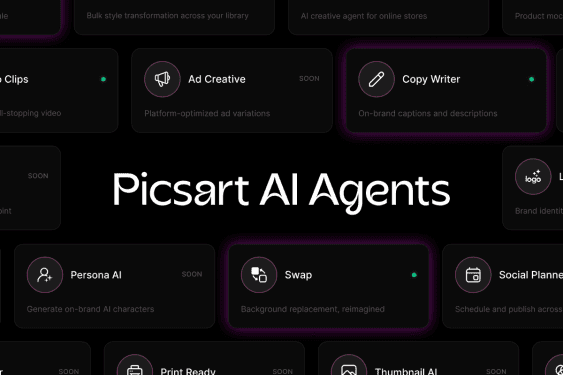
Picsart now allows creators to ‘hire’ AI assistants through agent marketplace
The AI-powered design platform Picsart is launching anAI agentmarketplace, allowing creators to “hire” AI assistants to help them with specific tasks, like resizing and remixing social content, or editing product photos on Shopify. With over 130 million worldwide users that skew Gen Z, Picsart is like a more advanced Canva for social media managers and content creators. The company reachedunicorn statusamid thecreator economy boomin 2021, but has remained relevant by continuing to ramp up its AI-powered products to serve the current market. The timing is good for Picsart to launch such a marketplace, since viral projects likeOpenClawhave fueled industry demand for agentic AI chatbots that can carry out requests like a personal assistant. “Creators have been stuck as the operator of every workflow — the one doing, not deciding,” said Hovhannes Avoyan, Picsart founder and CEO, in a statement. “Our Agents change that relationship — you set direction, the agent builds a plan using real data, you approve, it executes. Picsart says that it will introduce more specialized agents each week, but to start, creators can work with four different agents: Flair, Resize Pro, Remix, and Swap. The Flair agent is perhaps the most sophisticated of the bunch, integrating with Shopify to act as an assistant for online store owners. The agent analyzes market trends to make recommendations for how a shop could improve, like suggesting it edit product photos to look more cohesive. In a future update, Flair will be able to run A/B tests and identify underperforming products to proactively offer recommendations for how a creator can improve their sales. The Resize Pro agent can resize images and videos for the recommended dimensions on various different platforms, but it uses AI to generatively extend the frame if the original media isn’t conducive to a certain size. The AI supposedly will ensure that resized images look like they were composed intentionally and weren’t just cropped haphazardly. The Remix agent invites the creator to describe a style, like “vintage film,” “watercolor,” or “cyberpunk” and edit an existing photo library to fit within that theme, while the agent feature allows users to change the backgrounds of photos in bulk. For an agent like Flair, which is supposed to work behind the scenes asynchronously to analyze store data, it will be especially helpful that users can chat with these agents on WhatsApp or Telegram. Picsart integrates with those apps specifically since their APIs enable businesses to set up AI chatbots; but as more platforms add similar tools, the functionality could broaden. “As agents extend to messaging apps creators already use, that conversation happens anywhere — at your desk or from the subway,” added Avoyan. In some cases, AI agents can prove problematic, since any LLM-based software has the potential to hallucinate and could potentiallytake actionsthat the creator did not intend. But Picsart allows users to set “autonomy levels” for agents like Flair, which give the option of requiring creator approval before taking any action. These agents should also be less vulnerable toprompt injection attacksthan more public facing agents, assuming that Picsart doesn’t roll out agents that interact more directly with customers or the internet at large. Like many other AI tools, Picsart offers a free plan with just a few AI credits each week, but users can get significantly more capacity when paying for premium subscriptions, which start at about $10 per month when billed annually. To use an AI agent, you’ll probably need a paid plan.
View

NVIDIA’s 7-Chip Vera Rubin Platform in Full Production, Company Materialises Groq Deal
“Vera Rubin is a generational leap — seven breakthrough chips, five racks, one giant supercomputer,” said Jensen Huang.
View
OpenAI in Talks with Private Equity Firms to Form $10 Bn Joint Venture
The company’s enterprise business has reached an annualised revenue of about $10 billion.
View

The Forces Pushing Automobile GCCs in India Towards Digital Reinvention
Nearly 20% of these centres have been established in just the last three years, reflecting strong industry momentum.
View

Andrew Ng Builds a Stack Overflow for AI Coding Agents
Chub is designed for your coding agent to use (not for you to use!).”
View

Yotta, Gorilla Technologies Sign AI Infrastructure Deal Expected to Generate $500 Mn
Under the agreement, Yotta Data Services will operate 640 high-performance servers with more than 5,000 GPUs for AI workloads.
View

TCS Launches Rapid Outcome AI Platform With NVIDIA to Fast-Track Enterprise AI Adoption
The new platform blends generative, predictive and vision AI to move enterprises from pilots to production at scale.
View

Adobe, NVIDIA Partner to Develop Next-Gen Firefly Models for Creative Marketing
Adobe and NVIDIA will focus on developing next-generation Adobe Firefly models.
View

LTM Ties Up With IIT Kharagpur for Demand-Led AI Skilling of Workforce
Partnership combines training and research to build project-aligned AI capabilities across teams.
View

Memories AI is building the visual memory layer for wearables and robotics
Shawn Shen believes that AI will need to remember what it sees in order to succeed in the physical world. Shen’s companyMemories.aiis using Nvidia AI tools to build the infrastructure for wearables and robotics to be able to remember and recall visual memories. Memories.ai announced a collaboration with semiconductor giant Nvidia at its GTC conference on Monday. Through this partnership, Memories.ai uses Nvidia’s Cosmos-Reason 2, a reasoning vision language model, and Nvidia Metropolis, an application for video search and summarization, to continue to develop its visual memory technology. Shen (pictured above left) told TechCrunch that he and his co-founder and CTO, Ben Zhou (pictured above right), got the idea for the company while building the AI system behind Meta’s Ray-Ban glasses. Building the AI glasses got them thinking about how people would actually use the tech in real life if users couldn’t recall the video data they were recording. They looked around to see if they could find anyone already building that type of visual memory solution for AI. When they couldn’t, they decided to spin out of Meta and build it themselves. “AI is already doing really well in the digital world. What about the physical world?” Shen said. “AI wearables, robotics need memories as well. … Ultimately, you need AI to have visual memories. We believe in that future.” The ability for AI systems to remember, in general, is relatively new.OpenAI updated ChatGPT to start to remember past chats in 2024andfine-tuned that feature in 2025.Elon Musk’s xAIandGoogle Geminihave also launched their own memory tools in the past two years. But these advancements have largely focused on text-based memory, Shen said. Text-based memory is much more structured and easier to index but isn’t as helpful for physical AI applications that largely interact with the world through sight and visuals. Memories.ai was launched in 2024 and has raised $16 million thus far, through an $8 million seed round in July 2025 and an $8 million extension. The round was led by Susa Ventures and included Seedcamp, Fusion Fund, and Crane Venture Partners, among others. Shen said successfully building this visual memory layer required two things: building the infrastructure needed to embed and index videos into a data format that can be stored and recalled, and capturing the data needed to train the model to do just that. The company launched itslarge visual memory model (LVMM) in July 2025. Shen said it could be compared to a smaller version ofGemini Embedding 2, a multimodal indexing and retrieving model, that was released earlier this month. For data collection, the company created LUCI, a hardware device worn by the company’s “data collectors” that records video used to train the model. Shen said they don’t plan to become a hardware company, nor sell these devices, but, rather, that they built their own because they weren’t satisfied with off-the-shelf video recorders that focused on high-definition and battery-eating video formats. The company released the second generation of this LVMM and signed apartnership with Qualcommto run on Qualcomm’s processors starting later this year. Memories.ai is also working with some of the large wearable companies already, Shen said, but declined to disclose which ones. Despite some demand now, Shen sees even bigger opportunities in wearables and robotics yet to come. “In terms of commercialization, we are more focused on the model and the infrastructure, because ultimately we think the wearables and robotics market will come, but it’s probably just not now,” Shen said.
View

Warren presses Pentagon over decision to grant xAI access to classified networks
Sen. Elizabeth Warren (D-MA) sent aletterto Defense Secretary Pete Hegseth on Monday expressing concern over the Pentagon’s decision to give Elon Musk’s company xAI access to classified networks. “Grok, the controversial AI model developed by xAI, has provided disturbing outputs for users, including giving users ‘advice on how to commit murders and terrorist attacks,’ generating antisemitic content, and creating child sexual abuse material,” the letter reads. Warren said Grok’s “apparent lack of adequate guardrails” could pose “serious risks to the safety of U.S. military personnel and to the cybersecurity of classified systems.” She demanded Hegseth provide information on how the Department of Defense plans to “mitigate these potential national security risks.” Warren isn’t the first to express alarm at Grok, xAI’s controversial chatbot, gaining access to classified systems. Last month, acoalition of nonprofits urgedthe government to immediately suspend the deployment of Grok infederal agencies, including the DoD, after X users repeatedly prompted the chatbot to turn real photos of women, and in some cases children, intosexualized imageswithout their consent. The same day Warren sent her letter, a class action lawsuit was filed against xAI alleging Grok had generated sexual content from real images of the plaintiffs as minors. The letter comes in the aftermath of the Pentagon’s decision tolabel Anthropic a supply chain riskafter the AI firm refused to give the military unrestricted access to its AI systems. Anthropic had been, until recently, the only AI company with classified-ready systems. In the midst of that conflict, the DoD signed anagreement with OpenAIas well as xAI to use the two companies’ AI systems in classified networks, according toAxios. A senior Pentagon official confirmed that Grok was onboarded to be used in a classified setting, but is not yet being used. “It is unclear what assurances or documentation xAI has provided to the Department of Defense about Grok’s security safeguards, data-handling practices, or safety controls, and whether DoD has evaluated those assurances before reportedly allowing Grok access to classified system,” Warren writes. Warren requested a copy of the deal reportedly reached between the DoD and xAI on the use of Grok in classified systems and an explanation of how the department plans to ensure Grok is not exposed to cyberattacks and will “not leak sensitive or classified military information.” (Last week, a former employee of Musk’s Department of Government Efficiency reportedlystoleAmericans’ personal data from the Social Security Administration and stored it on a thumb drive — the latest accusation ofDOGE-related data leakage.) Chief Pentagon spokesperson Sean Parnell said the department “looks forward to deploying Grok to its official AI platform GenAI.mil in the very near future.” GenAI.milis the military’s secure enterprise platform for generative AI that gives DoD workers access to large language models (LLMs) and other AI tools within government-approved cloud environments. It is designed to help with primarily non-classified tasks like research, document drafting, and data analysis.
View

Jensen Huang just put Nvidia’s Blackwell and Vera Rubin sales projections into the $1 trillion stratosphere
Nvidia CEO Jensen Huang threw out a lot of numbers — mostly of the technical variety — during his keynote Monday to kick off the company’s annualGTC Conferencein San Jose, California. But there was one financial figure that investors surely took notice of: his projection that there will be $1 trillion worth of orders for Nvidia’s Blackwell and Vera Rubin chips, a monetary reflection of a booming AI business. About an hour into his keynote, Huang noted that last year Nvidia saw about $500 billion in demand for its Blackwell and upcoming Rubin chips through 2026. “Now, I don’t know if you guys feel the same way, but $500 billion is an enormous amount of revenue,” he said. “Well, I’m here to tell you that right now where I stand — a few short months after GTC DC, one year after last GTC — right here where I stand, I see through 2027, at least $1 trillion.” The Rubin computing chip architecture, which was first announced in 2024, has been described by Huang as the state of the art in AI hardware that outperforms its Blackwell predecessor. The companysaid in January, when it officially started production of Rubin, it would operate 3.5x faster than the Blackwell architecture on model-training tasks and 5x faster on inference tasks, reaching as high as 50 petaflops. Nvidia has said it expects to ramp up production in the second half of the year.
View