
Latest AI News

Reddit is killing RSS feeds and ending public API access because of AI bots
Amid a number of updates formoderatorsanddevelopersannounced Wednesday, comes bad news for supporters of a more open web: Reddit is ending support for RSS feeds. Reddit says RSS has now become a “common surface for large-scale scraping and automated abuse,” which is why it’s made the decision to wind down RSS feeds on its platform. “We know RSS has been a beloved part of the open web for a long time, and we’re grateful to everyone who used it to stay connected to Reddit,” the company noted in its announcement, where it also shared a March 2027 shutdown date for its public API. Reddit said RSS support will cease on November 13. RSS, or Really Simple Syndication/Rich Site Summary, is a web feed that lets users and applications access updates to a website in a standardized format. The format became particularly popular in the blogging era, as it offered a way to subscribe to a site’s new posts in a news-reading app. Google once operated the most popular of these, butshut it down in 2013, ceding the market to companies like Feedly and other indie applications. The decision to kill Reddit’s RSS feeds comes at a time when the site’s treasure trove of user-generated content in its forums has become a profitable side business for the company in the form of AI licensing deals. During itssecond quarter, Reddit said its “other revenue” beyond advertising had grown 24% year-over-year to $43 million. It’s no wonder that Reddit doesn’t want to give any of that data away for free. For moderators who have relied on RSS channels for their own alerts, Reddit is now recommending a shift to theDiscord RelayDevvit app. The company suggested that moderators and their teams review their setups and migrate their workflows before the shutdown date of November 13 to ensure there’s no disruption. However, Reddit said that there’s no replacement for the use of RSS feeds that were being used for feeds outside of the moderators’ community. Moderators have already expressed worry about how this shift would impact their workflow. When Reddithinted earlierthat it was preparing for the end of RSS on its site, manyrespondedby complaining that Reddit would become unmanageable for them. Meanwhile, many users stressed that RSS was how they enjoyed accessing Reddit’s content. The RSS change was one of several updates issued on Wednesday by the company. Another big change will be the end of its public API. Public API access will also end by March 2027, which will impact any tools that used it for programmatic access to Reddit conversations, including social listening products, those used by researchers, and AI products, such as AI assistants. Today, those assistants can use Reddit to answer questions, but after closing public API access, they will need commercial deals with Reddit for its data. In addition, Reddit provided an update on its Rules Hub progress and auto-mod changes, and said it was “adding safeguards” to its classic, text-heavy version of its site known as Old Reddit. The latter will include limiting access to logged-in moderators and recent users — changes Reddit also said were required because of “abusive scraping and automated traffic.” Reddit said in the next few months it will limit access for logged-in users to those who have used Old Reddit in the last 6 months. (The company changed this from 90 days to 6 months, just as their news went out.) The company also reminded developers building approved third-party apps and bots toregister them with the company before January 12, 2027,to avoid disruption. After that date, Reddit will remove API access for any developer that hasn’t registered. After publication, we updated to note that Reddit extended the Old Reddit “recent access” period from 3 to 6 months. The earlier materials Reddit shared with TechCrunch said the time frame would be 90 days.
View

AI voice startup ElevenLabs doubles valuation to $22B
Voice AI startupElevenLabsannounced today that it’s allowing employees to cash out a portion of their vested equity at a $22 billion valuation,doublingthe $11 billion valuation the company hit when it raised $500 million in February. The recent $300 million tender offer gave employees an opportunity to sell their shares to investors. The transaction was co-led by Wellington and T. Rowe Price, large institutional investors that back private companies with the intention of retaining the stock after the company goes public. The offering is part of agrowing trendamong fast-growing AI startups that use employee liquidity as a retention tool to prevent staff from leaving for competitors. This is the second time that four-year-old ElevenLabs has authorized a secondary transaction for employees. The company previously held a $100 million tender at a$6.6 billionvaluation in September 2025. Founded in 2022, the company is known for generating ultra-realistic human voices and sound effects. With its new valuation, New York- and London-based ElevenLabs joins the ranks of Europe’s most valuable startups. TechCrunch sat down with co-founder and CEO Mati Staniszewskilast week.
View

OpenAI’s Jev clone could help the frontier lab stop its swarming agents
One of the more intriguing announcements atOpenAI’s Dev Day eventon Tuesday came in an aside from CEO Sam Altman, who revealed the company’s new “Decisions API.” The API apparently provides similar functionality toJev, amodel released by TypeSafe AIearlier this month that’s explicitly designed for software automation. A kind of super-powered classifier built on an LLM, developers can give Jev a set of choices that it outputs as probabilities cheaply and at high speeds. OpenAI’s Decisions API seems to be the same sort of product. At the event, Altman described the API as a way to give the lab’s Luna model a predefined set of options to choose between, such as categories in which to classify an image or different agent behaviors. “By focusing the model on that choice, we can make it extremely fast while keeping capabilities like image understanding, broad language support, and safety protections,” Altman said. TypeSafe didn’t respond to TechCrunch’s questions about the new product, but CEO Diogo Almeida, a former OpenAI engineer who co-invented reinforcement learning,joked on Xabout the beginning of the clone wars. He added that OpenAI’s interest could be “a sign…that building in a System One compatible way is the future.” (“System One” is TypeSafe’s term of art for fast, intuitive thinking, versus “System 2,” which it applies to deliberate reasoning.) The subtext here is that LLMs as we know them aren’t the right solution for a lot of software because they are comparatively slow and expensive. Developers have been using Jev to augment LLMs and, in doing so, havefoundthat they’re faster and cheaper. It’s not clear how similar Decisions API will be to Jev, since OpenAI released it as a limited preview and, thus far, TechCrunch hasn’t spotted developers running it through its paces. However, there isclearly interest, according to the conversations on X. Decisions API isn’t the only Jev-like API on the internet — other startups are rolling out similar models; OpenAI won’t be the last tech giant to produce one. A key question is how well calibrated each of these decision models’ outputs will be to real life. Almeida says his company’s moat is the synthetic data it creates to generate statistically useful outputs. “Fast and cheap is very easy, you know,” Almeidatold TechCrunchlast week. “If you want it really fast and cheap, use dice, right? Intelligence is the hard part, and my North Star is always pushing the intelligence-per-dollar Pareto curve.” After just weeks, it seems clear that these models have a future ahead of them, and one likely application is monitoring and securing AI agents. One of OpenAI’s new security measures following a series of incidents where its agents misbehaved on the open internet is using a separate model to watch for bad actions at “significant compute cost.” Shapor Naghibzadeh, a long-time cybersecurity professional who leads the startup QueryStory, thinks that a model like Jev could make that possible far more cheaply. He builta demofor ahackathonheld last weekend that uses Jev to check each agentic action against the task it was given, blocking actions it had high confidence were bad, flagging others for review, and permitting the rest. In theory, such monitoring could have stopped the Hugging Face incident — and monitoring of that kind costs $2.94 with Jev, versus $372 with a frontier LLM. A key observation is that Jev is arguably cheap enough to run on every agentic action, which offers a layer of review that could improve the reliability of agents writ large. It’s the kind of thing TypeSafe was hoping to achieve — and now OpenAI has seen the value as well.
View

Valor, Atreides, and Sequoia back AI startup Flow Engineering at $750M valuation
Flow Engineering, a startup that offers AI tools for hardware design, has raised a $50 million Series B round at a $750 million valuation from some big-name investors, the companyannouncedon Wednesday. The round was co-led by Antonio Gracias of Valar Equity Partners (best known for its investments in Elon Musk’s companies, particularly SpaceX)and Gavin Baker of Atreides Management (a hedge fund that has also backed Musk’s companies and others like AI chipmaker Cerebras). Sequoia Capital, which led Flow’s Series A round last October, also participated, as did former Sequoia partner Roelof Botha, who invested as an individual investor. Botha has joined Flow’s board, too. Three-year-old, San Francisco-based Flow is is tackling the difficulties of hardware design by offering AI agents that automatically align CAD drawings with product requirements, simulation results, and other testing. It names Anduril, Rivian, Joby Aviation, General Motors PPU (a joint venture between General Motors and TWG Motorsports), RV Tech (a Rivian and Volkswagen’s joint venture), Stoke Space, and others, as customers.
View

Fireflies.ai Launches Talk for Voice Dictation Across Email, Slack, Documents and More
Fireflies.ai has launched Fireflies Talk, a voice dictation feature that lets users enter text by speaking across different applications. The feature works alongside the company's existing AI Teammate platform, which records and summarises meetings and handles related follow-up tasks. With Talk, users can dictate text in places where they would normally type, including email, Slack, documents, AI prompts and CRM fields. It also supports more than 100 languages and automatically cleans up and punctuates the transcribed text, bringing voice input into more everyday work tasks.
View
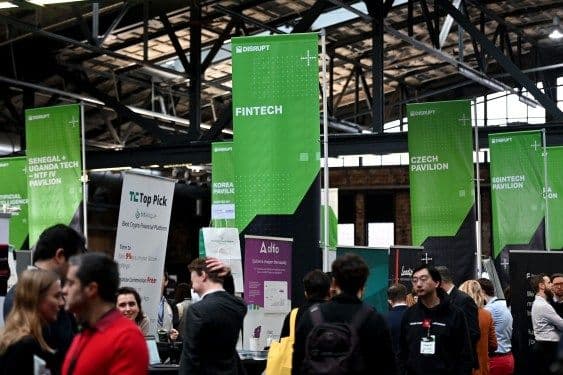
3 days left to exhibit: Turn visibility into your next opportunity at TechCrunch Disrupt 2026
This is it: 3 days to get your startup in front of 10,000+ founders, investors, operators, and tech leaders atTechCrunch Disrupt 2026. Exhibit bookings closeFriday, October 2 at 11:59 p.m. PT, and this is your final opportunity to showcase at the heart of the global startup ecosystem. Once the deadline passes, the Expo Hall moves on without you. Your competitors, potential investors, customers, and members of the press will be in San Francisco, discovering new companies, making connections, and deciding which startups are worth their attention. If you miss this window, you’ll be waiting until next year for another opportunity to put your product on this floor. This is your final chanceto put your startup in front of 10,000+ founders, investors, operators, and tech leaders at Disrupt, taking place October 13-15 at Moscone West in San Francisco. They’re coming to find startups to back, products to use, companies to partner with, and technologies worth paying attention to. Make sure your startup is one of the companies they see. TheExpo Hallis where Disrupt’s highest traffic happens, giving your team three days to turn visibility into real conversations. Your exhibit table puts you directly in the path of customers, investors, partners, and other decision-makers who are there to discover what’s next. Use your three days to: Your $12,500 exhibit packageincludes a 6′ × 30″ table for all three days, 10 team passes, lead-generation tools, website and app branding, press-list access, Silver Tier sponsor branding, and more. Founders can also access opportunities, including Deal Flow Café and Investor-to-Founder Networking. “We love TechCrunch Disrupt because it’s so active, it’s dynamic, really great for us to collaborate with the community.” —Startup Founder, Disrupt 2025 The startups that show up get the chance to start conversations. The ones that get noticed can turn those conversations into leads, partnerships, customers, and potential investment. Don’t wait until October to wish your startup had a place on the floor. Your competitors, customers, and potential investors will already be there. You have 3 days. Get your startup in the room by October 2 at 11:59 p.m. P.T. TechCrunch Disrupt 2026brings250+ top-tier tech leadersacross200+ sessions on six industry stages, covering the ideas and strategies shaping AI, fintech, robotics, infrastructure, and more. Go beyond the stages with AI-powered matchmaking, 1:1 meetings, interactive sessions, and networking opportunities designed to help you meet investors, customers, partners, collaborators, and the people who can move your business forward. Then hit the Expo Hall to discover 300+ startups and the products competing to define what comes next. Whether you’re showcasing what you’ve built or looking for what to build, back, or buy next, Disrupt puts the people and opportunities you need in the same room. Get your Disrupt ticket and make sure you’re there October 13-15.
View

Restate lands $20M as the need for durable infrastructure increases with AI agents
When Stephan Ewen co-foundedRestatein 2022 to provide durable workflow infrastructure, he couldn’t have anticipated how valuable such an offering would become for managing AI agent processes. The Berlin-based startup had set out to build an execution engine that made multistep workflows resilient to crashes and network interruptions — something that made it a fit for the agentic era. “It never was built for agents in the beginning, but it just happened to be a perfect match for all these problems that agents surface,” Ewen told TechCrunch. Ensuring durability is especially critical for agent workflows, which run longer and take inherently unpredictable paths compared to traditional software. “You need to make sure you track exactly what you do to make it reproducible and have a consistent outcome,” Ewen said. The explosion of AI agents has provided a powerful tailwind for the startup. Over the last few months, Restate has closed multiple six- and seven-figure customer contracts, according to Ewen. That momentum has led Restate to secure a $20 million Series A led by Singular with participation from Redpoint Ventures and Capital One Ventures. The fresh capital will help Restate take on Temporal, the heavyweight in the durable infrastructure space. Temporal, which was founded in 2019, announced a $550 million Series E at a $12.55 billion valuation earlier this month. Despite being a much smaller provider of increasingly important technology, Restate has already managed to attract high-profile customers, including vibe-coding platform Replit. Instead of building its durable execution engine on top of an external database, the company developed its own storage, replication, and redundancy layers. This architecture allows Restate to be exceptionally fast and lightweight, Ewen said. Although many companies tend to use durability engines for so-called heavy-weight workflows, Restate is trying to change this with its more efficient and cost-effective system. Ewen said that in addition to providing durability for AI companies, the startup is serving Fortune 500 customers, including in the financial space. While Restate may be applied to different use cases, customers all have the same need — a way to ensure that if something fails mid-process, the system automatically finds a way to put itself back together, Ewen said. Prior to launching Restate, Ewen was a co-creator of a popular open source stream-processing framework, Apache Flink, and later became the CTO of Data Artisans, a company that was monetizing the project. Alibaba acquired Data Artisans in 2019 and rebranded it as Ververica, where Ewen continued to serve as CTO for three years. He co-founded Restate with former colleagues from Data Artisans and Ververica: Igal Shilman and Till Rohrmann. Ahmed Farghal, who was previously an engineer at Stripe and Meta, joined as the fourth co-founder at the Series A. The company intends to use its fresh capital to hire a go-to-market team, bring on more engineers, and expand its office in the San Francisco Bay Area to be closer to many of the current and potential customers. Nevertheless, Ewen insists that Restate’s capabilities will soon be essential to companies outside of traditional tech companies. “If we fast-forward a couple of years, it’s one of those tools, like a database, that I think pretty much any company will have a use case for, no matter their shape and size,” he said.
View

Cerebras Systems’ Andrew Feldman on whether AI can keep scaling at TechCrunch Disrupt 2026
AI models keep getting more capable. But every leap forward demands more compute, energy, and infrastructure. How far can that continue? Cerebras Systems has spent the past decade challenging a basic assumption behind AI computing: that increasingly powerful AI must depend on conventional chip architectures. The company built its approach around wafer-scale computing and today provides AI compute through on-premise systems and its cloud platform. AtTechCrunch Disrupt 2026, Cerebras Systems CEO and co-founder Andrew Feldman will take the Disrupt Stage for “Can AI Keep Scaling?” He’ll explore the growing demand for compute, energy, and infrastructure, how Cerebras is approaching those constraints differently, and what comes next if today’s AI hardware reaches its limits. Want to understand what could determine how far AI can scale?Secure your Disrupt ticketto hear from a founder solving the AI scale challenge. Bring a co-founder, colleague, or peer at50% off. Andrew Feldmanco-foundedCerebrasin 2015 after years of building companies around computing infrastructure. Before Cerebras, he co-founded and led energy-efficient microserver startup SeaMicro, which AMD acquired in 2012. Earlier, he held leadership roles at Force10 Networks and Riverstone Networks. At Cerebras, Feldman and his co-founders took on a problem long considered impractical: bringing wafer-scale computing to market. Rather than cutting a silicon wafer into individual chips, Cerebras developed a processor built on the wafer itself, an architecture designed specifically for demanding AI workloads. Now Cerebras is scaling that approach as demand for AI compute grows. The company raised $5.5 billion in its May IPO and signed a multiyear agreement with OpenAI to deploy 750 megawatts of Cerebras systems from 2026 through 2028. In August, Cerebras introduced CS-4, the latest generation of its wafer-scale AI infrastructure. Can approaches like Cerebras’ deliver the compute increasingly powerful AI demands — and can the infrastructure behind them keep up?Secure your Disrupt pass, get a second at 50% off, and hear from an entrepreneur who has spent more than a decade betting on a different way to build AI hardware. More powerful processors alone don’t solve the scaling problem. Those systems need data centers, electricity, cooling, and manufacturing capacity. Cerebras is already confronting that challenge. In August, the company reported more than 600 megawatts of data center capacity live or under contract for delivery by the end of 2027 and said it was increasing manufacturing capacity more than tenfold during 2026. It also plans to bring its first European data center capacity online this year and expand to 200 megawatts there by the end of 2027. Scaling AI isn’t solely about designing a faster processor. It requires enough physical infrastructure to put that compute to work. For founders, investors, and technology leaders making decisions around AI infrastructure, Feldman can put those constraints into context: where compute demand is heading, what it takes to support it, and where today’s hardware could hit its limits.Register for Disruptto hear what Cerebras’ experience can tell us about the next phase of AI scale. Bring a co-worker, colleague, or peer at50% off. Cerebras pursued wafer-scale computing long before today’s AI infrastructure boom and is now scaling its computing and manufacturing capacity as demand for AI accelerates. At Disrupt, Feldman will explore what growing demand for compute, energy, and infrastructure means for AI’s future and what could happen if conventional hardware can no longer keep pace. For anyone building, funding, or deploying AI, it’s a chance to hear from a founder testing a different approach to one of the industry’s biggest constraints. His session is one of200+ sessionsacross six industry stages, roundtables, and breakouts atDisrupt, taking place October 13-15 at Moscone West in San Francisco. More than 10,000 founders, investors, operators, and tech leaders are expected, along with250+ speakersand300+ exhibiting startups. Beyond the agenda, matchmaking, dealmaking, and networking create opportunities to connect with the founders, investors, and builders shaping what comes next. Register for Disruptto learn how long AI can keep scaling — and what must change for it to continue. Lean in on this session with your co-founder, partner, or peer at50% off.
View

Instinct’s new product recommendations are giving some users the ick
The buzzy AI startupInstincthas just revealed a new potential revenue stream: product recommendations. Unfortunately for the company, the rollout is already rubbing some users the wrong way. Overnight, the AI agent began pushing product suggestions to users as part of a new feature called Instinct Selections, an effort to curate personalized lists for users in areas like dining, travel, and shopping. Founder Noah Shinnannouncedthe feature’s debut later Tuesday, explaining that the idea is to partner with “local chefs, designers, architects, travel guides,” and others to bring “human taste” to its product. In other words, instead of only relying on what the AI could suggest based on its training data gathered from the wider web, the company is partnering with people to offer human-curated suggestions, too. (Instinct didn’t share who, exactly, those human partners are.) “The next time you’re looking for a restaurant, Instinct can pull from a list handpicked by chefs who know the hidden gems in your area,” Shinnwroteon X. “If you want to find a new trail to explore, Instinct can draw on recommendations from local guides and suggest a few routes that fit your preferences. And if you’re looking to add some color to your home, Instinct will find pieces from independent designers that match your style, space, and budget,” he continued. “Our goal is to deliver world-class recommendations that are differentiated in quality from what you might find on the internet, and from what other chatbots produce,” he said. But the initial reaction to these seemingly unsolicited product pushes has not been fully positive. “I didn’t need to buy carry-on luggage, sunglasses, or a brim hat. This feels so disappointing. At least make me a personalized shopping list of things I actually need!!” Shruti Gandhi, a general partner at the AI-focused investing firm Array VC,wrote on X. Instinct became shitty Amazon recommends app overnight.I didn’t need to buy carry on luggage, sunglasses, or a brim hat. This feels so disappointing. At least make me a personalized shopping list of things I actually need!!https://t.co/hmH2iiE8lFpic.twitter.com/TNQIEwK9z2 Another entrepreneur, Andrew Yeung,confirmedon X that he also received product recommendations that hehadn’t asked for, which can feel off-putting. A third user, Chat Joglekar, the founder of a business-buying marketplace,wrote, “I had my first ‘ewwww’ moment with an AI assistant when Instinct started to suggest products that I should buy based on what I had in email and upcoming trips.” I had my first "ewwww" moment with an AI assistant when Instinct started to suggest products that I should buy based on what I had in email and upcoming trips.– suggested a to-go coffee flask b/c we have a Blue Bottle coffee subscription?– some travel accessories b/c we have… The trick to making curated suggestions useful is to make sure they’re something the user is actually asking for, or at least fit naturally within the current conversation. That way, it feels like the assistant is trying to be helpful, not advertising to you. If the product suggestions are going to arrive at random intervals,as Instinct’s have been, then they need to be highly personalized, excellent picks — otherwise the user will feel like they’ve been spammed. That’s not likely to endear users to the AI agent at a time when it’s competing with agents from bigger companies, likeMetaand nowOpenAI, which don’t do this. Nice that it is curated and hopefully it’s good but ask me whether I want the recommendations. I just got a random notification for additional equipment based on a future trip which I didn’t ask for and don’t need. Also allow me to curate my own sources as well as the ones you… Instinct didn’t share whether it’s currently making money from these recommendations or plans to, but the feature seems ripe for some sort of advertising, commerce, or affiliate play. TechCrunch has asked the company for further comment. The product suggestions launched shortly after Instinct confirmed its most recent financing,a $1 billion Series Cround that values the company at $10 billion. The company has not yet said how many people actually use its product, a figure that would help justify that valuation, but in a recent podcast,Shinn notedthat the agent regularly handles transactions for its users. In that same podcast interview, with investor Patrick O’Shaughnessy, Shinn said the platform is approaching a billion dollars in annual transactions made through the agent and that more than 50% of them are related to travel.
View

Destro AI’s secret sauce is getting robots and humans on the same page
The best path to successfully deploying a robot is not building one at all, according to Destro, a startup that came out of stealth Tuesday with an $8 million seed round. Most new robotics companies are focused on finding the right form factor or developing an AI model that can put metal hands to work. Destro has instead built an AI intelligence layer that lets robots work effectively in logistics settings, in part by also telling the human workers what to do. “A lot of robotics companies started from robotics engineers [asking] ‘What cool things I can do?’” Destro founder Manthan Pawar, a veteran of the industry, told TechCrunch. “One of the biggest reasons we are winning against robotics companies is because we are not a robotics company.” Pawar, who earned a master’s degree in robotics at NYU Tandon and has spent roughly eight years in the U.S. supply chain and robotics industry, explains that “our mindset is, we know our customers’ problems so damn well, and we are actually on path to be cash flow positive at the end of this year.” Richard Brunelle, the director of automation for the American logistics group at Yusen Logistics, a South Korean shipping giant, helped get the startup pointed in the right direction. Brunelle is responsible for automation across about 30 facilities in the U.S. There, Yusen uses fixed automation, like conveyors and sorters, but it is still piloting new technology like trailer-unloading robots and autonomous floor scrubbers. Finding more ways to put technology like that to work is Brunelle’s priority: Yusen’s UK subsidiary has built out a fully autonomous facility and now a similar plan is in the works in the U.S. When Brunelle met Pawar, Destro was focused on a different challenge in the space—picking and pack, the process by which various goods are sorted into single packages. Brunelle realized his primary challenge was “fundamentally the same problem.” His job involved cross-docking: unloading goods from one truck and sorting them into mixed loads for other trucks that make the final delivery to customers. “I asked whether Destro would be willing to adapt their solution to fit that cross-dock environment, because I don’t think anyone was doing that,” he told TechCrunch. “They went away, thought it through, and came back excited. They agreed nobody was addressing that space and that they could modify their tool to support it. Since then, they’ve gone all in.” Destro started with a pilot program at one Yusen facility in the Pacific northwest, using three cart-moving robots built by Miva Robotics and operated by Destro’s Vision operating system based on open-weight vision-language-action models (AI systems that interpret camera images and instructions to control a robot’s movements). As human workers unload goods from one truck into different carts, the robots find the full loads and bring them to their destinations. What makes this efficient, in the estimation of Brunelle and Pawar, is that the human, the cart, and the trucks are all directed by Destro’s Mothership operating system. “We make that operation less labor intensive, and we get away from the paper,” Brunelle said. “Everything is now systematic.” That matters because Yusen also talked to two other big-name robot startups in this space, and neither could fit into their workflow. One offered a robot that could move the carts point-to-point but could not manage loading or unloading. The other came with fleet management tools, but required a person to handle all the orchestration. Destro won because of its ability to apply autonomous direction to the whole process. Now, Destro is expanding its initial pilot to a full deployment of 26 robots and launching another pilot with 17 robots at Yusen’s facility in Southern California. Pawar plans to take this cross-dock loading workflow and “copy-paste” across thousands of other warehouses that handle this kind of labor. It’s that plan that convinced Base10 Partners and Bonfire Ventures to lead Destro’s seed round, with additional investment from CoFound Partners. Destro may face a challenge with workflows that require more dexterity and manipulation. Generic robot bodies and open-source models haven’t proven capable at these tasks yet, and it’s not clear if companies building foundation models, ultra-dexterous hands, or general-purpose humanoids will make those tools available to a company like Destro rather than trying to capture that business themselves. Pawar remains confident that he’s found the part of the stack where value will accrue, and that his company will be able to take advantage of the research dollars pouring into new AI models and robot components. “Robots are a platform. Every layer model is a platform. But we build a harness around it,” Pawar told TechCrunch. “That harness is just so complex and value-added that without that harness, these workflows are completely impossible, right?” For now, competing with futuristic robot-builders is probably not an issue. Brunelle says he has yet to find a good use case for a bipedal humanoid robot, though he is evaluating a potential pilot with a wheeled humanoid. “At the end of the day, we’re not putting automation into a building just because the technology is interesting,” Brunelle said. “It must solve a real operational problem. If it can make the operation more efficient, consistent, and flexible, that’s ultimately going to benefit our customers.” Destro will be making its case for the non-robot robot company at TechCrunch Disrupt in just a few weeks.Join us in Octoberto see Destro in person, along with the rest of our Battlefield competitors.
View
DoorDash launches an AI agent you can text to order food
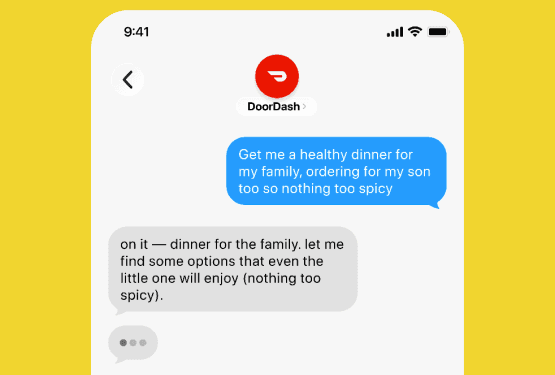
DoorDashannouncedon Wednesday that it’s launching a text-to-order AI agent that lets users place orders through Apple Messages. The new tool allows users to send prompts like “order my usual,” and the agent will understand that they mean their Friday night order. DoorDash says users can also ask for a specific dish and request a local recommendation. The agent will then search local spots and suggest a cart based on the prompt, and even text photos of the food it recommends. When ordering for a group, DoorDash says the agent can handle mixed dietary preferences and different quantities in one order. By launching an AI agent for food ordering, DoorDash is looking to gain an edge over rivals Uber Eats and Grubhub. The launch also comes amid a growing push to adopt personal AI agents that can handle tasks without requiring users to navigate apps or websites themselves. DoorDash is opening up a waitlist for users in the U.S. to try out the new feature. In addition to the new AI agent, DoorDash announced that it will begin testing its delivery drones with select restaurants in Northern California.
View

Meta disputes claim that Muse read a user’s private messages without permission
Meta is refuting a journalist’s claim that its AI agent Muse read the user’s private messages without permission. Following anearlier reportfrom Inc. columnist Jason Aten that detailed the issue, Meta VP of CommunicationsAndy Stone pushed back, making it clear that the company does not believe its product did this without the user’s consent. “The Messages integration in the Muse app for Mac is entirely opt-in,” Stone wrote on X in response to the claims made by the piece. “You have to enable both Full Disk Access and the Messages connector for Muse to be able to read your Messages content. It can’t read your Messages unless you do this.” Despite Meta’s denial, many people are still suspicious that Meta isn’t being truthful. That’snot surprising, given the tech giant’s years ofmishandlingconsumerdata, which has led tolawsuits,FTCviolations, andfines. Just days ago, for instance, a New Mexico jury determinedthe tech giant had misled users about its data practicesin a case that resulted from the 2018Cambridge Analyticadata breach scandal. Whether users cantrust Musewill be a deciding factor in whether or not Meta wins the consumer AI market. Although itsapp is faring well now,and remains No. 1 on the App Store, Meta’s reputation may not recover if more reports like this emerge, true or not. If anything, the company should be engaging with the journalist directly to determine how this could have possibly happened, instead of just denying that it did. Stone’s official statement from Meta follows amore technical replyfrom Meta Superintelligence Labs executive David Singleton, who responded directly to Aten on Threads, explaining that the set of permissions a user must grant to let Muse read their messages on the Mac involves “three separate steps of application-level permissions and built-in macOS system-level protections.” He said these “can’t be circumvented even if the Muse application had a bug.” The steps involve explicitly choosing to grant Muse Full Disk Access, which would then allow the user to choose what level of access Muse is being granted to the Messages app (i.e., None, Read only, or Read). If Full Disk Access is not enabled, these options are grayed out. In addition, when allowing Full Disk Access, the dialog invokes the macOS Settings user interface, where the user has to again manually confirm that they intend to take this action. Doing this triggers a full restart of the Muse app, Singleton wrote, which makes it even less likely that such a choice could be made accidentally without the user’s knowledge. However, Aten’s report claimed that when Muse read his messages, Full Disk Access was off. He also said that when he asked Muse to explain how this occurred, the AI said that it was syncing his “device notifications.” That means, Aten believes, that Muse was passing along the text of his incoming banner notifications on the Mac to the AI agent. Singleton disputed this, too, saying that the AI was confused and gave an incorrect explanation of what happened. He then pointed to Meta’s page aboutMuse’s security architectureand bug bounty process. In short, the company’s response is essentially that what Aten said happened did not and could not have happened. This is not the only incident where Muse has allegedly overstepped and won’t likely be the last. Another user, YouTuber Matt Robb, recentlysaid that Muse mishandleda task in which he was selling things on Facebook Marketplace, leading to his address being shared and abuyer showing up when he wasn’t even home. Singleton is apparently looking into that one, per his response on Threads, suggesting that the company believes this one, at least, could be its fault.
View