
Latest AI News

Edge AI for ASHA Workers: Neonatal Care in Rural India Gets a Tech Upgrade
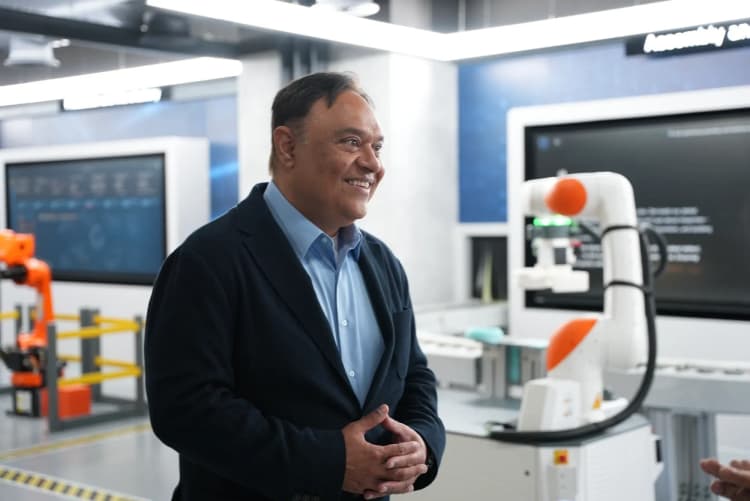
Developed by Wadhwani AI, Shishu Mapaan uses video and AI to estimate anthropometric metrics of newborns, enabling faster, more accessible frontline care.
View

Why Wall Street wasn’t won over by Nvidia’s big conference
When Nvidia CEO Jensen Huang took the stage for hisannual GTC keynoteon Monday, the $4-trillion-dollar company’s stock started to drop. Wall Street investors, it seems, were unmoved by the leather jacket-clad founder’s bullish 2.5-hour speech. Instead, they placed more weight on AI’s uncertain future and fears of a bubble. The nervousness felt by Wall Street couldn’t be more different than the buzzy atmosphere in Silicon Valley, where confidence, not uncertainty abounds. Huang talked for more than two hours about the company’s latest innovations, from newvideo game graphics techandupdated networking infrastructureto autonomous vehicle deals and a new chip designed with Groq to accelerate AI inference in the Vera Rubin system. He also threw out some eye-watering numbers about Nvidia’s business and beyond. Huang called the AI agent ecosystem a $35 trillion market and the physical AI and robotics industry a $50 trillion market. Huang also said he expects to see$1 trillion worth of purchase ordersfor the company’s Blackwell and Vera Rubin chips — just two of Nvidia’s many products — by the end of 2027. Shouldn’t that make investors excited? It’s not surprising that they aren’t, Futurum CEO Daniel Neuman told TechCrunch. “[AI] is so good, so transformational, and moving so fast that we don’t actually understand what it’s going to mean for all the things that are the societal constructs that we’ve come to understand,” Neuman said. “The markets hate uncertainty. The speed of innovation has actually created a great new uncertainty that I think most people never expected.” Some of that uncertainty comes from misleading information coming out of the market, Neuman said, who added that headlines about low enterprise adoption of AI aren’t painting the full picture — at least, based on conversations he’s having. “Enterprise AI adoption is going to hit inflection and scale very quickly,” Neuman said. “I actually think it’s happening. When you say it’s not, I think what you’re probably saying is the [return on investment] and the receipts are still a little bit undefined and companies are citing the surveys and the reports that are largely six-month-old data. It just takes months to aggregate data.” This sentiment holds weight when you look at Nvidia’s numbers from past quarters. While companies may not be touting their AI ROI, they are increasingly purchasing Nvidia’s tech. The company continues to not only beat its lofty goals and quarterly estimates, but soar past them. Nvidia’s revenue was up 73% year-over-year last quarter. There is no sign that will change any time soon either. For example, just this week Nvidia confirmed Amazon made a plan to purchase 1 million GPUs, alongside other AI infrastructure, by the end of 2027 for Amazon Web Services (AWS),according to reporting from Reuters. Kevin Cook, a senior equity strategist at Zacks Investment Research, agreed with Neuman and joked to TechCrunch that investors not being happy doesn’t change the fact that the whole stock market is propped up by Nvidia, because its tech runs the rails for many of these businesses. “The economy is sort of orbiting around Nvidia,” Cook said. “It’s building this necessary infrastructure. All these different companies in hardware and software and physical AI — even Caterpillar is now physical AI — that are building off of these platforms.” None of this means there isn’t currently an AI bubble or couldn’t be one in the future. But while GTC may not have been a boon for Nvidia’s stock, the broader uncertainty doesn’t seem to be Nvidia’s problem. The company is clearly barreling full steam ahead, bringing seemingly the entire global economy right alongside it. “Nvidia, as you know, is a platform company,” Huang said in his GTC keynote. “We have technology. We have our platforms. We have a rich ecosystem, and today there are probably 100% of the $100 trillion dollars of industry here.
View

Delve accused of misleading customers with ‘fake compliance’
Ananonymous Substack postpublished this week accuses compliance startupDelveof “falsely” convincing “hundreds of customers they were compliant” with privacy and security regulations, potentially exposing those customers to “criminal liability under HIPAA and hefty fines under GDPR.” Delve is a Y Combinator-backed startup that last yearannounced raising a $32 million Series Aat a $300 million valuation. (The round was led by Insight Partners.) On Friday, the startup attempted to refute the accusationson its blog, calling the Substack post “misleading” and saying it “contains a number of inaccurate claims.” The Substack post is credited to “DeepDelver,” who described themselves as working at a (now former) Delve client. DeepDelver recounted receiving an email in December claiming the startup had “leaked a spreadsheet with confidential client reports.” While Delve CEO Karun Kaushik apparently assured customers in a subsequent email that they were in compliance and that no external party gained access to sensitive data, DeepDelver said they and other customers had become suspicious. “Having the shared experience of being underwhelmed with the Delve experience, and having the overall sense that something fishy was going on, we decided to pool resources and investigate together,” they wrote. Their conclusion? That Delve “achieves its claim of being the fastest platform by producing fake evidence, generating auditor conclusions on behalf of certification mills that rubber stamp reports, and skipping major framework requirements while telling clients they have achieved 100% compliance.” DeepDelver went into considerable detail about those claims, accusing the startup of providing customers with “fabricated evidence of board meetings, tests, and processes that never happened,” then forcing those customers to “choose between adopting fake evidence or performing mostly manual work with little real automation or AI.” DeepDelver also claimed that virtually all of Delve’s clients seem to have gone through two audit firms, Accorp and Gradient, which they described as “part of the same operation,” one that operates primarily in India, with only a nominal presence in the United States. Those firms, they said, are just rubber-stamping reports that were generated by Delve. As a result, DeepDelver said the startup “inverts” the normal compliance structure: “By generating auditor conclusions, test procedures, and final reports before any independent review occurs, Delve places itself in the role of both implementer and examiner. This is not a technicality. It is a structural fraud that invalidates the entire attestation.” In addition to accusing Delve of misleading its customers, DeepDelver said the startup is helping those customers “mislead the public by hosting trust pages that contain security measures that were never implemented.” DeepDelver said that while their company was discussing its issues with Delve, the startup “sent us multiple boxes of donuts already to keep us happy.” Nonetheless, DeepDelver’s employer supposedly unpublished its trust page and no longer relies on the startup for compliance. Delve responded to the accusations by saying it does not issue compliance reports at all. Instead, it’s an “automation platform” that ingests information about compliance, then provides auditors with access to that information. “Final reports and opinions are issued solely by independent, licensed auditors, not Delve,” the company said. Delve also said that its customers “can opt to work with an auditor of their choosing or opt to work with one from Delve’s network of independent, accredited third-party audit firms.” Those auditors, the startup said, are “established firms used broadly across the industry, including by other compliance platforms.” In response to the accusation that it’s providing customers with “fake evidence,” Delve countered that it’s simply offering “templates to help teams document their processes in accordance with compliance requirements, as do other compliance platforms.” “Draft templates are not the same as ‘pre-filled evidence,” the company said. Delve added that it is “actively investigating any leaks” and is “still reviewing the Substack.” Following the initial Substack post, an X user named James Zhousaidthey were able to gain access to sensitive information from Delve, such as employee background checks and equity vesting schedules. Dvuln founder Jamieson O’Reillyshared more detailsfrom what O’Reilly said was a conversation with Zhou about “several gaping security holes in Delve’s external attack surface.” TechCrunch sent an email seeking additional comment to the media contact address listed on Delve’s website. The email bounced, but I subsequently received a calendar invite for a “Delve demo” later this week. TechCrunch has also reached out to DeepDelver for additional comment. This post has been updated with additional information about purported security vulnerabilities provided by Jamieson O’Reilly, and additional details about Delve’s response to TechCrunch.
View

Publisher pulls horror novel ‘Shy Girl’ over AI concerns
Hachette Book Group said it will not be publishing a novel called “Shy Girl” over concerns that artificial intelligence was used to generate the text. The novel was scheduled to be published in the United States this spring. Hachette said it will also discontinue the book in the United Kingdom, where it’s already available. Although the publisher claimed the decision came after a thorough review of the text, reviewers onGoodReadsandYouTubehad been speculating that the book was likely AI-generated. AndThe New York Times saidit asked Hachette about the “Shy Girl” concerns the day before the announcement. In an email to the NYT, author Mia Ballard denied using AI to write her novel, instead blaming an acquaintance she’d hired to edit the original, self-published version of “Shy Girl.” Ballard said she’s pursuing legal action, and that as a result of the controversy “my mental health is at an all time low and my name is ruined for something I didn’t even personally do.” Writer Lincoln Michel and other industry observers have noted that U.S. publishersrarely do extensive editingwhen they acquire titles that have already been published in other forms.
View

Coding Platform Cursor Admits Use of China’s Kimi K2.5 Model in Composer 2 After Backlash
Cursor accesses the Kimi K2.5 model through Fireworks AI, which provides hosted inference and reinforcement learning infrastructure.
View

New court filing reveals Pentagon told Anthropic the two sides were nearly aligned — a week after Trump declared the relationship kaput
Anthropic submitted two sworn declarations to a California federal court late Friday afternoon, pushing back on the Pentagon’s assertion that the AI company poses an “unacceptable risk to national security” and arguing that the government’s case relies on technical misunderstandings and claims that were never actually raised during the months of negotiations that preceded the dispute. The declarations were filed alongside Anthropic’s reply brief in its lawsuit against the Department of Defense and come ahead of a hearing this coming Tuesday, March 24, before Judge Rita Lin in San Francisco. The dispute traces back to late February, when President Trump and Defense Secretary Pete Hegseth publicly declared they were cutting ties with Anthropic after the company refused to allow unrestricted military use of its AI technology. The two people who submitted the declarations are Sarah Heck, Anthropic’s Head of Policy, and Thiyagu Ramasamy, the company’s Head of Public Sector. Heck is a former National Security Council official who worked at the White House under the Obama administration before moving to Stripe and then Anthropic, where she runs the company’s government relationships and policy work. She was personally present at the February 24 meeting where CEO Dario Amodei sat down with Defense Secretary Hegseth and the Pentagon’s Under Secretary Emil Michael. In herdeclaration, Heck calls out what she describes as a central falsehood in the government’s filings: that Anthropic demanded some kind of approval role over military operations. That claim, she says, simply isn’t true. “At no time during Anthropic’s negotiations with the Department did I or any other Anthropic employee state that the company wanted that kind of role,” she wrote. She also claims that the Pentagon’s concern about Anthropic potentially disabling or altering its technology mid-operation was never raised during negotiations. Instead, she says, it appeared for the first time in the government’s court filings, which gave Anthropic no opportunity to respond. Another detail in Heck’s declaration sure to draw attention is that on March 4 — the day after the Pentagon formally finalized its supply-chain risk designation against Anthropic — Under Secretary Michael emailed Amodei to say the two sides were “very close” on the two issues the government now cites as evidence that Anthropic is a national security threat: its positions on autonomous weapons and mass surveillance of Americans. The email, which Heck attaches as an exhibit to her declaration, is worth reading alongside what Michael said publicly in the days afterward. On March 5, Amodei published a statement saying the company had been having “productive conversations” with the Pentagon. The day after that, Michaelposted on Xthat “there is no active Department of War negotiation with Anthropic.” A week after that, he told CNBC there was “no chance” of renewed talks. Heck’s point appears to be: If Anthropic’s stance on those two issues is what makes it a national security threat, why was the Pentagon’s own official saying the two sides were nearly aligned on exactly those issues right after the designation was finalized? (She stops short of saying the government used the designation as a bargaining chip, but the timeline she lays out leaves the question hanging.) Ramasamy brings a different kind of expertise to the case. Before joining Anthropic in 2025, he spent six years at Amazon Web Services managing AI deployments for government customers, including classified environments. At Anthropic, he’s credited with building the team that brought its Claude models into national security and defense settings, including the$200 million contractwith the Pentagon announced last summer. Hisdeclarationtakes on the government’s claim that Anthropic could theoretically interfere with military operations by disabling the technology or otherwise altering how it behaves, which Ramasamy says isn’t technically possible. Per his telling, once Claude is deployed inside a government-secured, “air-gapped” system operated by a third-party contractor, Anthropic has no access to it; there is no remote kill switch, no backdoor, and no mechanism to push unauthorized updates. Any kind of “operational veto” is a fiction, he suggests, explaining that a change to the model would require the Pentagon’s explicit approval and action to install. Anthropic, he says, can’t even see what government users are typing into the system, let alone extract that data. Ramasamy also disputes the government’s claim that Anthropic’s hiring of foreign nationals makes the company a security risk. He notes that Anthropic employees have undergone U.S. government security clearance vetting — the same background check process required for access to classified information — adding in his declaration that “to my knowledge,” Anthropic is the only AI company where cleared personnel actually built the AI models designed to run in classified environments. Anthropic’s lawsuit argues that the supply-chain risk designation — the first ever applied to an American company — amounts to government retaliation for the company’s publicly stated views on AI safety, in violation of the First Amendment. The government, in a 40-page filing earlier this week,rejected that framing entirely, saying that Anthropic’s refusal to allow all lawful military uses of its technology was a business decision, not protected speech, and that the designation was a straightforward national security call and not punishment for the company’s views.
View

This 15-Year-Old Indian Founder is Building Balloon Rocket Launchers for India
Celestial Aerospace targets a commercial orbital launch by early 2029. Shreyans Jain says the next few years will test the team’s pace and discipline.
View

Nvidia has an OpenClaw strategy. Do you?
CEO Jensen Huang took the stage atNvidia’s GTC conferencethis week in his signature leather jacket to deliver a two-and-a-half-hour keynote, projecting $1 trillion in AI chip sales through 2027, declaring that every company needs an “OpenClaw strategy,” and closing with a rambling Olaf robot that had to get its mic cut. The message was hard to miss: Nvidia wants to be foundational to everything, from AI training to autonomous vehicles to Disney parks. On this episode of TechCrunch’sEquitypodcast, Kirsten Korosec, Anthony Ha, and Sean O’Kane break down what Nvidia’s growing web of AI infrastructure partnerships actually means for startups, and discuss more of the week’s headlines. Listen to the full episode to hear about: Subscribe to Equity onYouTube,Apple Podcasts,Overcast,Spotifyand all the casts. You also can follow Equity onXandThreads, at @EquityPod.
View

What happened at Nvidia GTC: NemoClaw, Robot Olaf, and a $1 trillion bet
Loading the player… CEO Jensen Huang took the stage atNvidia’s GTC conferencethis week in his signature leather jacket to deliver a two-and-a-half-hour keynote, projecting $1 trillion in AI chip sales through 2027, declaring that every company needs an “OpenClaw strategy,” and closing with a rambling Olaf robot that had to get its mic cut. The message was hard to miss: Nvidia wants to be foundational to everything, from AI training to autonomous vehicles to Disney parks. On this episode of TechCrunch’sEquitypodcast, Kirsten Korosec, Anthony Ha, and Sean O’Kane break down what Nvidia’s growing web of AI infrastructure partnerships actually means for startups, and discuss more of the week’s headlines. Subscribe to Equity onYouTube,Apple Podcasts,Overcast,Spotifyand all the casts. You also can follow Equity onXandThreads, at @EquityPod.
View

Microsoft rolls back some of its Copilot AI bloat on Windows
Microsoftannouncedon Friday a series of changes focused on improving the quality of its Windows 11 operating system, which notably includes dialing back the number of entry points to its AI assistant, Copilot. The company said it will reduce Copilot AI integrations in some apps, starting with Photos, Widgets, Notepad, and its Snipping Tool. Under the heading of “integrating AI where it’s most meaningful,”Pavan Davuluri, EVP of Windows and Devices, wrote on the company’s blog that Microsoft is becoming more intentional about “how and where Copilot integrates across Windows.” Its goal, he explained, is to focus on AI experiences that are “genuinely useful.” This “less-is-more” approach to integrating AI into existing platforms may reflect the growing consumer pushback against AI bloat. While many people today understand AI to be a useful tool, there are also concerns around trust and safety. For instance, aPew Research studypublished this month noted that half of U.S. adults are now more concerned than excited about AI as of June 2025, up from 37% in 2021. This is not the first time Microsoft has rethought its Copilot integrations. Earlier this month, the news siteWindows Centralsaid the company’s plan to ship Copilot-branded AI features across Windows 11 had been quietly shelved. This, the site said, included some system-level integrations within the Settings app, File Explorer, and elsewhere. Before this, Microsoft haddelayed the launchof its AI-powered memory feature, Windows Recall for Copilot + PCs, for over a year as it tried to address users’ privacy concerns. The Recall feature launched last April, but security vulnerabilities arestill being discovered. It’s clear that user feedback is influencing Microsoft’s moves around AI on Windows. Davuluri wrote that he and his team have spent the past several months listening to the community about how they’d like to see Windows improved. The Copilot rollback is just one of the changes being made. The company said it’s also introducing the ability to move the taskbar to the top or sides of the screen, giving users more control over system updates, speeding up File Explorer, improving the Widgets experience, updating the Feedback Hub, and making it easier to navigate its Windows Insider Program — a community that offers feedback about Windows’ future.
View

Trump’s AI framework targets state laws, shifts child safety burden to parents
The Trump administration on Friday laid out alegislative frameworkfor a singular policy for AI in the United States. The framework would centralize power in Washington by preempting state AI laws, potentially undercutting the recent surge of efforts from states to regulate the use and development of the technology. “This framework can only succeed if it is applied uniformly across the United States,” reads a White House statement on the framework. “A patchwork of conflicting state laws would undermine American innovation and our ability to lead in the global AI race.” The framework outlines seven key objectives that prioritize innovation and scaling AI, and proposes a centralized federal approach that would override stricter state-level regulations. It places significant responsibility on parents for issues like child safety, and lays out relatively soft, nonbinding expectations for platform accountability. For example, it says Congress should require AI companies to implement features that “reduce the risks of sexual exploitation and harm to minors,” but does not lay out any clear, enforceable requirements. Trump’s framework comesthree months after he signed an executive orderdirecting federal agencies to challenge state AI laws. The order gave the Commerce Department 90 days to compile a list of “onerous” state AI laws, potentially risking states’ eligibility for federal funds like broadband grants. The agency has yet to publish that list. The order also directed the administration to work with Congress on a uniform AI law. That vision is coming into focus, and it mirrorsTrump’s earlier AI strategy, which focused less on guardrails and more on promoting companies’ growth. The new framework proposes a “minimally burdensome national standard,” echoing the administration’s broader push to “remove outdated or unnecessary barriers to innovation” and accelerate AI adoptions across industries. This is a pro-growth, light-touch regulatory approach championed by “accelerationists,” one of whom is White House AI czar and venture capitalist David Sacks. While the framework nods to federalism, the carve-outs for states are relatively narrow, preserving only their authority over general laws like fraud and child protection, zoning, and state use of AI. It draws a hard line against states regulating AI development itself, which it says is an “inherently interstate” issue tied to national security and foreign policy. The framework also seeks to prevent states from “penaliz[ing] AI developers for a third party’s unlawful conduct involving their models” — a key liability shield for developers. Missing from that framework are any gestures toward liability frameworks, independent oversight, or enforcement mechanisms for potential novel harms caused by AI. In effect, the framework would centralize AI policymaking in Washington while narrowing the space for states to act as early regulators of emerging risks. Critics say states are the sandboxes of democracy and have been quicker to pass laws around emerging risks. Notably,New York’s RAISE ActandCalifornia’s SB-53seek to ensure large AI companies have and adhere to safety protocols that are publicly documented. “White House AI czar David Sacks continues to do the bidding of Big Tech at the expense of regular, hardworking Americans,” said Brendan Steinhauser, CEO of The Alliance for Secure AI. “This federal AI framework seeks to prevent states from legislating on AI and provides no path to accountability for AI developers for the harms caused by their products.” Many in the AI industry are celebrating this direction because it gives them broader liberties to “innovate” without the threat of regulation. “This framework is exactly what startups have been asking for: a clear national standard so they can build fast and scale,” Teresa Carlson, president of General Catalyst Institute, told TechCrunch. “Founders shouldn’t have to navigate a patchwork of conflicting state AI laws that impede innovation.” The framework was issued at a moment when child safety has emerged as acentral flashpointin the debate over AI. Certain states have moved aggressively topass laws aimed at protecting minorsandplacing more responsibilityon tech companies. The administration’s proposal points in a different direction, placing greater emphasis on parental control than platform accountability. “Parents are best equipped to manage their children’s digital environment and upbringing,” the framework reads. “The Administration is calling on Congress to give parents tools to effectively do that, such as account controls to protect their children’s privacy and manage their device use.” The framework also says the administration “believes” that AI platforms should “implement features to reduce potential sexual exploitation of children and encouragement of self-harm.” While it calls on Congress to require such safeguards and affirms that existing laws, including those banning child sexual abuse materials, should apply to AI systems, the proposal employs qualifiers like “commercially reasonable” and stops short of laying out clear prerequisites. On the topic of copyright, the framework attempts to find a middle ground between protecting creators and allowing AI systems to be trained on existing works, citing the need for “fair use.” That kind of language mirrors arguments AI companies have made as they face agrowing number of copyright lawsuitsover their training data. The main guardrails Trump’s AI framework seem to outline involve ensuring “AI can pursue truth and accuracy without limitation.” Specifically, it focuses on preventing government-driven censorship, rather than platform moderation itself. “Congress should prevent the United States government from coercing technology providers, including AI providers, to ban, compel, or alter content based on partisan or ideological agendas,” the framework reads. It also instructs Congress to provide a way for Americans to pursue legal redress against government agencies that seek to censor expression on AI platforms or dictate information provided by an AI platform. The framework comes as Anthropic issuingthe government for allegedly infringing on its First Amendment rights after the Department of Defense (DOD)labeled it a supply-chain risk. Anthropic argues that the DOD is designating it as such in retaliation for not allowing the military to use its AI products for mass surveillance of Americans or for making targeting and firing decisions in autonomous lethal weapons. Trump has referred to Anthropic and its CEO Dario Amodei as “woke” and a “radical leftist.” The framework’s language, which emphasizes protecting “lawful political expression or dissent,” seems to build on Trump’s earlierexecutive order targeting “woke AI,”which pushed federal agencies to adopt systems deemed ideologically neutral. It’s unclear what qualifies as censorship versus standard content moderation, so such language could make it difficult for regulators to coordinate with platforms on issues like misinformation, election interference, or public safety risks. Samir Jain, vice president of policy at the Center for Democracy and Technology, pointed out: “[The framework] rightly says that the government should not coerce AI companies to ban or alter content based on ‘partisan or ideological agendas,’ yet the Administration’s ‘woke AI’ Executive Order this summer does exactly that.”
View

WordPress.com now lets AI agents write and publish posts, and more
Web hosting platformWordPress.comis embracing AI agents, a decision that could change the look and feel of the web. The companyannounced Fridaythat it will now allow AI agents to draft, edit, and publish content on customers’ websites, as well as manage comments, update and fix metadata, organize content with tags and categories. All of this is controlled through an interface where the website’s owner explains what they want to do using natural language commands. With these new capabilities, websites could be almost entirely created and run via AI agents controlled by humans. This lowers the barrier to setting up and maintaining websites; it may also help fill the web with content no longer written by people, but by machines. As a publishing platform, WordPresspowers over 43%of all websites on the internet. The hosted version at WordPress.com represents only a small fraction of that total. Still, its network of websites has a sizable footprint,seeing 20 billion page viewsand 409 million unique visitors every month. The new AI capabilities follows the introduction ofMCP support on WordPress.comlast fall. MCP, or Model Context Protocol, is a newer standard that allows applications to provide context to large language models (LLMs). With WordPress.com’s MCP support, AI assistants have been able to connect to the platform to give customers visibility into their site’s content, settings, and analytics from their preferred AI app, like Claude Desktop, Cursor, VS Code, or others. Now, WordPress.com will allow AI agents to not only read the site’s content but also create posts, landing pages, and About pages, as well as make structural changes. At launch, the AI agents will also be able to approve, reply to, and clean up comments; create, rename, and restructure categories and tags across the site; and fix alt text, captions, and titles to improve the site’s SEO. These changes and others are all tracked through the site’s Activity Log, the company notes. Customers can author drafts for their AI agent to publish, tag, and categorize, along with a meta description. But they can opt to allow their AI agent to create a post or page by describing what they want to publish. The company says all changes require the user’s approval, and posts written by AI are saved as drafts by default. Even with these limitations, the expanded capabilities could greatly speed up the creation of websites where humans aren’t doing much of the content creation. The company also notes that the AI agent can search the site’s theme and design before it begins creating content, so it understands how to use the same colors, fonts, spacing, and block patterns. To enable the new functionality on their account, WordPress.com customers will go towordpress.com/mcp, then toggle on the capabilities they want to use. They can then connect their preferred AI client, such as Claude, Cursor, ChatGPT, or anyotherMCP-enabled tool, and begin creating. While there are likely going to be concerns about what this means for the state of the web’s content, it’s worth noting that AI-authored posts can give human readers insight into how these models write and engage. Meta recentlysnapped up a social network called Moltbook, where AI agents were allowed to post, reply, and connect with one another. Anthropic has also experimented withletting an AI write a blog, with human oversight.
View