最新 AI 资讯

‘AI-pilled’ firms spend $7,500 per employee each month on AI
An Nvidia executive recentlysaidthat the cost of compute is now greater than the salaries of his employees. Last week,Mercor’s CEO saidthe startup is spending more on tokens for internal agents than on employee headcount. As enterprisesblow through their token budgets,a big question is: Are companies actually spending more on AI than on humans? Not quite yet, according tofresh researchfrom the Ramp AI Index, which measures the adoption rate of AI among American businesses. The top 1% of firms — which Ramp describes as “AI-pilled” — are spending $7,500 per employee per month. Whether you think that’s a lot or a little depends on your perspective, but it’s certainly not more than the roughly $16,000 per month the average software engineer makes. And those are just the power users. The top 10% spend about $611 monthly per employee, and the median only spend about $11.38, or about the cost of a seat on an enterprise plan. That said, despite pressures, AI spending is still rising. Among the AI-pilled firms, spend grew 14.1% per employee last month. It’s not yet clear if that trend will continue. The top 1% of firms tend to mix and match, opting to bounce between multiple frontier models and platforms that give them access to cheaper open-source models.
View
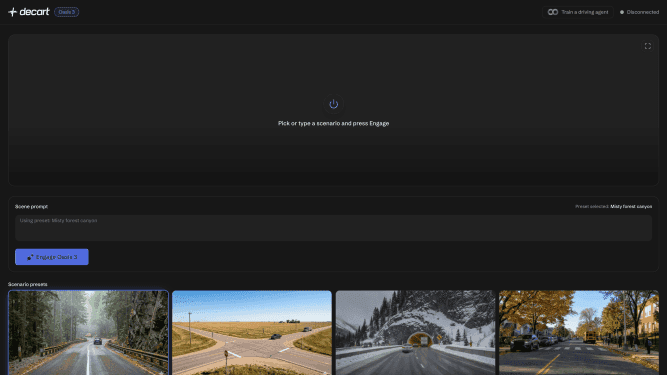
Decart’s new world model can simulate hours of photorealistic driving — with some caveats
AI startupDecarton Wednesday unveiled Oasis 3, its latest interactive world model that can generate photorealistic driving environments in real time, TechCrunch has exclusively learned. The model is currently available via API. The startup is initially targeting autonomous vehicle companies that need to simulate rare driving scenarios at scale, and plans to expand into robotics and other physical AI applications. But the bigger bet is on developers: By offering API access from day one, Decart is trying to build a developer ecosystem around world models much like how OpenAI did with language models. “It’s going to be the first usable world model that people can actually program on top of,” Dean Leitersdorf, co-founder and CEO of Decart, told TechCrunch. “I think there’s going to be an entire developer community that emerges on top of this.” The startup already has a community of more than 100,000 developers, many of whom are building products on top of its real-time video model Lucy, largely in e-commerce and live streaming. Oasis 3 is based on that foundation model, and it represents the company’s push into physical AI. Access is priced at $0.02 per second, and enterprise pricing depends on use cases, Decart said. Decart is playing in an increasingly packed world model arena. Last year, Google releasedGenie 3in research preview, Fei-Fei Li’sWorld Labs launched Marblefor commercial use cases, and video generation startups like Luma andRunwayare also translating their physics-aware video models into world models. Oasis 3’s release comes a few weeks after two-year-old Decart raised $300 million, which Leitersdorf says followed “huge demand increases for the models we built” in e-commerce, live streaming and physical AI. The round boosted Decart’s valuation to nearly $4 billion, and brought a series of strategic investors such as Toyota, Adobe and eBay. All of these companies are potential customers, says Leitersdorf. Nvidia, an existing investor, also participated in the round. Oasis 3’s edge lies in the photo-realism of its models and infinite generation capability. That’s due to some efficiency wizardry on Decart’s part, powered by the company’s other main product: the DOS (Decart Optimization Stack) software that allows models to run efficiently on Nvidia, Amazon and Google hardware, making its models far less expensive to run than competitors. “This is built on top of our entire real-time stack, which we optimize all the way down to the hardware,” Leitersdorf said. “By being so vertically integrated, we’re able to be more than an order of magnitude cheaper than anyone else in the industry in order to run these models.” The startup’s models are so efficient, per Leitersdorf, that it has burned through “drastically less” than $100 million in its lifetime. Oasis 3 generates physically accurate, multi-camera environments — one front-facing and two-side facing — for training and testing systems. And instead of offering limited demos and research previews, Decart allows developers to generate scenarios infinitely, which is perfect for autonomous vehicle developers looking to try as many edge cases as possible. Compared to other models I’ve tried, like Google’s Genie 3 or World Labs’s Marble, Oasis 3 delivers the most photorealistic environments from a single text prompt I’ve seen. And the fact that you can interact with them for hours suggests a level of efficiency that Decart’s rivals might lack. But by letting you generate a world for so long, the model also degrades significantly. In my testing, I found the system could consistently set up a strong initial scene that matches the prompt, but the thematic integrity degraded rapidly as I moved through the world. I prompted it to generate a New York City street in the morning, it did so, beautifully. But as I drove along, the environment looked less like New York and more like a standard version of any urban, Western city. When I tried to turn around and make my way back to the initial intersection, it was gone, replaced by an entirely new environment. On top of that, the controls aren’t very responsive, and I often lost control over where the car was moving (again, a drawback shared by other world models I’ve tested). The experience felt less like a coherent simulation and more of a dream-like, disjointed stream of consciousness that quickly grows nonsensical. Another issue, which I’ve also seen in other world models, is that the car will just drive through other cars, meaning the model doesn’t simulate physics properly in the environment. Leitersdorf calls this a “major research problem that we’re cracking now,” attributing it to the fact that “there’s drastically more data on good driving compared to accidents.” Part of what makes this physics consistency difficult is fundamental to how this world model works. Oasis 3 is auto-regressive, meaning it generates one frame at a time, and looks back at what it previously generated to decide what comes next. This is a key architectural feature of many world models, and it is a compute-intensive one, too. In order to maintain consistency, Leitersdorf says the Decart team is working to improve the length of the model’s memory. “Every frame we generate is roughly 8,000 tokens,” he said. “Generating this at tens of frames per second — that’s hundreds of thousands of tokens per second. The context window fills up very quickly. We’re researching how to do longer context to store millions more tokens, and how to compress the memory into fewer tokens.” Leitersdorf thinks the consistency issue might be partially solved in the model’s next version, which will allow users to start generating worlds based on a video of an environment rather than an image. He acknowledged that world models as a field are still early. Still, the founder is less focused on the current limitations of his tech than what will happen when developers get their hands on it. “It takes me back to the early days of LLMs, when OpenAI invented the API for models,” he said, pointing to the emergence of a developer community that advanced the field by finding and building new use cases. “When we talk again in three months, we’ll be like, ‘Here’s 100 developers that all built 100 different applications with Oasis that surprised all of us,’” he said.
View

Jedify raises $24M to help companies arm AI agents with context on their business
AI vendors promote their enterprise products as if they’re turnkey solutions, but the chances are low that AI agents will hit the ground running right away. Unless you put in the effort to train a model on the specifics of your business, it’s unlikely to understand how your company, for example, defines revenue or knows who is allowed to see which file. That’s part of the reason why we’re seeing AI companies deploying engineers to help integrate their AI products into customers’ systems. New York-based startupJedifyis attacking this very gap. The company says its platform connects to enterprises’ knowledge sources via APIs to build a “context graph” about their business that AI agents can use to work better. These sources can be databases, data warehouses and lakes, SaaS apps or BI tools, as well as unstructured sources such as reports, documentation, code bases, and even Slack channels and meeting recordings. To build that out, Jedify has raised $24 million in a Series A funding round led by Norwest, TechCrunch has exclusively learned. The round saw participation from returning backers S Capital VC and Cerca Partners, as well as new investor Oceans Ventures. Data giant Snowflake also participated as a strategic investor and is integrating the startup’s tech with its AI products, such as its Cortex AI service, Semantic Views, and CoWork. Jedify’s pitch is that to be useful within enterprises, AI agents need access to the relationships between entities, data, permissions, domain knowledge, workflows, operational assumptions, and company-specific terminology. This context, the company says, allows an AI agent to narrow its attention to the information that is relevant to a particular task instead of searching across everything a company has. Co-founder and CEO Assaf Henkin (pictured above, on the far right) pointed to Kiteworks, a compliance company, as an example of how customers are using Jedify. Kiteworks connected Snowflake, Tableau, Notion, and internal playbooks, including documents and screenshots, to Jedify, then built agentic tools for different customer workflows. “They wanted to arm their sellers and account teams with a sophisticated app — you can think of it as both like a dashboard application and a real-time conversational application. When they go into a customer conversation, Jedify builds for them, on the fly, everything they need to know. And during the conversation, they can, in real time, get very specific details surfaced proactively,” Henkin said. Henkin argues that Jedify’s context graph is different from the semantic layers, metadata catalogs, and knowledge graphs that companies already use because it is multi-dimensional, capturing relationships across entities, data, people, permissions, and customers. It’s also model-agnostic and updates in real time as information flows into and out of the systems it is connected to. “When you want to enable an agentic solution to really be autonomous, to drive decisions across CRM data, Zendesk tickets, maybe telemetry data that’s coming in real time, that’s when a context graph is much better in terms of capabilities versus a semantic layer,” he said. Permissions are an obvious hurdle here. It wouldn’t do for an agent to give an intern access to the CFO’s revenue projections, for example. Henkin said his platform works to address that by inheriting permissions from identity systems, file systems, SaaS tools, and databases, including row-, column-, and table-level access rules, then lets its customers create additional groups that define what and whom agents or workflows are allowed to reach. It also offers observability and governance tools to help customers ensure their AI agents are behaving as intended. Jedify is currently targeting mid-market and large enterprise customers that have mature data stacks and multiple databases or data warehouses. Henkin said the company has between 10 and 20 early customers, one of which is The Weather Company, and is seeing interest from data-heavy sectors such as gaming, industrials, and consumer packaged goods. Snowflake’s investment and partnership are notable because large data platforms are also trying to build similar capabilities. But Henkin argues that Jedify is complementary to such efforts because much of a company’s data, and most of its institutional knowledge, isn’t usually stored with a single cloud provider. “[The large data companies] will tell you, ‘Oh yeah, just bring everything.’ But in reality, companies have multiple databases, and warehouses, and data solutions […] The big thing is that not all of your data is in those environments, and most of your knowledge is not there, so it’s a bit of a disadvantage that they actually have,” he said. Henkin also noted that for companies trying to do this on their own, training an AI model to build a comparable context layer can be cost-prohibitive, especially ascompanies are scrutinizing and clamping down on their AI token usage. And the rapid advances in AI model development play into the company’s broader bet: as models grow more capable and more interchangeable, proprietary context that helps those models work better within businesses could prove a valuable and durable moat. The startup will use the fresh cash for product development, hiring, and go-to-market motion. It brings the firm’s total funding to about $33 million.
View
Eros Brings Cultural AI Ecosystem to UK with $355 Mn Investment
The initiative will strengthen collaboration between India and the UK in artificial intelligence, storytelling, and creative industries.
View

Big Tech Cloud Infra is Breaking the Illusion of India's Sovereign AI Ambitions
Hyperscalers such as Google are actively investing in India. However, they primarily serve their own enterprise clients.
View

Piper Serica Moves to Fix Deep Tech Startups’ Biggest Funding Gap
The Bharat Tech Fund supports companies at advanced technology readiness levels that have spent years developing their products but struggle to scale due to insufficient funding.
View
The Real Reason Why AI Agents are Failing in Organisations
Genpact’s Ajay Vatsal believes the biggest returns from agentic AI will come from better operational outcomes and employee augmentation.
View

AI is Eating Away at Indian IT's Old Business. Can it Rewrite Enterprise Playbook?
From Mistral tie-ups to proprietary agentic platforms, India's technology services majors are racing to reinvent themselves for the AI era.
View

Google Rolls Out Gemini 3.5 Live Translate for Real-Time Multilingual Conversations
Google on Wednesday rolled out its latest speech-to-speech translation model called Gemini 3.5 Live Translate. Google claims it is designed to enable more natural multilingual conversations. As per the company, the new AI model can detect more than 70 languages and generate translated speech. The result is claimed to preserve a speaker's tone, pacing, and intonation while continuously delivering near real-time translations. Gemini 3.5 Live Translate is rolling out across Google Translate, Google Meet, Google AI Studio, and the Gemini Live API for developers.
View

Meta signs first AI data center deal in India with Reliance
As tech companies race to secure the computing power needed to train and deploy AI systems, Meta is making its first AI infrastructure bet in India, striking a data center partnership with conglomerate Reliance Industries in a market that is rapidly emerging as a hub for AI infrastructure. The partnership,announcedon Wednesday, will see Meta collaborate with Reliance on a 168-megawatt AI-enabled data center in Jamnagar, Gujarat, expanding a relationship that has evolved from Meta’s multibillion-dollar investment in Reliance’s Jio Platforms to a$100 million joint venturelaunched last year to develop enterprise AI solutions for customers in India and overseas markets. The deal comes as India cements its status as a natural destination for AI infrastructure investments, with tech giants seeking new geographies for data centers amid soaring demand for computing power to train and deploy AI models. Companies includingMicrosoft,Amazon,Google,OpenAI, andUberhave recently announced AI and cloud infrastructure investments in the country, which has rapidly expanded its data center footprint in recent years. The rush into India extends beyond global technology firms. Earlier this week, Blackstone-backed AirTrunk announced plans toinvest $30 billion to build 5 gigawatts of data center capacityin the country by 2030, while Indian conglomerates includingAdaniandTata Consultancy Serviceshave also unveiled major data center expansion plans aimed at supporting AI workloads. New Delhi has sought to attract such investments through policy incentives, includingtax exemptions through 2047for foreign cloud providers on services sold overseas, so long as those workloads are run from Indian data centers. India’s installed data center capacity has risen fromabout 375 megawatts in 2020 to around 1.5 gigawattsin 2025, according to government data. Industry estimates project that figure could growmore than fivefold to over 8 gigawattsby the end of the decade, driven by cloud adoption, AI workloads, and rising demand for local data processing. The Meta-Reliance agreement marks the latest chapter in a relationship that has steadily deepened since Metainvested $5.7 billionin Jio Platforms in 2020. Since then, the companies have expanded their collaboration across digital services, enterprise AI, and now the infrastructure underpinning next-generation AI systems. As part of the partnership, Meta is leasing capacity at Reliance’s new Jamnagar facility, which the companies said will be powered by renewable energy and cooled using desalinated seawater. Meta has committed to covering the entire cost of the energy and water required to support its operations there. Reliance said the 168-megawatt facility will ready within two years and can be expanded over time. Further, the data center will also support Meta’s global infrastructure and AI computing requirements, plugging India more directly into the company’s worldwide network of AI facilities. Under the agreement, Reliance said it would provide end-to-end services ranging from design and construction to renewable power, connectivity, and ongoing operations, a sign of the conglomerate’s ambitions to become a one-stop shop for AI infrastructure among global technology companies. Separately, Meta said it had contracted nearly 1 gigawatt of new renewable energy capacity in India through agreements with CleanMax and Fourth Partner Energy, which will supplement the renewable power supporting the Jamnagar facility. The companies did not disclose the value of the agreement, the type of AI workloads that will run from the facility, or whether Meta plans additional AI infrastructure investments in India.
View

Haleon to Invest ₹2,000 Crore in First India Manufacturing Facility in Madhya Pradesh
The site is expected to generate up to 500 direct jobs, along with indirect employment opportunities.
View

Shunya Labs Launches Voice AI Platform Supporting 216 Indian Languages and Dialects
The platform combines speech recognition, natural language understanding, and generative AI to enable human-like conversations in regional languages and dialects.
View