Description
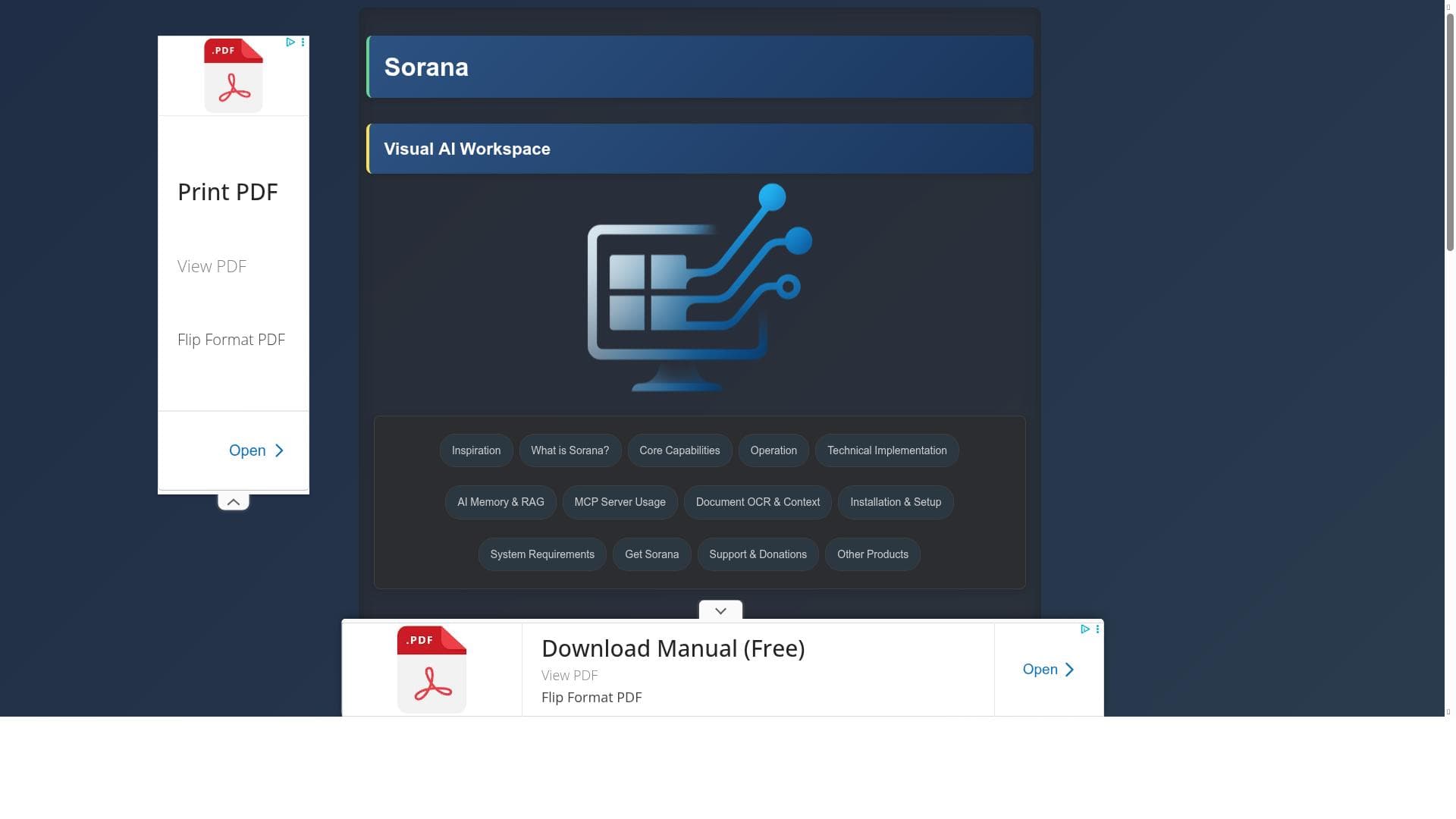
Sorana is a cutting-edge AI-powered visual workspace that transforms digital file organization through semantic grouping on an intuitive 2D canvas. Ideal for knowledge workers and teams, it combines no-code multi-agent workflows, OCR document processing, and advanced AI backend integration, all while keeping data securely under user control.
Sorana is an innovative AI-powered visual workspace designed to revolutionize the way individuals and teams organize, process, and interact with digital files. At its core, Sorana leverages advanced semantic analysis and spatial AI to group related content automatically and arrange it intuitively on a two-dimensional canvas. This approach transforms file management from a traditional list or folder hierarchy into a dynamic, visual experience that enhances understanding and productivity. Beyond mere organization, Sorana integrates a built-in MCP (Multi-Channel Protocol) server enabling advanced file and web operations, and incorporates OCR (Optical Character Recognition) capabilities to extract and embed textual information from scanned documents directly into the workspace. This combination of features makes Sorana a comprehensive platform for managing complex digital projects, knowledge bases, and workflows with ease and precision. One of Sorana's standout features is its Spatial AI Organization, which uses artificial intelligence to semantically analyze files and cluster them based on content relationships. This grouping is visually represented on a 2D canvas, providing users with an immediate, intuitive overview of their projects and data. The WYSIWYG (What You See Is What You Get) Canvas Editor empowers users to manipulate workspace elements directly—dragging and dropping files, creating categories, renaming items, and adjusting group boundaries—without needing technical expertise. This visual and interactive interface encourages exploration and makes complex data structures more accessible. Sorana also excels in model management, offering seamless connectivity to a wide range of AI backends. Users can integrate cloud-based services like OpenAI, Mistral, and Lemonade, as well as on-premises or local models such as Llamacpp, LM Studio, and Ollama. This flexibility allows organizations to balance performance, privacy, and cost considerations by choosing or switching between AI providers as needed. Additionally, Sorana supports no-code multi-agent orchestration, enabling users to create and link custom AI agents into sophisticated processing pipelines through a drag-and-drop interface within the canvas. This feature is particularly valuable for automating workflows, enhancing document understanding, and performing complex data manipulations without programming. Visual Structure Mapping further enriches the user experience by generating dynamic mind maps and visual representations of folder hierarchies. This helps users comprehend relationships and dependencies within their data at a glance. The OCR Document Processing capability integrates scanned PDFs and text files into the AI agents’ memory, significantly enhancing the contextual understanding and processing power of the workspace. Meanwhile, the MCP server facilitates advanced file and web operations, streamlining tasks such as file transfers, batch processing, and web data retrieval. Sorana is ideal for knowledge workers, researchers, project managers, and teams dealing with large volumes of diverse digital content who require an intelligent, visual, and flexible workspace. Use cases include managing research documents, organizing creative projects, automating document workflows, and integrating AI-driven insights into everyday file management. Its no-code interface and extensive AI backend support make it accessible to both technical and non-technical users. Importantly, Sorana is available for free, lowering the barrier to entry and encouraging widespread adoption. Compared to traditional file management tools or standalone AI platforms, Sorana’s unique combination of spatial AI organization, multi-agent orchestration, and integrated OCR with a built-in MCP server offers a more holistic and powerful solution. However, users should consider that while Sorana supports numerous AI backends, the quality and capabilities of these models may vary, and optimal performance depends on backend selection and configuration. Additionally, as a relatively new platform, some advanced enterprise features or integrations might still be evolving. In summary, Sorana stands out as a versatile and forward-thinking AI workspace that redefines digital file organization and processing. Its rich feature set, visual interface, and flexible AI integrations make it a compelling choice for anyone looking to harness AI to manage complex digital environments more effectively.

Description
Sorana is a cutting-edge AI-powered visual workspace that transforms digital file organization through semantic grouping on an intuitive 2D canvas. Ideal for knowledge workers and teams, it combines no-code multi-agent workflows, OCR document processing, and advanced AI backend integration, all while keeping data securely under user control.
Sorana is an innovative AI-powered visual workspace designed to revolutionize the way individuals and teams organize, process, and interact with digital files. At its core, Sorana leverages advanced semantic analysis and spatial AI to group related content automatically and arrange it intuitively on a two-dimensional canvas. This approach transforms file management from a traditional list or folder hierarchy into a dynamic, visual experience that enhances understanding and productivity. Beyond mere organization, Sorana integrates a built-in MCP (Multi-Channel Protocol) server enabling advanced file and web operations, and incorporates OCR (Optical Character Recognition) capabilities to extract and embed textual information from scanned documents directly into the workspace. This combination of features makes Sorana a comprehensive platform for managing complex digital projects, knowledge bases, and workflows with ease and precision. One of Sorana's standout features is its Spatial AI Organization, which uses artificial intelligence to semantically analyze files and cluster them based on content relationships. This grouping is visually represented on a 2D canvas, providing users with an immediate, intuitive overview of their projects and data. The WYSIWYG (What You See Is What You Get) Canvas Editor empowers users to manipulate workspace elements directly—dragging and dropping files, creating categories, renaming items, and adjusting group boundaries—without needing technical expertise. This visual and interactive interface encourages exploration and makes complex data structures more accessible. Sorana also excels in model management, offering seamless connectivity to a wide range of AI backends. Users can integrate cloud-based services like OpenAI, Mistral, and Lemonade, as well as on-premises or local models such as Llamacpp, LM Studio, and Ollama. This flexibility allows organizations to balance performance, privacy, and cost considerations by choosing or switching between AI providers as needed. Additionally, Sorana supports no-code multi-agent orchestration, enabling users to create and link custom AI agents into sophisticated processing pipelines through a drag-and-drop interface within the canvas. This feature is particularly valuable for automating workflows, enhancing document understanding, and performing complex data manipulations without programming. Visual Structure Mapping further enriches the user experience by generating dynamic mind maps and visual representations of folder hierarchies. This helps users comprehend relationships and dependencies within their data at a glance. The OCR Document Processing capability integrates scanned PDFs and text files into the AI agents’ memory, significantly enhancing the contextual understanding and processing power of the workspace. Meanwhile, the MCP server facilitates advanced file and web operations, streamlining tasks such as file transfers, batch processing, and web data retrieval. Sorana is ideal for knowledge workers, researchers, project managers, and teams dealing with large volumes of diverse digital content who require an intelligent, visual, and flexible workspace. Use cases include managing research documents, organizing creative projects, automating document workflows, and integrating AI-driven insights into everyday file management. Its no-code interface and extensive AI backend support make it accessible to both technical and non-technical users. Importantly, Sorana is available for free, lowering the barrier to entry and encouraging widespread adoption. Compared to traditional file management tools or standalone AI platforms, Sorana’s unique combination of spatial AI organization, multi-agent orchestration, and integrated OCR with a built-in MCP server offers a more holistic and powerful solution. However, users should consider that while Sorana supports numerous AI backends, the quality and capabilities of these models may vary, and optimal performance depends on backend selection and configuration. Additionally, as a relatively new platform, some advanced enterprise features or integrations might still be evolving. In summary, Sorana stands out as a versatile and forward-thinking AI workspace that redefines digital file organization and processing. Its rich feature set, visual interface, and flexible AI integrations make it a compelling choice for anyone looking to harness AI to manage complex digital environments more effectively.
Tool Features
- Spatial AI Organization: Uses AI to semantically group files and arrange them on a 2D canvas, providing a visual overview of projects.
- WYSIWYG Canvas Editor: Direct manipulation of workspace elements with drag and drop, creating categories, renaming items, and adjusting group boundaries.
- Advanced Model Management: Connect to multiple cloud, on-prem and local LLM backends including OpenAI, Mistral, Lemonade, Llamacpp, LM Studio, Ollama and others.
- No-Code Multi-Agent Orchestration: Create custom agents and connect them into processing pipelines using a drag-and-drop interface within the 2D canvas workspace.
- Visual Structure Mapping: Generate dynamic visual representations and mind maps of folder hierarchies to understand relationships.
- OCR Document Processing: Enhance agent knowledge by integrating OCR-processed PDFs and text files directly into their memory and processing capabilities.
- MCP Server for File Operations: Perform file and web operations through the built-in MCP server.
- Supports Connection to On-Prem and Cloud AI Backends: Flexible configuration to switch between AI backends based on needs, privacy, and performance.
Frequently Asked Questions
What is Sorana?
Sorana is an AI-powered visual workspace that uses semantic analysis and spatial AI to organize digital files on a 2D canvas. It features built-in OCR document processing, a MCP server for advanced file operations, and supports integration with multiple AI backends for enhanced workflows.
How much does Sorana cost?
Sorana is available for free, providing full access to its core features without any subscription fees.
Who is Sorana best for?
Sorana is best suited for knowledge workers, researchers, project managers, and teams who manage large volumes of digital content and want to leverage AI for semantic organization, workflow automation, and enhanced document processing.
What are the main features of Sorana?
Key features include Spatial AI Organization for semantic file grouping on a 2D canvas, a WYSIWYG canvas editor, advanced model management supporting multiple AI backends, no-code multi-agent orchestration, visual structure mapping, OCR document processing, and a built-in MCP server for file and web operations.
Does Sorana offer a free trial?
Sorana is offered for free, so there is no need for a trial period to access its features.
What integrations does Sorana support?
Sorana supports integration with various AI backends including cloud services like OpenAI, Mistral, Lemonade, and local or on-premises models such as Llamacpp, LM Studio, and Ollama, allowing flexible AI model management.
How does Sorana work?
Sorana uses AI to semantically analyze and group files, displaying them on an interactive 2D canvas. Users can manipulate workspace elements directly, create no-code AI agent workflows, process documents with OCR, and perform advanced file operations via the MCP server, all while connecting to preferred AI backends.
Socials
Use ToolSponsored Tools


































Reviews
No reviews yet. Be the first to share your experience.