Description
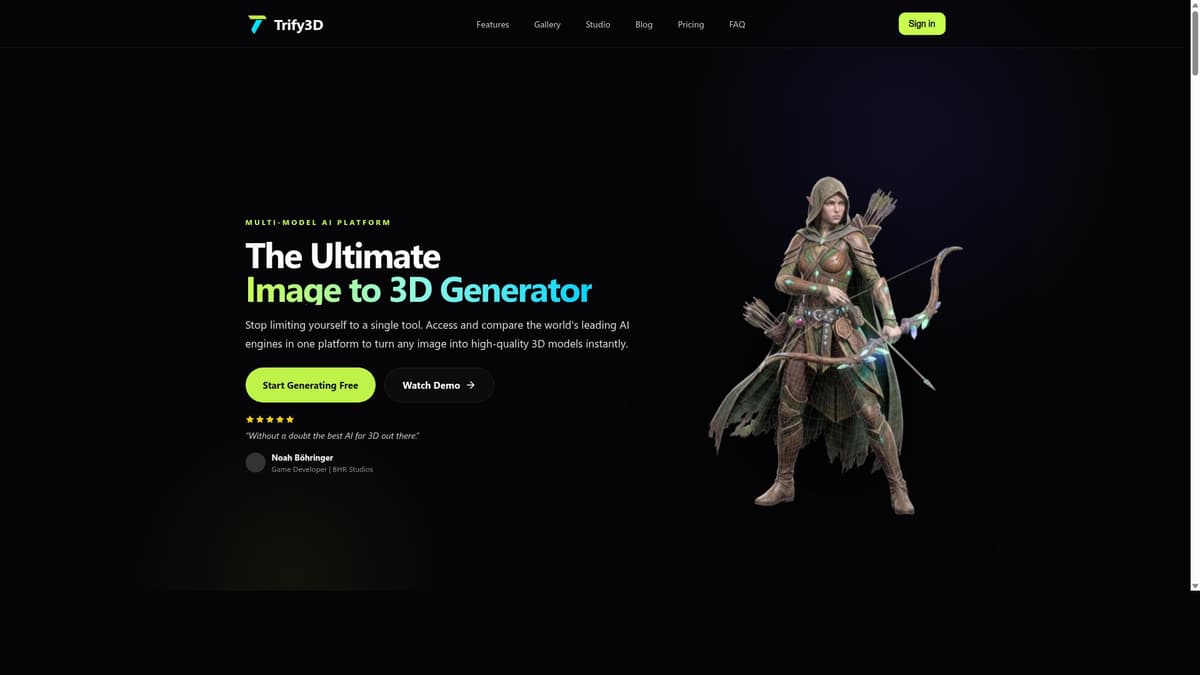
Shapen revolutionizes the creative process by transforming sketches, drawings, and photos into detailed 3D models ready for animation, rendering, or 3D printing. Ideal for artists, designers, and engineers, it simplifies 3D asset creation by automating image-to-3D conversion, making it accessible even to those without extensive modeling experience.
Shapen is an innovative AI-powered tool designed to transform 2D images into fully realized 3D models, catering to a wide range of creative and professional needs such as animation, rendering, and 3D printing. At its core, Shapen leverages advanced image-to-3D conversion technology to interpret sketches, drawings, and photographs, converting them into detailed three-dimensional objects that can be further manipulated or utilized in various digital workflows. This capability bridges the gap between traditional 2D visual content and the increasingly important 3D space, enabling users to bring their concepts to life with remarkable ease and precision. One of Shapen's standout features is its ability to create 3D models directly from diverse types of 2D inputs. Whether you have a simple hand-drawn sketch, a complex digital drawing, or a photograph, Shapen can process these images and generate accurate 3D representations. This flexibility makes it an invaluable asset for artists, designers, and engineers who want to prototype or visualize their ideas without needing extensive 3D modeling expertise. The tool focuses heavily on the image-to-3D conversion process, ensuring that the resulting models retain the essential details and characteristics of the original image while being optimized for use in animation pipelines, rendering engines, or 3D printing setups. Shapen is particularly well-suited for professionals and hobbyists in fields such as game development, animation studios, product design, and 3D printing enthusiasts. For animators and game developers, the ability to quickly convert concept art into 3D assets can significantly accelerate production timelines. Product designers and engineers can use Shapen to prototype physical objects by transforming sketches into printable 3D models, facilitating rapid iteration and testing. Additionally, educators and students in art and design disciplines can leverage Shapen to explore 3D modeling concepts without the steep learning curve associated with traditional 3D software. The platform operates on a freemium pricing model, offering users access to basic features at no cost, which is ideal for individuals or small teams looking to experiment with image-to-3D conversion. For more advanced capabilities, higher resolution outputs, or commercial use, Shapen provides premium plans that unlock additional features and enhanced support. This tiered approach allows users to scale their usage according to their project requirements and budget constraints. When compared to alternative 3D modeling tools, Shapen stands out due to its specialized focus on image-based input and its streamlined conversion process. Unlike traditional 3D modeling software that requires manual mesh creation and sculpting skills, Shapen automates much of the initial modeling phase, reducing the time and expertise needed to generate 3D assets. However, while it excels at converting images into 3D forms, it may not replace full-featured 3D design suites for complex modeling tasks or detailed texture work. Users seeking comprehensive modeling and animation toolsets might still need to complement Shapen with other software. Potential limitations include the dependency on the quality and clarity of the input images; highly complex or ambiguous images might result in less accurate 3D models. Additionally, as a relatively specialized tool, Shapen’s feature set is concentrated on image-to-3D conversion, so users requiring extensive post-processing or animation tools will need to integrate it within a broader software ecosystem. Despite these considerations, Shapen offers a powerful and accessible solution for converting 2D visuals into 3D models, making it a valuable addition to the toolkit of creatives and professionals working at the intersection of 2D and 3D content creation.

Description
Shapen revolutionizes the creative process by transforming sketches, drawings, and photos into detailed 3D models ready for animation, rendering, or 3D printing. Ideal for artists, designers, and engineers, it simplifies 3D asset creation by automating image-to-3D conversion, making it accessible even to those without extensive modeling experience.
Shapen is an innovative AI-powered tool designed to transform 2D images into fully realized 3D models, catering to a wide range of creative and professional needs such as animation, rendering, and 3D printing. At its core, Shapen leverages advanced image-to-3D conversion technology to interpret sketches, drawings, and photographs, converting them into detailed three-dimensional objects that can be further manipulated or utilized in various digital workflows. This capability bridges the gap between traditional 2D visual content and the increasingly important 3D space, enabling users to bring their concepts to life with remarkable ease and precision. One of Shapen's standout features is its ability to create 3D models directly from diverse types of 2D inputs. Whether you have a simple hand-drawn sketch, a complex digital drawing, or a photograph, Shapen can process these images and generate accurate 3D representations. This flexibility makes it an invaluable asset for artists, designers, and engineers who want to prototype or visualize their ideas without needing extensive 3D modeling expertise. The tool focuses heavily on the image-to-3D conversion process, ensuring that the resulting models retain the essential details and characteristics of the original image while being optimized for use in animation pipelines, rendering engines, or 3D printing setups. Shapen is particularly well-suited for professionals and hobbyists in fields such as game development, animation studios, product design, and 3D printing enthusiasts. For animators and game developers, the ability to quickly convert concept art into 3D assets can significantly accelerate production timelines. Product designers and engineers can use Shapen to prototype physical objects by transforming sketches into printable 3D models, facilitating rapid iteration and testing. Additionally, educators and students in art and design disciplines can leverage Shapen to explore 3D modeling concepts without the steep learning curve associated with traditional 3D software. The platform operates on a freemium pricing model, offering users access to basic features at no cost, which is ideal for individuals or small teams looking to experiment with image-to-3D conversion. For more advanced capabilities, higher resolution outputs, or commercial use, Shapen provides premium plans that unlock additional features and enhanced support. This tiered approach allows users to scale their usage according to their project requirements and budget constraints. When compared to alternative 3D modeling tools, Shapen stands out due to its specialized focus on image-based input and its streamlined conversion process. Unlike traditional 3D modeling software that requires manual mesh creation and sculpting skills, Shapen automates much of the initial modeling phase, reducing the time and expertise needed to generate 3D assets. However, while it excels at converting images into 3D forms, it may not replace full-featured 3D design suites for complex modeling tasks or detailed texture work. Users seeking comprehensive modeling and animation toolsets might still need to complement Shapen with other software. Potential limitations include the dependency on the quality and clarity of the input images; highly complex or ambiguous images might result in less accurate 3D models. Additionally, as a relatively specialized tool, Shapen’s feature set is concentrated on image-to-3D conversion, so users requiring extensive post-processing or animation tools will need to integrate it within a broader software ecosystem. Despite these considerations, Shapen offers a powerful and accessible solution for converting 2D visuals into 3D models, making it a valuable addition to the toolkit of creatives and professionals working at the intersection of 2D and 3D content creation.
Tool Features
- Create 3D models from images
- Supports 3D model creation from sketches, drawings, and photos
- Focused on image-to-3D conversion technology
Frequently Asked Questions
What is Shapen?
Shapen is an AI-driven tool that converts 2D images such as sketches, drawings, and photos into 3D models suitable for animation, rendering, or 3D printing.
How much does Shapen cost?
Shapen offers a freemium pricing model with basic features available for free and premium plans that provide enhanced capabilities and higher resolution outputs for commercial or advanced use.
Who is Shapen best for?
Shapen is ideal for animators, game developers, product designers, 3D printing enthusiasts, educators, and students who want to quickly transform 2D visuals into 3D models without needing advanced modeling skills.
What are the main features of Shapen?
Key features include creating 3D models from various types of 2D images, supporting sketches, drawings, and photos, and focusing on advanced image-to-3D conversion technology to generate accurate and usable 3D assets.
Does Shapen offer a free trial?
Yes, Shapen provides free access to its basic features under a freemium model, allowing users to try the core image-to-3D conversion functionality without cost.
What integrations does Shapen support?
While specific integrations are not detailed, Shapen-generated 3D models can be exported and used within common animation, rendering, and 3D printing software workflows.
How does Shapen work?
Shapen uses AI-powered image-to-3D conversion technology to analyze 2D images and automatically generate corresponding 3D models, enabling users to bring flat visuals into three-dimensional space efficiently.
Sponsored Tools






































Reviews
No reviews yet. Be the first to share your experience.