Rover by rtrvr.ai
Description
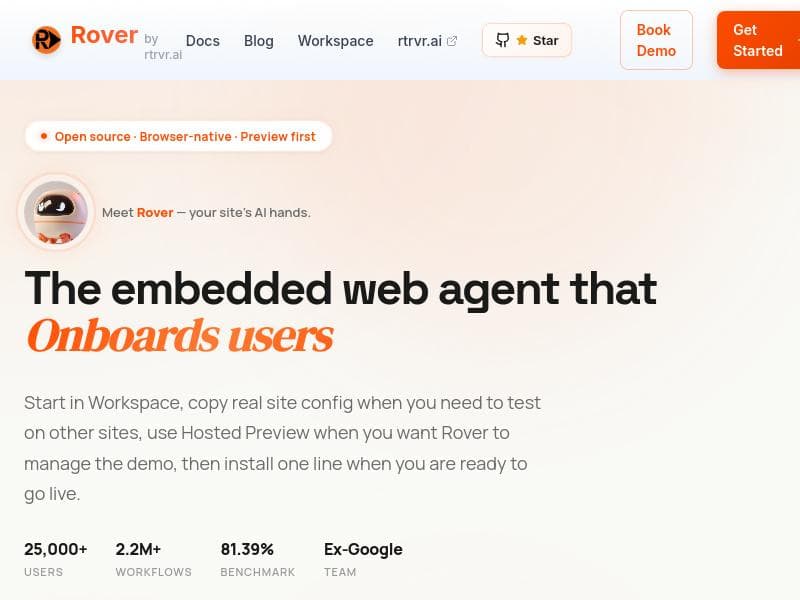
Rover by rtrvr.ai transforms your website into an interactive, agentic platform by embedding an AI assistant that performs real actions like onboarding, form-filling, and checkout completion through natural conversation. Ideal for e-commerce and SaaS sites, Rover’s open-source SDK and single-line installation enable developers to automate workflows seamlessly without complex setups or knowledge bases.
Rover by rtrvr.ai is an innovative AI-powered web agent designed to seamlessly integrate into your website and act as an autonomous assistant that performs tasks on behalf of your users. Its core purpose is to enhance user experience by taking direct actions such as onboarding visitors, running complex workflows, filling out forms, and even completing purchases through conversational interactions. Unlike traditional chatbots that primarily provide information or direct users to resources, Rover actively manipulates the website's interface to fulfill user requests, effectively becoming "your site's new hands." This unique capability transforms static websites into dynamic, agentic platforms where users can engage in natural language conversations and have their intents executed in real time, streamlining processes like checkout or registration without manual input from the user. One of Rover's standout features is its open-source AI web agent SDK, which allows developers to customize and extend its capabilities freely. Its DOM-native integration means Rover interacts directly with the website's Document Object Model, enabling precise control over page elements without relying on screenshots or remote virtual machines. This approach not only improves reliability and speed but also simplifies deployment. Developers can preview Rover's actions live on their site before installation, ensuring the agent behaves as expected. Installation itself is remarkably straightforward, requiring just a single line of script to embed Rover into any webpage. Additionally, Rover operates effectively without the need for a dedicated knowledge base, making it versatile and easy to implement across diverse websites without extensive setup or training data. Rover is particularly well-suited for e-commerce platforms, SaaS applications, and service websites that want to reduce friction in user interactions and boost conversion rates. For example, an online store can deploy Rover to assist customers with checkout by automatically filling in shipping and payment details and completing the purchase upon user request. SaaS companies can use Rover to guide new users through onboarding workflows, ensuring they configure their accounts correctly without manual intervention. Customer support teams benefit as well, since Rover can handle routine tasks and queries autonomously, freeing human agents to focus on more complex issues. Its ability to run workflows and fill forms through conversational commands makes it invaluable for any site aiming to improve usability and automate repetitive tasks. Rover follows a freemium pricing model, allowing users to start with a free tier that provides basic functionality suitable for small websites or testing purposes. Paid plans likely offer enhanced features, higher usage limits, and priority support, although specific pricing details should be confirmed on the official website. This flexible pricing structure makes Rover accessible to startups and enterprises alike, enabling gradual scaling as business needs grow. Compared to other AI assistants and chatbots, Rover's primary differentiator is its agentic nature—actively interacting with the website's interface rather than just responding with text. Many AI tools require extensive knowledge bases or rely on static scripts and remote environments to simulate user actions, which can be brittle and slow. Rover's direct DOM integration and open-source SDK provide developers with greater control, transparency, and reliability. Its single-line installation and live preview features further simplify adoption, contrasting with more complex setups required by competitors. While traditional chatbots excel at conversational engagement, Rover excels at task completion and workflow automation, filling a unique niche in the AI assistant landscape. Potential limitations include the need for developers to have some familiarity with web development to fully leverage the SDK and customize Rover's behavior. Since it operates directly on the DOM, significant changes to the website's structure might require adjustments to Rover's scripts. Additionally, while Rover does not require a knowledge base, complex use cases involving nuanced understanding or multi-turn conversations may necessitate supplementary AI models or integrations. Users should also consider privacy and security implications when allowing an AI agent to perform actions on behalf of users, ensuring compliance with relevant regulations. Overall, Rover by rtrvr.ai offers a powerful, developer-friendly solution for embedding intelligent, action-oriented AI agents into websites. Its unique combination of open-source flexibility, direct DOM interaction, and conversational task automation makes it an excellent choice for businesses seeking to enhance user engagement and streamline online workflows.

Description
Rover by rtrvr.ai transforms your website into an interactive, agentic platform by embedding an AI assistant that performs real actions like onboarding, form-filling, and checkout completion through natural conversation. Ideal for e-commerce and SaaS sites, Rover’s open-source SDK and single-line installation enable developers to automate workflows seamlessly without complex setups or knowledge bases.
Rover by rtrvr.ai is an innovative AI-powered web agent designed to seamlessly integrate into your website and act as an autonomous assistant that performs tasks on behalf of your users. Its core purpose is to enhance user experience by taking direct actions such as onboarding visitors, running complex workflows, filling out forms, and even completing purchases through conversational interactions. Unlike traditional chatbots that primarily provide information or direct users to resources, Rover actively manipulates the website's interface to fulfill user requests, effectively becoming "your site's new hands." This unique capability transforms static websites into dynamic, agentic platforms where users can engage in natural language conversations and have their intents executed in real time, streamlining processes like checkout or registration without manual input from the user. One of Rover's standout features is its open-source AI web agent SDK, which allows developers to customize and extend its capabilities freely. Its DOM-native integration means Rover interacts directly with the website's Document Object Model, enabling precise control over page elements without relying on screenshots or remote virtual machines. This approach not only improves reliability and speed but also simplifies deployment. Developers can preview Rover's actions live on their site before installation, ensuring the agent behaves as expected. Installation itself is remarkably straightforward, requiring just a single line of script to embed Rover into any webpage. Additionally, Rover operates effectively without the need for a dedicated knowledge base, making it versatile and easy to implement across diverse websites without extensive setup or training data. Rover is particularly well-suited for e-commerce platforms, SaaS applications, and service websites that want to reduce friction in user interactions and boost conversion rates. For example, an online store can deploy Rover to assist customers with checkout by automatically filling in shipping and payment details and completing the purchase upon user request. SaaS companies can use Rover to guide new users through onboarding workflows, ensuring they configure their accounts correctly without manual intervention. Customer support teams benefit as well, since Rover can handle routine tasks and queries autonomously, freeing human agents to focus on more complex issues. Its ability to run workflows and fill forms through conversational commands makes it invaluable for any site aiming to improve usability and automate repetitive tasks. Rover follows a freemium pricing model, allowing users to start with a free tier that provides basic functionality suitable for small websites or testing purposes. Paid plans likely offer enhanced features, higher usage limits, and priority support, although specific pricing details should be confirmed on the official website. This flexible pricing structure makes Rover accessible to startups and enterprises alike, enabling gradual scaling as business needs grow. Compared to other AI assistants and chatbots, Rover's primary differentiator is its agentic nature—actively interacting with the website's interface rather than just responding with text. Many AI tools require extensive knowledge bases or rely on static scripts and remote environments to simulate user actions, which can be brittle and slow. Rover's direct DOM integration and open-source SDK provide developers with greater control, transparency, and reliability. Its single-line installation and live preview features further simplify adoption, contrasting with more complex setups required by competitors. While traditional chatbots excel at conversational engagement, Rover excels at task completion and workflow automation, filling a unique niche in the AI assistant landscape. Potential limitations include the need for developers to have some familiarity with web development to fully leverage the SDK and customize Rover's behavior. Since it operates directly on the DOM, significant changes to the website's structure might require adjustments to Rover's scripts. Additionally, while Rover does not require a knowledge base, complex use cases involving nuanced understanding or multi-turn conversations may necessitate supplementary AI models or integrations. Users should also consider privacy and security implications when allowing an AI agent to perform actions on behalf of users, ensuring compliance with relevant regulations. Overall, Rover by rtrvr.ai offers a powerful, developer-friendly solution for embedding intelligent, action-oriented AI agents into websites. Its unique combination of open-source flexibility, direct DOM interaction, and conversational task automation makes it an excellent choice for businesses seeking to enhance user engagement and streamline online workflows.
Tool Features
- Open-source AI web agent SDK
- DOM-native integration
- Live site preview before installation
- No need for screenshots or remote VMs
- Single line installation
- Works without a knowledge base
Frequently Asked Questions
What is Rover by rtrvr.ai?
Rover is an AI-powered web agent that integrates directly into your website to perform tasks on behalf of users, such as onboarding, running workflows, filling forms, and completing purchases through conversational commands.
How much does Rover by rtrvr.ai cost?
Rover offers a freemium pricing model, allowing users to access basic features for free with options to upgrade for enhanced capabilities and higher usage limits. Detailed pricing information is available on their official website.
Who is Rover by rtrvr.ai best for?
Rover is ideal for e-commerce platforms, SaaS providers, and service websites looking to automate user interactions, streamline workflows, and improve conversion rates by enabling AI-driven task completion directly on their sites.
What are the main features of Rover by rtrvr.ai?
Key features include an open-source AI web agent SDK, DOM-native integration for direct website interaction, live site preview before installation, single-line script installation, operation without the need for a knowledge base, and no reliance on screenshots or remote virtual machines.
Does Rover by rtrvr.ai offer a free trial?
Yes, Rover provides a freemium plan that allows users to try the tool with basic features at no cost, enabling evaluation before committing to paid plans.
What integrations does Rover by rtrvr.ai support?
Rover integrates natively with your website’s DOM and can be embedded via a simple script tag. While it does not require external knowledge bases or remote VMs, it can be customized through its open-source SDK to work alongside other tools as needed.
How does Rover by rtrvr.ai work?
Rover operates by embedding a lightweight script into your website that enables an AI agent to understand user commands and directly interact with page elements—filling forms, clicking buttons, and running workflows—without manual input or external dependencies.
Socials
Use ToolSponsored Tools































Reviews
No reviews yet. Be the first to share your experience.