Picsellia Atlas
Description
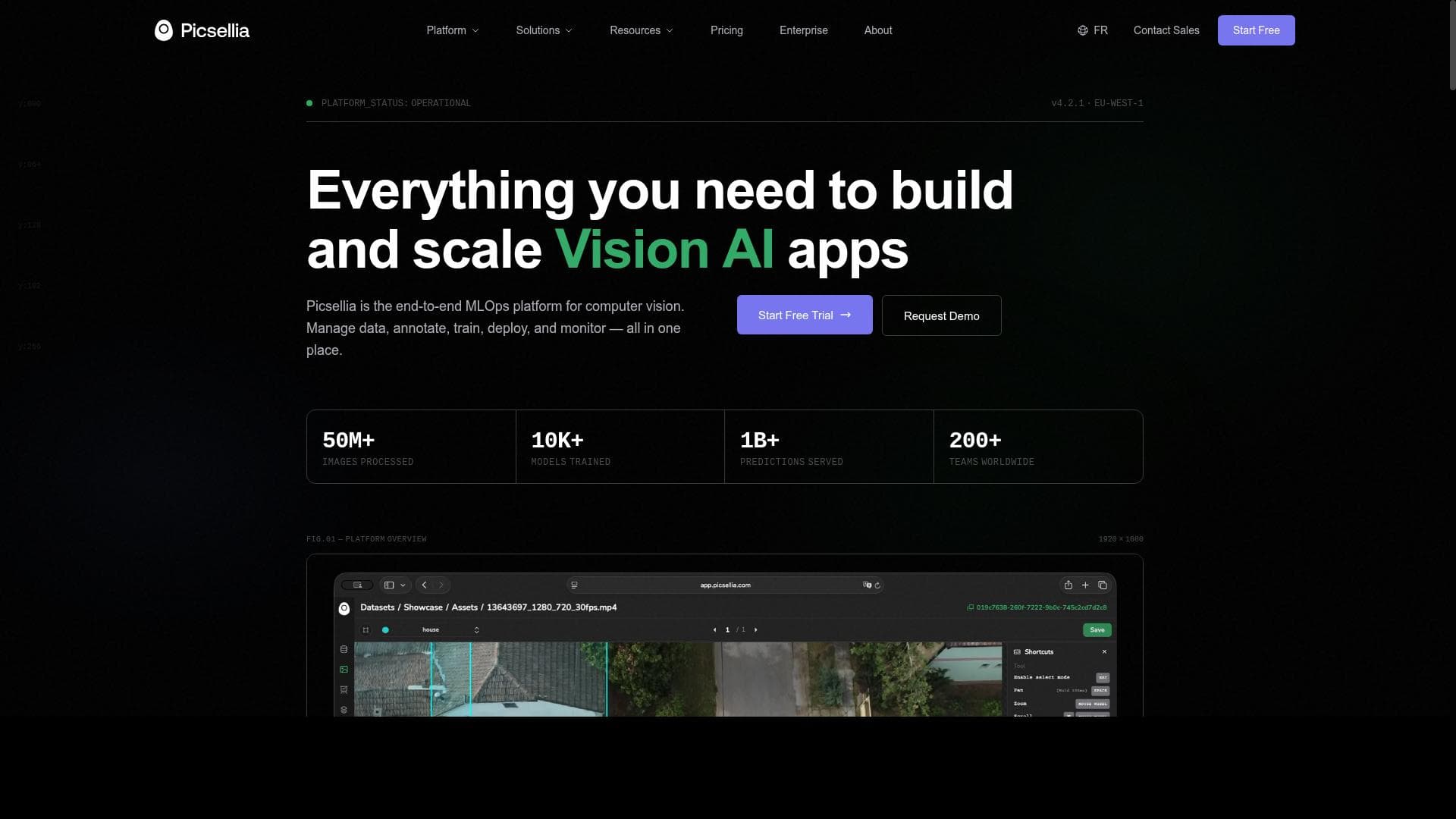
Picsellia Atlas is a unique open-source Vision AI Agent that lets you interact with image datasets using natural language, eliminating the need for coding. Ideal for AI developers and researchers, it simplifies managing, annotating, training, deploying, and monitoring vision AI models all within one platform.
Picsellia Atlas is an innovative open-source Vision AI Agent seamlessly integrated into the Picsellia platform, designed to revolutionize how users interact with visual data. Its core purpose is to simplify and enhance computer vision workflows by enabling users to explore, manage, and improve image datasets through natural language commands. This no-code, hassle-free approach empowers data scientists, AI engineers, and researchers to focus on building and deploying vision AI models without getting bogged down by complex coding or data management tasks. By leveraging Atlas, users can accelerate their AI projects, improve model accuracy, and streamline deployment and monitoring processes, all within a unified environment. At the heart of Picsellia Atlas are several powerful features that cover the entire computer vision project lifecycle. First, it offers robust data management capabilities, allowing users to organize, label, and curate large image datasets efficiently. The annotation tools are intuitive and designed to facilitate precise labeling, which is critical for training high-quality AI models. Users can annotate images directly within the platform, reducing the need for external tools and ensuring consistency across datasets. Training vision AI models is another cornerstone of Atlas. The platform supports various model architectures and training configurations, enabling users to experiment and optimize models tailored to their specific use cases. Once trained, models can be deployed as AI applications directly through Picsellia, streamlining the transition from development to production. Additionally, Atlas provides comprehensive monitoring tools to track model performance at scale, detect anomalies, and maintain reliability in real-world applications. Picsellia Atlas is particularly well-suited for organizations and individuals working on computer vision projects who want to minimize technical overhead and accelerate development cycles. This includes AI researchers, machine learning engineers, startups developing vision-based products, and enterprises looking to integrate AI into their workflows without extensive coding. Use cases range from autonomous vehicle perception systems, medical imaging analysis, retail visual search, to quality control in manufacturing. The natural language interface makes it accessible to users with varying technical expertise, democratizing access to advanced vision AI capabilities. Regarding pricing, Picsellia Atlas operates on a freemium model, allowing users to access core features at no cost, which is ideal for experimentation and small projects. For more advanced needs, such as larger datasets, enhanced collaboration, or enterprise-grade support, paid plans are available. This flexible pricing structure ensures that both individual developers and large organizations can benefit from the platform according to their scale and requirements. Compared to alternatives, Picsellia Atlas stands out due to its open-source nature combined with a no-code, natural language interface, which is relatively rare in the vision AI space. While many platforms offer data annotation or model training separately, Atlas integrates these capabilities with deployment and monitoring in a single cohesive environment. This end-to-end approach reduces friction and accelerates time-to-value. However, some competitors may offer more specialized features or integrations tailored to niche industries, so users should evaluate based on specific project needs. One consideration when adopting Picsellia Atlas is that while the no-code interface lowers the barrier to entry, users with very complex or custom model requirements might still need to supplement with traditional coding or external tools. Additionally, as an open-source project, community support and documentation quality can vary, although Picsellia provides professional support options for enterprise users. Overall, Picsellia Atlas offers a compelling blend of accessibility, functionality, and scalability for vision AI practitioners looking to streamline their workflows and harness the power of visual data effectively.

Description
Picsellia Atlas is a unique open-source Vision AI Agent that lets you interact with image datasets using natural language, eliminating the need for coding. Ideal for AI developers and researchers, it simplifies managing, annotating, training, deploying, and monitoring vision AI models all within one platform.
Picsellia Atlas is an innovative open-source Vision AI Agent seamlessly integrated into the Picsellia platform, designed to revolutionize how users interact with visual data. Its core purpose is to simplify and enhance computer vision workflows by enabling users to explore, manage, and improve image datasets through natural language commands. This no-code, hassle-free approach empowers data scientists, AI engineers, and researchers to focus on building and deploying vision AI models without getting bogged down by complex coding or data management tasks. By leveraging Atlas, users can accelerate their AI projects, improve model accuracy, and streamline deployment and monitoring processes, all within a unified environment. At the heart of Picsellia Atlas are several powerful features that cover the entire computer vision project lifecycle. First, it offers robust data management capabilities, allowing users to organize, label, and curate large image datasets efficiently. The annotation tools are intuitive and designed to facilitate precise labeling, which is critical for training high-quality AI models. Users can annotate images directly within the platform, reducing the need for external tools and ensuring consistency across datasets. Training vision AI models is another cornerstone of Atlas. The platform supports various model architectures and training configurations, enabling users to experiment and optimize models tailored to their specific use cases. Once trained, models can be deployed as AI applications directly through Picsellia, streamlining the transition from development to production. Additionally, Atlas provides comprehensive monitoring tools to track model performance at scale, detect anomalies, and maintain reliability in real-world applications. Picsellia Atlas is particularly well-suited for organizations and individuals working on computer vision projects who want to minimize technical overhead and accelerate development cycles. This includes AI researchers, machine learning engineers, startups developing vision-based products, and enterprises looking to integrate AI into their workflows without extensive coding. Use cases range from autonomous vehicle perception systems, medical imaging analysis, retail visual search, to quality control in manufacturing. The natural language interface makes it accessible to users with varying technical expertise, democratizing access to advanced vision AI capabilities. Regarding pricing, Picsellia Atlas operates on a freemium model, allowing users to access core features at no cost, which is ideal for experimentation and small projects. For more advanced needs, such as larger datasets, enhanced collaboration, or enterprise-grade support, paid plans are available. This flexible pricing structure ensures that both individual developers and large organizations can benefit from the platform according to their scale and requirements. Compared to alternatives, Picsellia Atlas stands out due to its open-source nature combined with a no-code, natural language interface, which is relatively rare in the vision AI space. While many platforms offer data annotation or model training separately, Atlas integrates these capabilities with deployment and monitoring in a single cohesive environment. This end-to-end approach reduces friction and accelerates time-to-value. However, some competitors may offer more specialized features or integrations tailored to niche industries, so users should evaluate based on specific project needs. One consideration when adopting Picsellia Atlas is that while the no-code interface lowers the barrier to entry, users with very complex or custom model requirements might still need to supplement with traditional coding or external tools. Additionally, as an open-source project, community support and documentation quality can vary, although Picsellia provides professional support options for enterprise users. Overall, Picsellia Atlas offers a compelling blend of accessibility, functionality, and scalability for vision AI practitioners looking to streamline their workflows and harness the power of visual data effectively.
Tool Features
- Manage data for computer vision projects
- Annotate images for training AI models
- Train vision AI models
- Deploy AI applications
- Monitor vision AI applications at scale
Frequently Asked Questions
What is Picsellia Atlas?
Picsellia Atlas is an open-source Vision AI Agent integrated into the Picsellia platform that enables users to manage, explore, and improve image datasets using natural language commands without coding. It supports the entire computer vision workflow from data annotation to model deployment and monitoring.
How much does Picsellia Atlas cost?
Picsellia Atlas offers a freemium pricing model, providing access to core features for free, with paid plans available for advanced capabilities, larger datasets, and enterprise support.
Who is Picsellia Atlas best for?
Picsellia Atlas is best suited for AI researchers, machine learning engineers, startups, and enterprises working on computer vision projects who want to streamline their workflows without extensive coding.
What are the main features of Picsellia Atlas?
Key features include managing data for computer vision projects, annotating images for AI training, training vision AI models, deploying AI applications, and monitoring these applications at scale.
Does Picsellia Atlas offer a free trial?
Yes, Picsellia Atlas provides free access to its core features through its freemium plan, allowing users to try the platform without any upfront cost.
What integrations does Picsellia Atlas support?
While specific integrations depend on the Picsellia platform's ecosystem, Atlas supports seamless workflows within Picsellia and can be extended or integrated with other tools via its open-source framework.
How does Picsellia Atlas work?
Picsellia Atlas works by allowing users to interact with their visual data through natural language commands, simplifying tasks such as dataset exploration, annotation, model training, deployment, and monitoring—all within a unified, no-code interface.
Socials
Use ToolSponsored Tools





























Reviews
No reviews yet. Be the first to share your experience.