Description
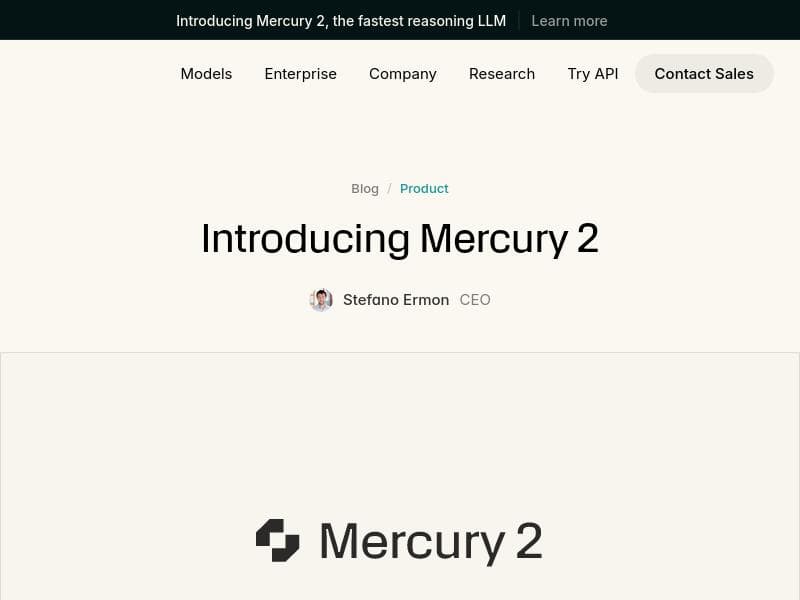
Mercury 2 is the world's fastest reasoning language model, leveraging parallel refinement and reasoning diffusion to generate over 1,000 tokens per second. Designed for production environments requiring instant, high-quality AI reasoning, it excels in real-time agentic loops and latency-sensitive applications.
Mercury 2 is an advanced language model designed to revolutionize the way AI reasoning tasks are performed by breaking away from traditional sequential decoding methods. Unlike conventional large language models (LLMs) that generate tokens one after another, Mercury 2 employs a novel parallel refinement approach, enabling it to produce multiple tokens simultaneously. This innovative mechanism allows Mercury 2 to achieve an unprecedented generation speed of over 1,000 tokens per second, making it the world's fastest reasoning language model. Its core purpose is to deliver high-quality, reasoning-grade outputs within extremely tight latency constraints, which is critical for real-time agentic loops and interactive AI applications where speed and accuracy are paramount. At the heart of Mercury 2 is the concept of reasoning diffusion, a breakthrough in LLM architecture that enhances the model's ability to perform complex reasoning tasks rapidly. This approach optimizes the model for rapid AI reasoning by refining outputs in parallel rather than relying on slower, step-by-step token generation. The result is a model that not only accelerates throughput but also maintains or improves the quality of reasoning, making it suitable for production environments where both speed and precision are non-negotiable. Mercury 2 is engineered to integrate seamlessly into existing production pipelines, ensuring that developers and enterprises can leverage its capabilities without significant overhead or disruption. Mercury 2 is ideally suited for organizations and developers who require instant, high-quality AI reasoning in their applications. This includes use cases such as real-time decision-making agents, conversational AI systems, automated reasoning tools, and any scenario where latency-sensitive AI inference is critical. For example, in customer support chatbots, Mercury 2 can provide rapid, contextually accurate responses, enhancing user experience. In automated research assistants, it can quickly synthesize and reason over large datasets to deliver insights without delay. Its ability to handle agentic loops efficiently makes it a powerful tool for AI systems that require continuous interaction and adaptation. Regarding pricing, Mercury 2 is offered as a paid service, reflecting its advanced capabilities and enterprise-grade performance. While specific pricing details are not publicly disclosed, potential users are encouraged to contact the provider directly for tailored plans that suit their scale and usage requirements. This paid model ensures dedicated support, ongoing updates, and integration assistance, which are crucial for mission-critical deployments. When compared to alternative language models, Mercury 2 stands out primarily due to its parallel refinement decoding strategy and reasoning diffusion architecture. Most other LLMs rely on sequential decoding, which inherently limits their token generation speed and increases latency. Mercury 2's ability to generate tokens simultaneously not only accelerates processing but also enables it to meet the demanding latency budgets of real-time applications. This makes it particularly advantageous over traditional GPT-based models in scenarios where speed and reasoning quality must coexist. However, as a cutting-edge technology, Mercury 2 may require adaptation in existing workflows and some learning curve for developers unfamiliar with diffusion-based models. Potential limitations to consider include the fact that Mercury 2 is a paid product, which might be a barrier for smaller teams or hobbyists looking for free or open-source alternatives. Additionally, while its parallel refinement approach offers speed advantages, it may necessitate specialized integration efforts to fully harness its capabilities within certain legacy systems. Users should also evaluate their specific use cases to ensure that Mercury 2's reasoning diffusion model aligns with their performance and accuracy requirements. Despite these considerations, Mercury 2 represents a significant step forward in AI language modeling, particularly for applications demanding rapid, high-quality reasoning under tight latency constraints.

Description
Mercury 2 is the world's fastest reasoning language model, leveraging parallel refinement and reasoning diffusion to generate over 1,000 tokens per second. Designed for production environments requiring instant, high-quality AI reasoning, it excels in real-time agentic loops and latency-sensitive applications.
Mercury 2 is an advanced language model designed to revolutionize the way AI reasoning tasks are performed by breaking away from traditional sequential decoding methods. Unlike conventional large language models (LLMs) that generate tokens one after another, Mercury 2 employs a novel parallel refinement approach, enabling it to produce multiple tokens simultaneously. This innovative mechanism allows Mercury 2 to achieve an unprecedented generation speed of over 1,000 tokens per second, making it the world's fastest reasoning language model. Its core purpose is to deliver high-quality, reasoning-grade outputs within extremely tight latency constraints, which is critical for real-time agentic loops and interactive AI applications where speed and accuracy are paramount. At the heart of Mercury 2 is the concept of reasoning diffusion, a breakthrough in LLM architecture that enhances the model's ability to perform complex reasoning tasks rapidly. This approach optimizes the model for rapid AI reasoning by refining outputs in parallel rather than relying on slower, step-by-step token generation. The result is a model that not only accelerates throughput but also maintains or improves the quality of reasoning, making it suitable for production environments where both speed and precision are non-negotiable. Mercury 2 is engineered to integrate seamlessly into existing production pipelines, ensuring that developers and enterprises can leverage its capabilities without significant overhead or disruption. Mercury 2 is ideally suited for organizations and developers who require instant, high-quality AI reasoning in their applications. This includes use cases such as real-time decision-making agents, conversational AI systems, automated reasoning tools, and any scenario where latency-sensitive AI inference is critical. For example, in customer support chatbots, Mercury 2 can provide rapid, contextually accurate responses, enhancing user experience. In automated research assistants, it can quickly synthesize and reason over large datasets to deliver insights without delay. Its ability to handle agentic loops efficiently makes it a powerful tool for AI systems that require continuous interaction and adaptation. Regarding pricing, Mercury 2 is offered as a paid service, reflecting its advanced capabilities and enterprise-grade performance. While specific pricing details are not publicly disclosed, potential users are encouraged to contact the provider directly for tailored plans that suit their scale and usage requirements. This paid model ensures dedicated support, ongoing updates, and integration assistance, which are crucial for mission-critical deployments. When compared to alternative language models, Mercury 2 stands out primarily due to its parallel refinement decoding strategy and reasoning diffusion architecture. Most other LLMs rely on sequential decoding, which inherently limits their token generation speed and increases latency. Mercury 2's ability to generate tokens simultaneously not only accelerates processing but also enables it to meet the demanding latency budgets of real-time applications. This makes it particularly advantageous over traditional GPT-based models in scenarios where speed and reasoning quality must coexist. However, as a cutting-edge technology, Mercury 2 may require adaptation in existing workflows and some learning curve for developers unfamiliar with diffusion-based models. Potential limitations to consider include the fact that Mercury 2 is a paid product, which might be a barrier for smaller teams or hobbyists looking for free or open-source alternatives. Additionally, while its parallel refinement approach offers speed advantages, it may necessitate specialized integration efforts to fully harness its capabilities within certain legacy systems. Users should also evaluate their specific use cases to ensure that Mercury 2's reasoning diffusion model aligns with their performance and accuracy requirements. Despite these considerations, Mercury 2 represents a significant step forward in AI language modeling, particularly for applications demanding rapid, high-quality reasoning under tight latency constraints.
Tool Features
- World's fastest reasoning language model
- Built to make production AI feel instant
- Optimized for rapid AI reasoning
- Seamless integration into production environments
Frequently Asked Questions
What is Mercury 2?
Mercury 2 is an advanced reasoning diffusion large language model that generates tokens simultaneously using parallel refinement, enabling it to produce reasoning-grade outputs at speeds exceeding 1,000 tokens per second.
How much does Mercury 2 cost?
Mercury 2 is a paid service. Specific pricing details are not publicly available and interested users should contact the provider directly for customized pricing plans.
Who is Mercury 2 best for?
Mercury 2 is ideal for developers and organizations needing rapid, high-quality AI reasoning in production environments, especially those working on real-time decision-making agents, conversational AI, and latency-sensitive applications.
What are the main features of Mercury 2?
Key features include the world's fastest reasoning language model architecture, parallel refinement decoding for simultaneous token generation, optimization for rapid AI reasoning, and seamless integration into production systems.
Does Mercury 2 offer a free trial?
There is no information indicating that Mercury 2 offers a free trial. Prospective users should inquire directly with the provider for any trial or demo opportunities.
What integrations does Mercury 2 support?
Mercury 2 is designed for seamless integration into production environments, though specific integration platforms or APIs are not detailed publicly. Users can expect compatibility with standard AI deployment workflows.
How does Mercury 2 work?
Mercury 2 uses a reasoning diffusion approach with parallel refinement decoding, generating multiple tokens simultaneously rather than sequentially, which allows it to achieve high-speed, reasoning-grade output suitable for real-time AI applications.
Socials
Use ToolSponsored Tools


































Reviews
No reviews yet. Be the first to share your experience.