Description
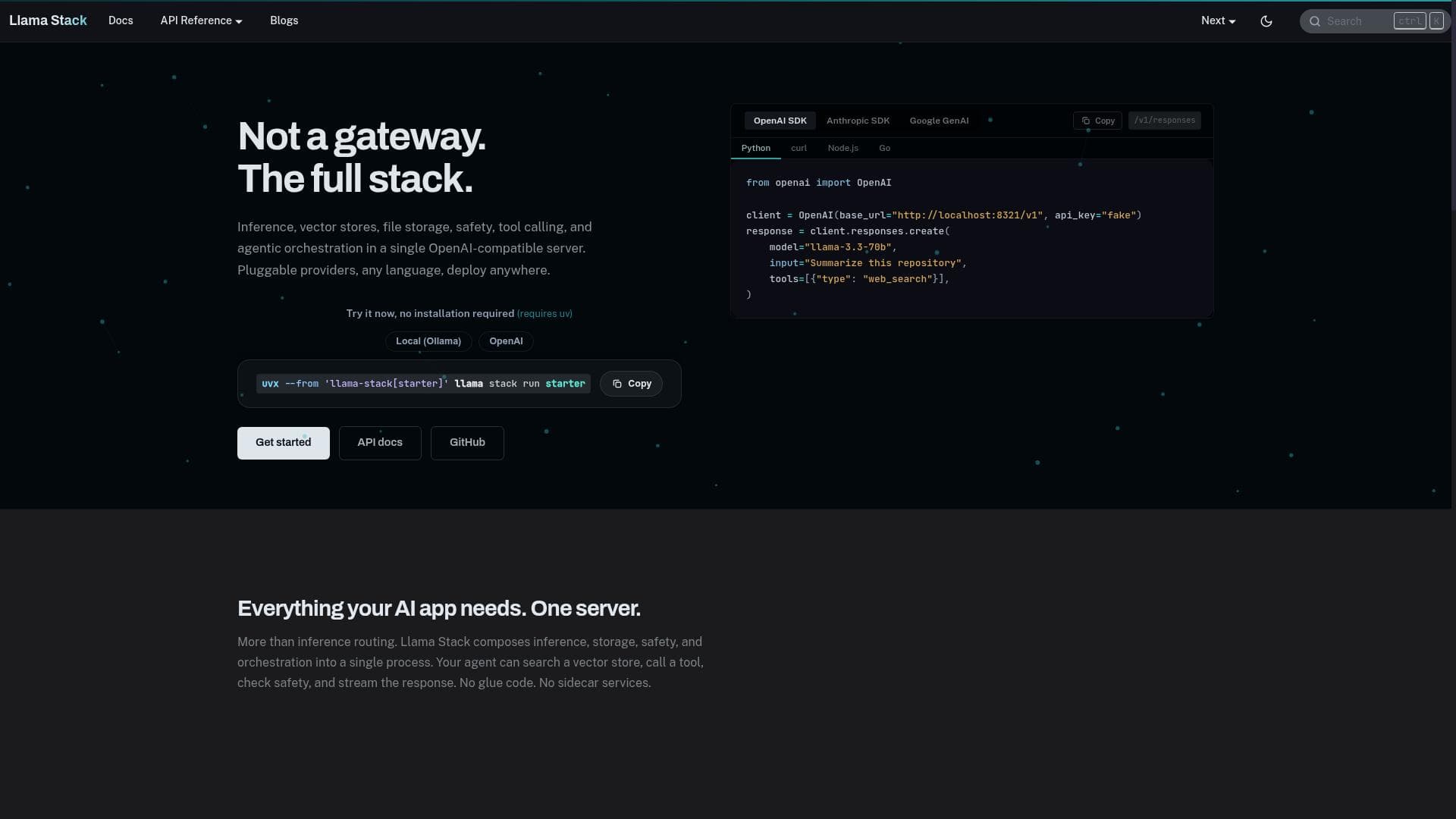
Llama Stack is a versatile framework that standardizes generative AI agent development across on-prem, cloud, and device environments with a unified API optimized for Llama models. Ideal for developers and enterprises seeking flexible, multi-provider AI orchestration with built-in safety and vector store capabilities, it offers a free, open approach to building sophisticated genAI applications.
Llama Stack is a comprehensive framework designed to standardize and streamline the development of generative AI (genAI) agentic applications across a variety of deployment environments, including on-premises, cloud infrastructures, single-node setups, and on-device platforms. Its core purpose is to provide developers with a unified API interface and an optimized developer experience specifically tailored for Llama models, enabling seamless integration and orchestration of AI agents in diverse operational contexts. By focusing on standardization, Llama Stack reduces the complexity typically associated with building and deploying genAI applications, making it easier to leverage advanced AI capabilities in real-world scenarios. At the heart of Llama Stack are several key features that empower developers to build robust and scalable AI solutions. The inference capability allows for efficient execution of AI models, ensuring responsive and accurate outputs. Vector stores are integrated to facilitate advanced similarity search and retrieval operations, which are essential for applications like recommendation systems, semantic search, and knowledge management. Safety features are embedded to help developers implement guardrails and ensure responsible AI usage, addressing concerns related to bias, misuse, and content moderation. Llama Stack also supports a variety of tools and agentic orchestration mechanisms, enabling complex workflows where multiple AI agents can interact, collaborate, or operate autonomously to achieve sophisticated tasks. Importantly, the platform is compatible with major AI providers such as OpenAI, Anthropic, and Google, allowing developers to plug in different backends and leverage the best available models and services. This pluggable provider architecture ensures flexibility and future-proofing, as users can switch or combine providers based on performance, cost, or feature requirements. This tool is best suited for AI developers, data scientists, and enterprises looking to build advanced generative AI applications that require multi-agent orchestration, safety controls, and flexible deployment options. Use cases span from conversational AI, automated content generation, and intelligent assistants to complex decision-making systems and research tools that benefit from vector-based retrieval and multi-provider integration. Organizations aiming to deploy genAI solutions on-premises or in hybrid environments will find Llama Stack particularly valuable due to its standardized API and optimized developer experience. Llama Stack is offered as a free tool, which lowers the barrier to entry for developers and organizations wanting to experiment with or deploy generative AI applications. Unlike many commercial AI development platforms that charge based on usage or subscription tiers, Llama Stack’s free availability encourages adoption and community-driven enhancements. This pricing model makes it an attractive choice for startups, academic researchers, and independent developers. Compared to alternatives, Llama Stack stands out by focusing on standardization across diverse environments and its deep optimization for Llama models. While other frameworks might specialize in cloud-only deployments or single-provider ecosystems, Llama Stack’s pluggable provider system and multi-environment support offer unmatched flexibility. However, its specialization in Llama models might limit users who prefer other model families or require specialized features outside its scope. Additionally, as an open and free tool, enterprise-grade support and advanced commercial features may be limited compared to paid platforms. Potential users should consider that while Llama Stack offers extensive capabilities, it requires familiarity with AI development and deployment concepts to fully leverage its features. The safety mechanisms, while robust, depend on correct implementation by developers. Furthermore, integration with multiple providers, while flexible, can introduce complexity in managing API keys, costs, and performance tuning. Overall, Llama Stack is a powerful, flexible, and cost-effective solution for building agentic genAI applications, especially for those invested in the Llama ecosystem and requiring multi-environment deployment options.

Description
Llama Stack is a versatile framework that standardizes generative AI agent development across on-prem, cloud, and device environments with a unified API optimized for Llama models. Ideal for developers and enterprises seeking flexible, multi-provider AI orchestration with built-in safety and vector store capabilities, it offers a free, open approach to building sophisticated genAI applications.
Llama Stack is a comprehensive framework designed to standardize and streamline the development of generative AI (genAI) agentic applications across a variety of deployment environments, including on-premises, cloud infrastructures, single-node setups, and on-device platforms. Its core purpose is to provide developers with a unified API interface and an optimized developer experience specifically tailored for Llama models, enabling seamless integration and orchestration of AI agents in diverse operational contexts. By focusing on standardization, Llama Stack reduces the complexity typically associated with building and deploying genAI applications, making it easier to leverage advanced AI capabilities in real-world scenarios. At the heart of Llama Stack are several key features that empower developers to build robust and scalable AI solutions. The inference capability allows for efficient execution of AI models, ensuring responsive and accurate outputs. Vector stores are integrated to facilitate advanced similarity search and retrieval operations, which are essential for applications like recommendation systems, semantic search, and knowledge management. Safety features are embedded to help developers implement guardrails and ensure responsible AI usage, addressing concerns related to bias, misuse, and content moderation. Llama Stack also supports a variety of tools and agentic orchestration mechanisms, enabling complex workflows where multiple AI agents can interact, collaborate, or operate autonomously to achieve sophisticated tasks. Importantly, the platform is compatible with major AI providers such as OpenAI, Anthropic, and Google, allowing developers to plug in different backends and leverage the best available models and services. This pluggable provider architecture ensures flexibility and future-proofing, as users can switch or combine providers based on performance, cost, or feature requirements. This tool is best suited for AI developers, data scientists, and enterprises looking to build advanced generative AI applications that require multi-agent orchestration, safety controls, and flexible deployment options. Use cases span from conversational AI, automated content generation, and intelligent assistants to complex decision-making systems and research tools that benefit from vector-based retrieval and multi-provider integration. Organizations aiming to deploy genAI solutions on-premises or in hybrid environments will find Llama Stack particularly valuable due to its standardized API and optimized developer experience. Llama Stack is offered as a free tool, which lowers the barrier to entry for developers and organizations wanting to experiment with or deploy generative AI applications. Unlike many commercial AI development platforms that charge based on usage or subscription tiers, Llama Stack’s free availability encourages adoption and community-driven enhancements. This pricing model makes it an attractive choice for startups, academic researchers, and independent developers. Compared to alternatives, Llama Stack stands out by focusing on standardization across diverse environments and its deep optimization for Llama models. While other frameworks might specialize in cloud-only deployments or single-provider ecosystems, Llama Stack’s pluggable provider system and multi-environment support offer unmatched flexibility. However, its specialization in Llama models might limit users who prefer other model families or require specialized features outside its scope. Additionally, as an open and free tool, enterprise-grade support and advanced commercial features may be limited compared to paid platforms. Potential users should consider that while Llama Stack offers extensive capabilities, it requires familiarity with AI development and deployment concepts to fully leverage its features. The safety mechanisms, while robust, depend on correct implementation by developers. Furthermore, integration with multiple providers, while flexible, can introduce complexity in managing API keys, costs, and performance tuning. Overall, Llama Stack is a powerful, flexible, and cost-effective solution for building agentic genAI applications, especially for those invested in the Llama ecosystem and requiring multi-environment deployment options.
Tool Features
- Inference
- Vector stores
- Safety
- Tools
- Agentic orchestration
- OpenAI + Anthropic + Google compatible
- Pluggable providers
Frequently Asked Questions
What is Llama Stack?
Llama Stack is a development framework that standardizes and simplifies the creation of generative AI agentic applications across various environments such as on-premises, cloud, single-node, and on-device. It provides a unified API and developer experience optimized for Llama models, enabling multi-agent orchestration, safety features, and integration with multiple AI providers.
How much does Llama Stack cost?
Llama Stack is available for free, allowing developers and organizations to use its features without any licensing or subscription fees.
Who is Llama Stack best for?
Llama Stack is best suited for AI developers, data scientists, startups, and enterprises looking to build and deploy generative AI applications that require multi-agent orchestration, safety controls, vector-based retrieval, and flexible deployment options across on-premises, cloud, or device environments.
What are the main features of Llama Stack?
Key features include inference optimized for Llama models, integrated vector stores for similarity search, built-in safety mechanisms, a suite of AI development tools, agentic orchestration capabilities, compatibility with major AI providers like OpenAI, Anthropic, and Google, and a pluggable provider architecture for flexible backend integration.
Does Llama Stack offer a free trial?
Llama Stack is completely free to use, so there is no need for a trial period or subscription to access its features.
What integrations does Llama Stack support?
Llama Stack supports integration with multiple AI providers including OpenAI, Anthropic, and Google, allowing developers to plug in different model backends and services according to their needs.
How does Llama Stack work?
Llama Stack works by providing a standardized API interface and developer experience optimized for Llama models, enabling developers to build, orchestrate, and deploy generative AI agents across various environments. It supports inference, vector stores, safety features, and multi-provider integrations to create flexible and scalable AI applications.
Socials
Use ToolSponsored Tools































Reviews
No reviews yet. Be the first to share your experience.