Description
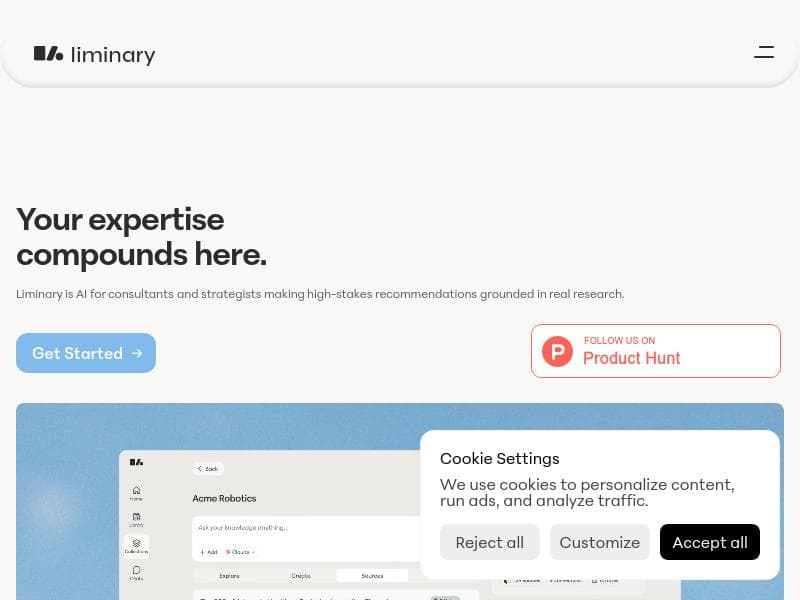
Liminary revolutionizes knowledge management by turning all your saved content into a shared AI-powered working memory that automatically surfaces relevant context as you work. Ideal for expert knowledge workers, it helps you reuse your best thinking, avoid starting from scratch, and produce source-grounded work with ease.
Liminary is an innovative AI-powered knowledge management tool designed to transform everything you’ve saved—whether documents, web content, emails, videos, or AI chat transcripts—into a dynamic, shared working memory accessible across writing, meetings, and research workflows. Unlike traditional chatbots, meeting transcription tools, or project-based notebooks that silo information, Liminary centralizes your knowledge into one AI-native storage system. This unified memory automatically surfaces relevant context exactly when you need it, helping expert knowledge workers avoid redundant effort, reuse their best insights, and produce work that is both efficient and source-grounded with traceable citations. At its core, Liminary’s purpose is to eliminate the friction of manual searching, organizing, and recalling information scattered across multiple platforms. It achieves this by saving content from virtually any source—web pages, PDFs, videos, emails, AI chats, and local files—into a single intelligent repository. The tool then leverages AI to analyze and index this content, enabling it to proactively suggest pertinent information as you write, conduct meetings, or perform research. This seamless integration of your knowledge base into your daily workflow reduces cognitive load and accelerates productivity by ensuring you never have to start from scratch or lose track of valuable insights. Key features of Liminary include its comprehensive content ingestion capabilities, which support a wide variety of formats and sources, making it easy to consolidate your knowledge without changing your habits. Its AI-driven context surfacing is another standout feature, automatically bringing up relevant notes, references, or data points based on your current task or conversation. This eliminates the need for manual searches or toggling between apps. Additionally, Liminary’s AI-native storage is purpose-built for the modern AI era, optimizing how information is stored, retrieved, and linked to ensure fast, accurate, and contextually relevant results. The platform also supports traceable citations, which is crucial for producing credible, source-backed work. Liminary is best suited for expert knowledge workers, researchers, writers, consultants, and professionals who rely heavily on accumulated knowledge and need to access it efficiently across multiple contexts. Use cases include preparing for meetings with automatically surfaced background information, drafting reports or articles with embedded citations, conducting research without losing track of sources, and managing complex projects where knowledge reuse is critical. It is particularly valuable for individuals and teams who handle large volumes of diverse content and require a smart system to organize and recall that information effortlessly. The pricing model for Liminary is freemium, allowing users to start with a free tier that provides essential features and content saving capabilities. This approach makes it accessible for individuals and small teams to test and integrate the tool into their workflows before scaling up. While specific pricing details for premium plans are not provided here, the freemium model typically includes options for enhanced storage, advanced AI features, and team collaboration tools. Compared to alternatives like traditional note-taking apps, project notebooks, or standalone AI chatbots, Liminary’s unique value lies in its unified, AI-powered shared memory that spans multiple work contexts. Unlike isolated tools that require manual input or searching, Liminary proactively delivers relevant knowledge, reducing cognitive overhead and improving workflow continuity. Its ability to ingest a broad range of content types and automatically link them with context sets it apart from simpler document managers or meeting transcription services. However, potential users should consider that as a relatively new AI-native platform, Liminary’s effectiveness depends on the quality and volume of content ingested. Users with minimal saved content may find less immediate benefit. Additionally, while the freemium model is great for trial, advanced features and larger storage needs may require paid plans. Integration specifics and compatibility with certain enterprise systems may also vary, so users should verify these aspects based on their environment. In summary, Liminary offers a powerful, AI-driven approach to knowledge management that helps expert workers harness their accumulated information more effectively. By turning saved content into a shared, contextually aware working memory, it streamlines research, writing, and meetings, enabling users to produce high-quality, source-backed work with greater speed and confidence.

Description
Liminary revolutionizes knowledge management by turning all your saved content into a shared AI-powered working memory that automatically surfaces relevant context as you work. Ideal for expert knowledge workers, it helps you reuse your best thinking, avoid starting from scratch, and produce source-grounded work with ease.
Liminary is an innovative AI-powered knowledge management tool designed to transform everything you’ve saved—whether documents, web content, emails, videos, or AI chat transcripts—into a dynamic, shared working memory accessible across writing, meetings, and research workflows. Unlike traditional chatbots, meeting transcription tools, or project-based notebooks that silo information, Liminary centralizes your knowledge into one AI-native storage system. This unified memory automatically surfaces relevant context exactly when you need it, helping expert knowledge workers avoid redundant effort, reuse their best insights, and produce work that is both efficient and source-grounded with traceable citations. At its core, Liminary’s purpose is to eliminate the friction of manual searching, organizing, and recalling information scattered across multiple platforms. It achieves this by saving content from virtually any source—web pages, PDFs, videos, emails, AI chats, and local files—into a single intelligent repository. The tool then leverages AI to analyze and index this content, enabling it to proactively suggest pertinent information as you write, conduct meetings, or perform research. This seamless integration of your knowledge base into your daily workflow reduces cognitive load and accelerates productivity by ensuring you never have to start from scratch or lose track of valuable insights. Key features of Liminary include its comprehensive content ingestion capabilities, which support a wide variety of formats and sources, making it easy to consolidate your knowledge without changing your habits. Its AI-driven context surfacing is another standout feature, automatically bringing up relevant notes, references, or data points based on your current task or conversation. This eliminates the need for manual searches or toggling between apps. Additionally, Liminary’s AI-native storage is purpose-built for the modern AI era, optimizing how information is stored, retrieved, and linked to ensure fast, accurate, and contextually relevant results. The platform also supports traceable citations, which is crucial for producing credible, source-backed work. Liminary is best suited for expert knowledge workers, researchers, writers, consultants, and professionals who rely heavily on accumulated knowledge and need to access it efficiently across multiple contexts. Use cases include preparing for meetings with automatically surfaced background information, drafting reports or articles with embedded citations, conducting research without losing track of sources, and managing complex projects where knowledge reuse is critical. It is particularly valuable for individuals and teams who handle large volumes of diverse content and require a smart system to organize and recall that information effortlessly. The pricing model for Liminary is freemium, allowing users to start with a free tier that provides essential features and content saving capabilities. This approach makes it accessible for individuals and small teams to test and integrate the tool into their workflows before scaling up. While specific pricing details for premium plans are not provided here, the freemium model typically includes options for enhanced storage, advanced AI features, and team collaboration tools. Compared to alternatives like traditional note-taking apps, project notebooks, or standalone AI chatbots, Liminary’s unique value lies in its unified, AI-powered shared memory that spans multiple work contexts. Unlike isolated tools that require manual input or searching, Liminary proactively delivers relevant knowledge, reducing cognitive overhead and improving workflow continuity. Its ability to ingest a broad range of content types and automatically link them with context sets it apart from simpler document managers or meeting transcription services. However, potential users should consider that as a relatively new AI-native platform, Liminary’s effectiveness depends on the quality and volume of content ingested. Users with minimal saved content may find less immediate benefit. Additionally, while the freemium model is great for trial, advanced features and larger storage needs may require paid plans. Integration specifics and compatibility with certain enterprise systems may also vary, so users should verify these aspects based on their environment. In summary, Liminary offers a powerful, AI-driven approach to knowledge management that helps expert workers harness their accumulated information more effectively. By turning saved content into a shared, contextually aware working memory, it streamlines research, writing, and meetings, enabling users to produce high-quality, source-backed work with greater speed and confidence.
Tool Features
- Saves content from anywhere including web pages, PDFs, videos, emails, AI chats, and local files
- Automatically surfaces the right information when you need it
- Eliminates the need for manual searching and organizing
- AI-native storage designed for the AI age
Frequently Asked Questions
What is Liminary?
Liminary is an AI-powered knowledge management tool that consolidates all your saved content into a shared working memory, automatically surfacing relevant information across writing, meetings, and research to enhance productivity and produce source-backed work.
How much does Liminary cost?
Liminary offers a freemium pricing model, allowing users to access essential features for free with options to upgrade for additional storage, advanced AI capabilities, and team collaboration tools.
Who is Liminary best for?
Liminary is ideal for expert knowledge workers, researchers, writers, consultants, and professionals who manage large volumes of diverse content and need to efficiently access and reuse their accumulated knowledge across multiple workflows.
What are the main features of Liminary?
Key features include saving content from various sources such as web pages, PDFs, videos, emails, AI chats, and local files; AI-driven automatic surfacing of relevant information; elimination of manual searching and organizing; and AI-native storage optimized for the modern AI era.
Does Liminary offer a free trial?
Yes, Liminary’s freemium model allows users to start using the tool for free with access to core features, enabling them to evaluate its capabilities before opting for paid plans.
What integrations does Liminary support?
Liminary supports saving and ingesting content from a wide range of sources including web pages, PDFs, videos, emails, AI chats, and local files, though specific third-party app integrations should be verified on their website.
How does Liminary work?
Liminary works by ingesting and storing all your saved content into an AI-native repository, then using AI to analyze and index this information. It automatically surfaces relevant context and citations as you work across writing, meetings, and research, streamlining knowledge reuse and productivity.
Socials
Use ToolSponsored Tools































Reviews
No reviews yet. Be the first to share your experience.