Description
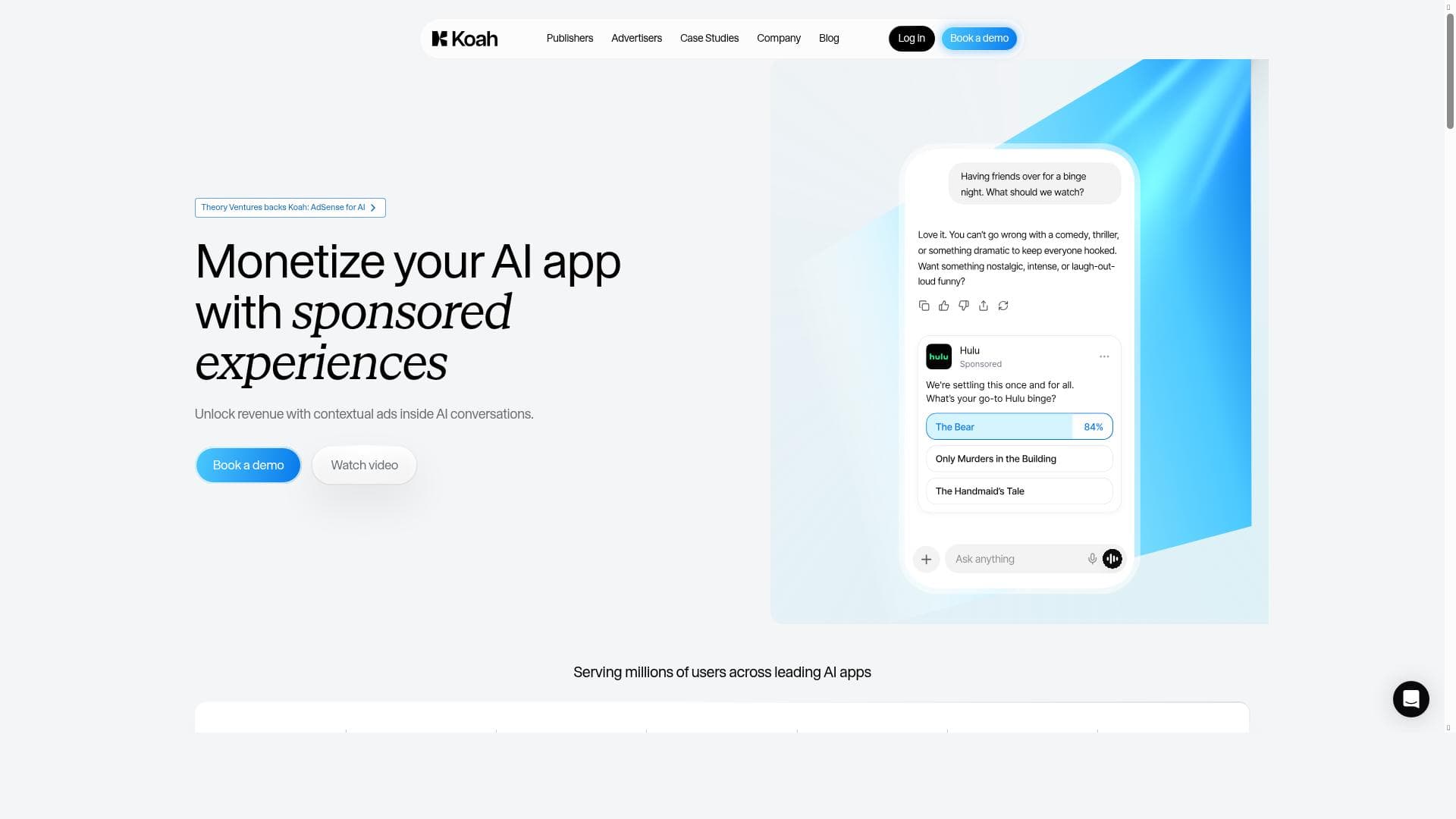
Koah empowers developers to monetize generative AI applications effortlessly by embedding native, context-aware ads directly within AI conversations. With its lightweight SDK and five-minute setup, Koah is ideal for AI app creators seeking seamless, relevant advertising that enhances user experience while unlocking new revenue streams.
Koah is a specialized monetization platform designed specifically for generative AI (GenAI) applications, enabling developers and businesses to seamlessly integrate contextual advertising within their AI-driven user experiences. Its core purpose is to help AI app creators unlock new revenue streams by embedding native, context-aware ads directly inside AI conversations, ensuring that advertisements feel relevant and non-intrusive to end users. By focusing on contextual ads, Koah enhances monetization without compromising the natural flow and engagement of AI interactions, making it an ideal solution for developers looking to capitalize on their AI applications without detracting from user experience. One of Koah's standout features is its lightweight SDK, available both as a JavaScript snippet and a React Native package, which facilitates rapid integration into existing AI applications. This streamlined setup process can be completed in as little as five minutes, allowing developers to quickly deploy monetization strategies without extensive engineering overhead. The SDK is designed to be minimalistic yet powerful, ensuring that it does not bloat the application or degrade performance. Koah’s contextual advertising technology intelligently analyzes the AI conversation context to serve ads that are highly relevant to the user’s current interaction, increasing the likelihood of engagement and conversion. Koah is particularly well-suited for developers, startups, and enterprises building generative AI chatbots, virtual assistants, or any AI-powered conversational interfaces that seek to generate revenue through advertising. Use cases include AI customer support bots that display relevant product offers, AI writing assistants that suggest related services, or AI-powered educational tools that monetize through targeted ad placements. By embedding ads contextually, Koah helps maintain a seamless user experience while providing a sustainable business model for AI applications that might otherwise rely solely on subscription or one-time payments. In terms of pricing, Koah operates on a freemium model, allowing developers to start monetizing their AI apps at no upfront cost. This approach lowers the barrier to entry and encourages experimentation with contextual ads. While specific pricing tiers and premium features are not detailed, the freemium plan likely includes basic access to the SDK and ad serving capabilities, with potential paid plans offering advanced analytics, higher ad volume, or priority support. This flexible pricing structure makes Koah accessible to a wide range of users, from indie developers to larger organizations. Compared to alternative monetization platforms, Koah’s unique selling point is its exclusive focus on generative AI applications and the seamless integration of contextual ads within AI conversations. Unlike generic ad networks that may disrupt the user experience or require complex customization, Koah’s SDK is purpose-built for AI environments, ensuring ads are relevant and native to the dialogue. This specialization sets it apart from traditional ad platforms and general-purpose monetization tools, providing a tailored solution that aligns with the nuances of AI-driven user interactions. However, potential users should consider some limitations. As a relatively new and niche platform, Koah’s ad inventory and reach might be more limited compared to established ad networks, potentially affecting revenue scale. Additionally, the effectiveness of contextual ads depends heavily on the AI application's domain and user engagement patterns, so results may vary. Developers should also evaluate privacy and data handling policies to ensure compliance with regulations when integrating ad services into AI conversations. Despite these considerations, Koah offers a compelling and efficient way to monetize GenAI apps with minimal setup and disruption.

Description
Koah empowers developers to monetize generative AI applications effortlessly by embedding native, context-aware ads directly within AI conversations. With its lightweight SDK and five-minute setup, Koah is ideal for AI app creators seeking seamless, relevant advertising that enhances user experience while unlocking new revenue streams.
Koah is a specialized monetization platform designed specifically for generative AI (GenAI) applications, enabling developers and businesses to seamlessly integrate contextual advertising within their AI-driven user experiences. Its core purpose is to help AI app creators unlock new revenue streams by embedding native, context-aware ads directly inside AI conversations, ensuring that advertisements feel relevant and non-intrusive to end users. By focusing on contextual ads, Koah enhances monetization without compromising the natural flow and engagement of AI interactions, making it an ideal solution for developers looking to capitalize on their AI applications without detracting from user experience. One of Koah's standout features is its lightweight SDK, available both as a JavaScript snippet and a React Native package, which facilitates rapid integration into existing AI applications. This streamlined setup process can be completed in as little as five minutes, allowing developers to quickly deploy monetization strategies without extensive engineering overhead. The SDK is designed to be minimalistic yet powerful, ensuring that it does not bloat the application or degrade performance. Koah’s contextual advertising technology intelligently analyzes the AI conversation context to serve ads that are highly relevant to the user’s current interaction, increasing the likelihood of engagement and conversion. Koah is particularly well-suited for developers, startups, and enterprises building generative AI chatbots, virtual assistants, or any AI-powered conversational interfaces that seek to generate revenue through advertising. Use cases include AI customer support bots that display relevant product offers, AI writing assistants that suggest related services, or AI-powered educational tools that monetize through targeted ad placements. By embedding ads contextually, Koah helps maintain a seamless user experience while providing a sustainable business model for AI applications that might otherwise rely solely on subscription or one-time payments. In terms of pricing, Koah operates on a freemium model, allowing developers to start monetizing their AI apps at no upfront cost. This approach lowers the barrier to entry and encourages experimentation with contextual ads. While specific pricing tiers and premium features are not detailed, the freemium plan likely includes basic access to the SDK and ad serving capabilities, with potential paid plans offering advanced analytics, higher ad volume, or priority support. This flexible pricing structure makes Koah accessible to a wide range of users, from indie developers to larger organizations. Compared to alternative monetization platforms, Koah’s unique selling point is its exclusive focus on generative AI applications and the seamless integration of contextual ads within AI conversations. Unlike generic ad networks that may disrupt the user experience or require complex customization, Koah’s SDK is purpose-built for AI environments, ensuring ads are relevant and native to the dialogue. This specialization sets it apart from traditional ad platforms and general-purpose monetization tools, providing a tailored solution that aligns with the nuances of AI-driven user interactions. However, potential users should consider some limitations. As a relatively new and niche platform, Koah’s ad inventory and reach might be more limited compared to established ad networks, potentially affecting revenue scale. Additionally, the effectiveness of contextual ads depends heavily on the AI application's domain and user engagement patterns, so results may vary. Developers should also evaluate privacy and data handling policies to ensure compliance with regulations when integrating ad services into AI conversations. Despite these considerations, Koah offers a compelling and efficient way to monetize GenAI apps with minimal setup and disruption.
Tool Features
- Monetize AI apps with native, context-aware advertising
- Lightweight SDK for easy integration
- Instant setup for quick deployment
- Contextual ads inside AI conversations
- Unlock revenue streams for AI applications
Frequently Asked Questions
What is Koah?
Koah is a monetization platform designed for generative AI applications that enables developers to integrate native, context-aware advertising within AI conversations using a lightweight SDK.
How much does Koah cost?
Koah offers a freemium pricing model, allowing users to start monetizing their AI apps for free, with potential premium plans available for advanced features and higher usage.
Who is Koah best for?
Koah is best suited for developers, startups, and enterprises building generative AI chatbots, virtual assistants, or conversational AI apps who want to generate revenue through contextual advertising.
What are the main features of Koah?
Key features include native, context-aware advertising tailored to AI conversations, a lightweight JavaScript and React Native SDK for easy integration, instant setup in about five minutes, and the ability to unlock new revenue streams within AI applications.
Does Koah offer a free trial?
Yes, Koah operates on a freemium model, allowing users to try the platform and start monetizing their AI apps at no initial cost.
What integrations does Koah support?
Koah provides a lightweight SDK available as a JavaScript snippet and a React Native package, making it compatible with web and mobile AI applications built on these technologies.
How does Koah work?
Koah works by embedding contextual ads directly inside AI conversations through its SDK, which analyzes the dialogue context to serve relevant, native advertisements that enhance monetization without disrupting user experience.
Sponsored Tools



































Reviews
No reviews yet. Be the first to share your experience.