Kling Motion Control
Description
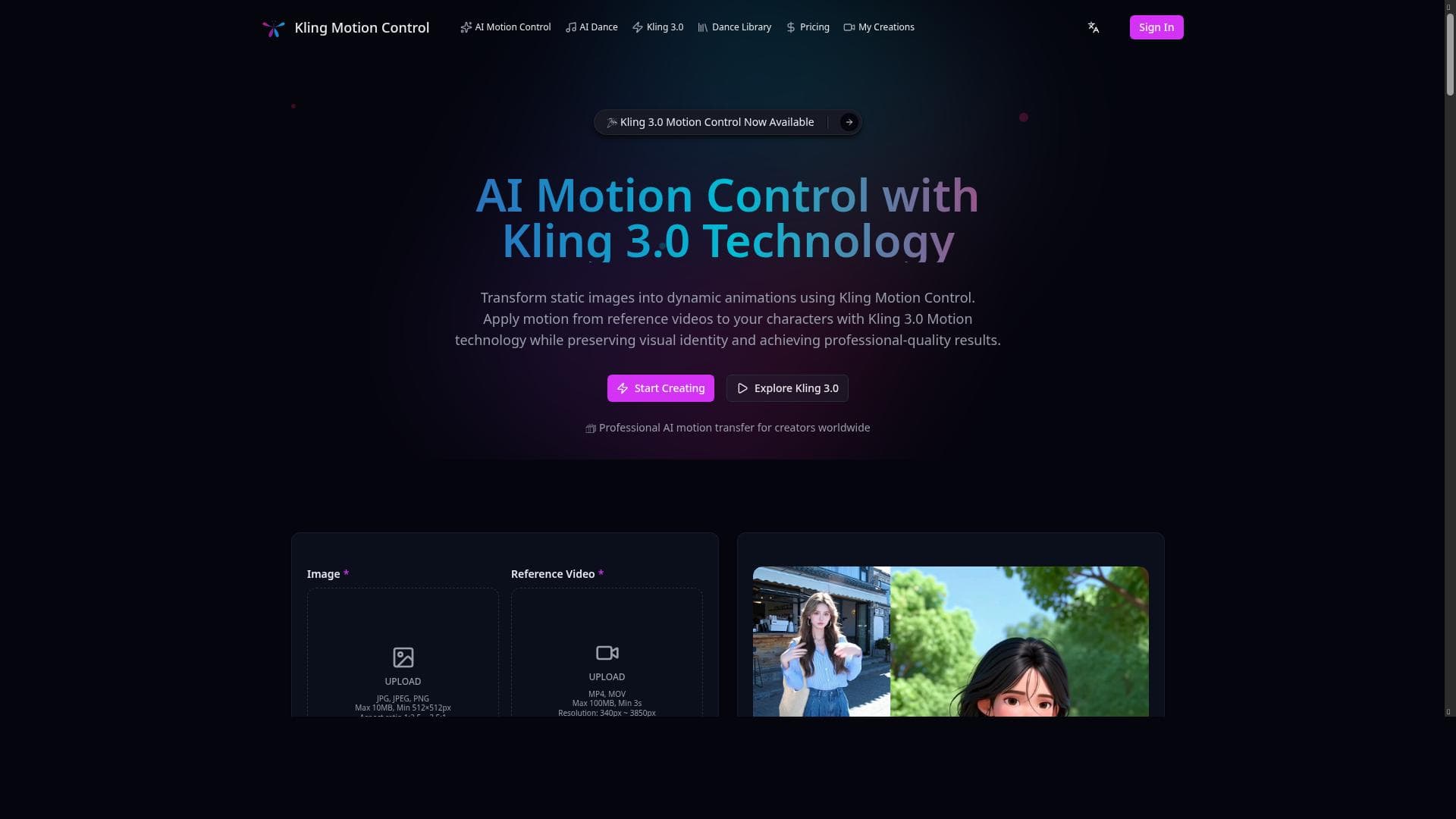
Kling Motion Control uniquely empowers creators to animate static images by transferring precise full-body motion from reference videos, ensuring exact replication of movements and expressions. Ideal for animators and digital artists seeking detailed control over character animations, it eliminates randomness and maintains identity consistency for truly realistic results.
Kling Motion Control is a cutting-edge AI tool designed to revolutionize the way creators animate static images by transferring motion from reference videos with remarkable accuracy. At its core, the tool enables users to breathe life into still characters by mirroring every movement and expression captured in a video, resulting in realistic, fully synchronized AI character animations. This capability is particularly valuable for animators, game developers, digital artists, and content creators who require precise control over character motion without the unpredictability often associated with AI-generated animations. By eliminating randomness, Kling Motion Control ensures that every gesture, facial expression, and body orientation is faithfully reproduced, allowing for seamless integration of dynamic motion into static visuals. One of the standout features of Kling Motion Control is its Accurate Motion Transfer technology, which meticulously maps the movements from a reference video onto a static image. This includes full-body and gesture precision, ensuring that even subtle nuances in posture and hand movements are captured and replicated. The tool also maintains Identity Consistency, preserving the unique characteristics and appearance of the original static image throughout the animation process. This is critical for creators who want to maintain brand or character integrity while animating. Additionally, Kling Motion Control offers Orientation Flexibility, allowing users to adjust the angle and perspective of the animated character to fit various scene requirements. Beyond motion replication, Kling Motion Control incorporates Prompt-Guided Scene Refinement, enabling users to fine-tune animations through descriptive prompts that adjust the scene’s mood, style, or specific motion details. An Audio Control Option further enhances the tool’s versatility by synchronizing character animations with sound inputs, making it ideal for lip-syncing or rhythm-based movements. These advanced features collectively provide a comprehensive suite for detailed and customizable animation workflows. Kling Motion Control is best suited for professionals and enthusiasts in animation, game design, virtual production, and digital storytelling who demand high fidelity and control in character animation. It is particularly useful for projects requiring exact replication of human motion, such as virtual influencers, educational content, marketing campaigns, and interactive media. The ability to upload custom reference videos means creators can use real-life footage to drive animations, bridging the gap between live-action and digital art. Regarding pricing, Kling Motion Control operates on a paid model, reflecting its advanced capabilities and professional-grade output. While specific pricing tiers are not detailed here, users can expect plans that cater to different levels of usage, from individual creators to studios. Potential customers should visit the official website to explore current subscription options and any available packages. Compared to alternative animation tools, Kling Motion Control stands out due to its focus on precise, full-body motion transfer from video references, a feature not commonly found in standard AI animation software. Many competitors rely on generative models that introduce randomness or lack fine control over gestures and identity preservation. Kling Motion Control’s emphasis on eliminating randomness and maintaining character integrity makes it a preferred choice for creators who need exact replication rather than approximate animation. However, users should consider that Kling Motion Control requires high-quality reference videos for optimal results, and the learning curve may be steeper for those unfamiliar with motion capture or animation principles. Additionally, as a paid tool, it may not be accessible for hobbyists or those seeking free solutions. Integration options and compatibility with other creative software are not explicitly mentioned, which could be a limitation for workflows requiring seamless interoperability. In summary, Kling Motion Control offers a powerful, precise, and flexible solution for animating static images through motion transfer from videos. Its rich feature set and focus on control and fidelity make it an invaluable asset for professionals aiming to create realistic AI-driven character animations.

Description
Kling Motion Control uniquely empowers creators to animate static images by transferring precise full-body motion from reference videos, ensuring exact replication of movements and expressions. Ideal for animators and digital artists seeking detailed control over character animations, it eliminates randomness and maintains identity consistency for truly realistic results.
Kling Motion Control is a cutting-edge AI tool designed to revolutionize the way creators animate static images by transferring motion from reference videos with remarkable accuracy. At its core, the tool enables users to breathe life into still characters by mirroring every movement and expression captured in a video, resulting in realistic, fully synchronized AI character animations. This capability is particularly valuable for animators, game developers, digital artists, and content creators who require precise control over character motion without the unpredictability often associated with AI-generated animations. By eliminating randomness, Kling Motion Control ensures that every gesture, facial expression, and body orientation is faithfully reproduced, allowing for seamless integration of dynamic motion into static visuals. One of the standout features of Kling Motion Control is its Accurate Motion Transfer technology, which meticulously maps the movements from a reference video onto a static image. This includes full-body and gesture precision, ensuring that even subtle nuances in posture and hand movements are captured and replicated. The tool also maintains Identity Consistency, preserving the unique characteristics and appearance of the original static image throughout the animation process. This is critical for creators who want to maintain brand or character integrity while animating. Additionally, Kling Motion Control offers Orientation Flexibility, allowing users to adjust the angle and perspective of the animated character to fit various scene requirements. Beyond motion replication, Kling Motion Control incorporates Prompt-Guided Scene Refinement, enabling users to fine-tune animations through descriptive prompts that adjust the scene’s mood, style, or specific motion details. An Audio Control Option further enhances the tool’s versatility by synchronizing character animations with sound inputs, making it ideal for lip-syncing or rhythm-based movements. These advanced features collectively provide a comprehensive suite for detailed and customizable animation workflows. Kling Motion Control is best suited for professionals and enthusiasts in animation, game design, virtual production, and digital storytelling who demand high fidelity and control in character animation. It is particularly useful for projects requiring exact replication of human motion, such as virtual influencers, educational content, marketing campaigns, and interactive media. The ability to upload custom reference videos means creators can use real-life footage to drive animations, bridging the gap between live-action and digital art. Regarding pricing, Kling Motion Control operates on a paid model, reflecting its advanced capabilities and professional-grade output. While specific pricing tiers are not detailed here, users can expect plans that cater to different levels of usage, from individual creators to studios. Potential customers should visit the official website to explore current subscription options and any available packages. Compared to alternative animation tools, Kling Motion Control stands out due to its focus on precise, full-body motion transfer from video references, a feature not commonly found in standard AI animation software. Many competitors rely on generative models that introduce randomness or lack fine control over gestures and identity preservation. Kling Motion Control’s emphasis on eliminating randomness and maintaining character integrity makes it a preferred choice for creators who need exact replication rather than approximate animation. However, users should consider that Kling Motion Control requires high-quality reference videos for optimal results, and the learning curve may be steeper for those unfamiliar with motion capture or animation principles. Additionally, as a paid tool, it may not be accessible for hobbyists or those seeking free solutions. Integration options and compatibility with other creative software are not explicitly mentioned, which could be a limitation for workflows requiring seamless interoperability. In summary, Kling Motion Control offers a powerful, precise, and flexible solution for animating static images through motion transfer from videos. Its rich feature set and focus on control and fidelity make it an invaluable asset for professionals aiming to create realistic AI-driven character animations.
Tool Features
- Accurate Motion Transfer
- Full‑Body & Gesture Precision
- Identity Consistency
- Orientation Flexibility
- Prompt‑Guided Scene Refinement
- Audio Control Option
Frequently Asked Questions
What is Kling Motion Control?
Kling Motion Control is an AI-powered tool that transfers motion from reference videos onto static images, enabling users to create realistic, fully synchronized character animations with precise control over movements and expressions.
How much does Kling Motion Control cost?
Kling Motion Control is a paid tool. Specific pricing details are not provided here, so interested users should visit the official website to review current subscription plans and pricing options.
Who is Kling Motion Control best for?
It is best suited for animators, game developers, digital artists, virtual production teams, and content creators who require accurate, full-body motion transfer and precise control over character animations.
What are the main features of Kling Motion Control?
Key features include Accurate Motion Transfer, Full-Body & Gesture Precision, Identity Consistency, Orientation Flexibility, Prompt-Guided Scene Refinement, and an Audio Control Option for synchronizing animations with sound.
Does Kling Motion Control offer a free trial?
There is no information provided about a free trial. Prospective users should check the official website for any trial offers or demo versions.
What integrations does Kling Motion Control support?
Integration details are not specified. Users may need to consult the official website or support channels to learn about compatibility with other software or platforms.
How does Kling Motion Control work?
Users upload a reference video capturing desired movements, and Kling Motion Control maps these motions onto a static image, replicating full-body gestures, facial expressions, and orientation with high precision to create realistic animations.
Sponsored Tools





























Reviews
No reviews yet. Be the first to share your experience.