Description
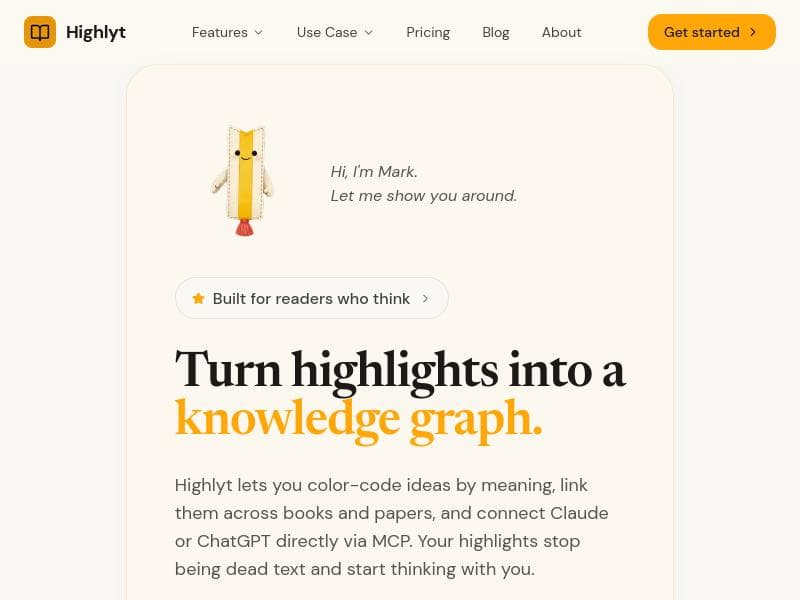
Highlyt revolutionizes digital reading by transforming isolated highlights into a semantic knowledge graph that links ideas across documents. Ideal for researchers, students, and knowledge workers, it combines color-coded annotations with AI integrations to create a dynamic map of your thinking and streamline knowledge synthesis.
Highlyt is an innovative AI-powered tool designed to transform the way readers and researchers interact with their digital documents, particularly PDFs and eBooks. At its core, Highlyt addresses a common frustration: the accumulation of countless highlights and annotations scattered across multiple documents, which often remain isolated and disconnected from one another. Instead of treating highlights as mere isolated snippets, Highlyt elevates each highlight into a meaningful node within a dynamic knowledge graph. This graph visually and structurally links ideas across books, papers, and articles, enabling users to see how concepts support, contradict, expand upon, or question each other. The result is a rich, interconnected map of one’s actual thinking and research insights, making knowledge synthesis and retrieval far more intuitive and powerful. Highlyt offers a suite of advanced features that enhance the reading and research experience. Its standout capability is color-coded PDF highlighting, where each color corresponds to a specific semantic meaning, such as support, contradiction, expansion, or inquiry. This semantic layering allows users to categorize and interpret their notes contextually rather than just visually. Beyond simple annotation, Highlyt builds a knowledge graph that links these highlights across multiple documents, creating a web of interconnected ideas rather than isolated fragments. The platform also supports an MCP server integration, enabling direct connectivity with AI models like Claude and ChatGPT, which can assist in summarization, elaboration, or further exploration of highlighted content. Users benefit from full-text search functionality across all uploaded documents and highlights, making it easy to locate specific information quickly. For interoperability, Highlyt supports exporting data in JSON and Markdown formats, allowing seamless integration with other AI tools or knowledge management systems. Additionally, it offers cloud synchronization with robust Row Level Security (RLS), ensuring that users’ data remains secure and accessible across devices. Highlyt is particularly well-suited for academics, researchers, students, writers, and knowledge workers who regularly engage with large volumes of text and require a sophisticated method to organize and connect their insights. For example, a graduate student conducting literature reviews can use Highlyt to track how different studies relate to each other, noting agreements or contradictions. Writers and content creators can map ideas from various sources to develop richer narratives or arguments. Professionals in research-intensive roles will find the knowledge graph invaluable for synthesizing complex information and generating new perspectives. The tool’s integration with AI chatbots also supports brainstorming and deeper analysis, making it a versatile companion for intellectual work. Highlyt operates on a freemium pricing model, allowing users to access core functionalities for free while offering premium features or higher usage limits under paid plans. This approach makes it accessible for casual users and students while providing scalability for professionals and teams requiring advanced capabilities or enhanced security features. Pricing details and plan tiers are available on the Highlyt website, ensuring transparency and flexibility. Compared to traditional PDF annotation tools or simple note-taking apps, Highlyt stands out by combining semantic highlighting with a knowledge graph approach. Unlike tools that treat highlights as isolated comments, Highlyt’s graph structure reveals relationships between ideas, enabling deeper cognitive connections and more effective knowledge management. Its direct integration with AI models like Claude and ChatGPT further differentiates it by facilitating AI-assisted research workflows. While other tools may offer cloud syncing or export options, Highlyt’s emphasis on semantic meaning and typed edges (supports, contradicts, expands, questions) provides a unique, structured approach to knowledge synthesis. However, users should consider that Highlyt’s advanced features may come with a learning curve, especially for those unfamiliar with knowledge graphs or semantic annotation. The effectiveness of the tool depends on consistent use of color-coded meanings and thoughtful linking of highlights, which may require some initial effort to establish a productive workflow. Additionally, while the freemium model is generous, some advanced integrations or security features may require a paid subscription. Finally, as with any cloud-based tool, users should evaluate data privacy policies and ensure compliance with their organizational requirements. In summary, Highlyt is a powerful, AI-enhanced platform that redefines digital reading and research by turning fragmented highlights into a coherent, semantic knowledge graph. Its combination of color-coded annotations, AI integrations, and secure cloud syncing makes it an indispensable tool for anyone seeking to deepen their understanding and organization of complex information.

Description
Highlyt revolutionizes digital reading by transforming isolated highlights into a semantic knowledge graph that links ideas across documents. Ideal for researchers, students, and knowledge workers, it combines color-coded annotations with AI integrations to create a dynamic map of your thinking and streamline knowledge synthesis.
Highlyt is an innovative AI-powered tool designed to transform the way readers and researchers interact with their digital documents, particularly PDFs and eBooks. At its core, Highlyt addresses a common frustration: the accumulation of countless highlights and annotations scattered across multiple documents, which often remain isolated and disconnected from one another. Instead of treating highlights as mere isolated snippets, Highlyt elevates each highlight into a meaningful node within a dynamic knowledge graph. This graph visually and structurally links ideas across books, papers, and articles, enabling users to see how concepts support, contradict, expand upon, or question each other. The result is a rich, interconnected map of one’s actual thinking and research insights, making knowledge synthesis and retrieval far more intuitive and powerful. Highlyt offers a suite of advanced features that enhance the reading and research experience. Its standout capability is color-coded PDF highlighting, where each color corresponds to a specific semantic meaning, such as support, contradiction, expansion, or inquiry. This semantic layering allows users to categorize and interpret their notes contextually rather than just visually. Beyond simple annotation, Highlyt builds a knowledge graph that links these highlights across multiple documents, creating a web of interconnected ideas rather than isolated fragments. The platform also supports an MCP server integration, enabling direct connectivity with AI models like Claude and ChatGPT, which can assist in summarization, elaboration, or further exploration of highlighted content. Users benefit from full-text search functionality across all uploaded documents and highlights, making it easy to locate specific information quickly. For interoperability, Highlyt supports exporting data in JSON and Markdown formats, allowing seamless integration with other AI tools or knowledge management systems. Additionally, it offers cloud synchronization with robust Row Level Security (RLS), ensuring that users’ data remains secure and accessible across devices. Highlyt is particularly well-suited for academics, researchers, students, writers, and knowledge workers who regularly engage with large volumes of text and require a sophisticated method to organize and connect their insights. For example, a graduate student conducting literature reviews can use Highlyt to track how different studies relate to each other, noting agreements or contradictions. Writers and content creators can map ideas from various sources to develop richer narratives or arguments. Professionals in research-intensive roles will find the knowledge graph invaluable for synthesizing complex information and generating new perspectives. The tool’s integration with AI chatbots also supports brainstorming and deeper analysis, making it a versatile companion for intellectual work. Highlyt operates on a freemium pricing model, allowing users to access core functionalities for free while offering premium features or higher usage limits under paid plans. This approach makes it accessible for casual users and students while providing scalability for professionals and teams requiring advanced capabilities or enhanced security features. Pricing details and plan tiers are available on the Highlyt website, ensuring transparency and flexibility. Compared to traditional PDF annotation tools or simple note-taking apps, Highlyt stands out by combining semantic highlighting with a knowledge graph approach. Unlike tools that treat highlights as isolated comments, Highlyt’s graph structure reveals relationships between ideas, enabling deeper cognitive connections and more effective knowledge management. Its direct integration with AI models like Claude and ChatGPT further differentiates it by facilitating AI-assisted research workflows. While other tools may offer cloud syncing or export options, Highlyt’s emphasis on semantic meaning and typed edges (supports, contradicts, expands, questions) provides a unique, structured approach to knowledge synthesis. However, users should consider that Highlyt’s advanced features may come with a learning curve, especially for those unfamiliar with knowledge graphs or semantic annotation. The effectiveness of the tool depends on consistent use of color-coded meanings and thoughtful linking of highlights, which may require some initial effort to establish a productive workflow. Additionally, while the freemium model is generous, some advanced integrations or security features may require a paid subscription. Finally, as with any cloud-based tool, users should evaluate data privacy policies and ensure compliance with their organizational requirements. In summary, Highlyt is a powerful, AI-enhanced platform that redefines digital reading and research by turning fragmented highlights into a coherent, semantic knowledge graph. Its combination of color-coded annotations, AI integrations, and secure cloud syncing makes it an indispensable tool for anyone seeking to deepen their understanding and organization of complex information.
Tool Features
- Color-coded PDF highlighting with semantic meanings
- Knowledge graph linking ideas across documents
- MCP server for direct Claude and ChatGPT integration
- Full-text search across all documents and highlights
- JSON and Markdown export for any AI tool
- Cloud-synced with Row Level Security (RLS)
Frequently Asked Questions
What is Highlyt?
Highlyt is an AI-powered tool that allows users to color-code highlights in PDFs and books by semantic meaning and link these highlights across documents to form a knowledge graph representing their actual thinking.
How much does Highlyt cost?
Highlyt operates on a freemium pricing model, offering core features for free with optional paid plans that unlock advanced capabilities and enhanced security. Detailed pricing information is available on their website.
Who is Highlyt best for?
Highlyt is best suited for researchers, students, academics, writers, and knowledge workers who regularly engage with large volumes of text and need to organize, connect, and synthesize ideas effectively.
What are the main features of Highlyt?
Key features include color-coded PDF highlighting with semantic meanings, a knowledge graph linking ideas across documents, MCP server integration for Claude and ChatGPT, full-text search across all documents and highlights, JSON and Markdown export, and cloud syncing with Row Level Security.
Does Highlyt offer a free trial?
Highlyt offers a freemium plan that allows users to access essential features for free, effectively serving as a free trial with optional upgrades for premium features.
What integrations does Highlyt support?
Highlyt supports direct integration with AI models such as Claude and ChatGPT via its MCP server, and it can export data in JSON and Markdown formats for compatibility with various AI and knowledge management tools.
How does Highlyt work?
Highlyt works by letting users highlight text in PDFs and books with color codes that represent semantic meanings. Each highlight becomes a node in a knowledge graph, and users can create typed edges between nodes (such as supports, contradicts, expands, or questions), building an interconnected map of ideas that can be searched, exported, and enhanced with AI assistance.
Socials
Use ToolSponsored Tools


































Reviews
No reviews yet. Be the first to share your experience.