Description
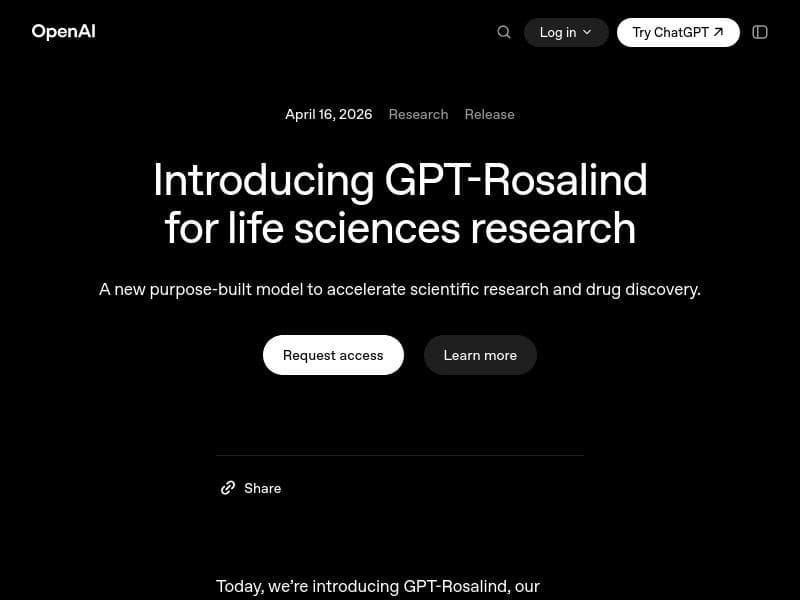
GPT-Rosalind by OpenAI is a specialized AI model designed to accelerate life sciences research by synthesizing complex biological data, generating innovative hypotheses, and planning experiments. Ideal for researchers in biology, chemistry, and genomics, it streamlines workflows and speeds up discoveries in drug development and molecular analysis.
GPT-Rosalind by OpenAI is a cutting-edge artificial intelligence model specifically designed to accelerate life sciences research by integrating advanced data synthesis, hypothesis generation, and experimental planning capabilities. Tailored for workflows in biology, chemistry, and genomics, GPT-Rosalind empowers scientists and researchers to streamline complex analytical processes, enabling faster transitions from raw data to actionable scientific discoveries. By leveraging its deep understanding of molecular biology, protein structures, and genetic information, the tool acts as a powerful assistant in navigating the vast and intricate datasets typical of modern life sciences research. At its core, GPT-Rosalind excels in several key areas. It accelerates drug discovery by rapidly analyzing chemical and biological data to identify promising therapeutic candidates and predict molecular interactions. Its genomics analysis capabilities allow researchers to interpret genetic sequences, detect mutations, and understand gene functions more efficiently. The model's protein reasoning feature enables detailed examination of protein folding, interactions, and functional predictions, which are crucial for both basic research and applied biomedical sciences. Additionally, GPT-Rosalind optimizes scientific research workflows by automating routine tasks such as data integration, literature review synthesis, and experiment design, thereby reducing manual workload and minimizing human error. This AI tool is particularly beneficial for pharmaceutical companies, academic research institutions, biotechnology startups, and individual scientists working in molecular biology, genomics, and chemical biology. Use cases include designing novel drug candidates, interpreting complex genomic datasets, planning targeted experiments, and generating new scientific hypotheses that can be tested in the lab. By providing actionable insights and predictive analytics, GPT-Rosalind helps researchers focus on high-impact experiments and accelerates the pace of innovation in life sciences. GPT-Rosalind is offered as a paid service, reflecting its advanced capabilities and the specialized nature of its applications. Pricing details are typically available upon request or through direct engagement with OpenAI’s sales team, allowing customization based on the scale of use and specific research needs. This model is positioned as a premium solution for organizations and researchers who require robust, domain-specific AI assistance rather than general-purpose language models. Compared to alternative AI tools in the life sciences domain, GPT-Rosalind stands out due to its deep integration of biological knowledge with AI-driven reasoning. Unlike generic AI models, it is trained and fine-tuned on life sciences data, which enhances its accuracy and relevance in scientific contexts. While other platforms might offer isolated functionalities such as genomics analysis or chemical informatics, GPT-Rosalind combines multiple disciplines into a unified interface, providing a comprehensive research assistant. However, users should consider that the tool requires a certain level of domain expertise to fully leverage its capabilities and that its paid nature might be a barrier for smaller labs or individual researchers with limited budgets. In terms of limitations, GPT-Rosalind’s effectiveness depends heavily on the quality and scope of input data, and like all AI models, it may occasionally generate hypotheses that require rigorous experimental validation. It is not a replacement for expert judgment but rather a complementary tool designed to augment human decision-making. Additionally, as a proprietary model, access and customization options may be limited compared to open-source alternatives. Prospective users should evaluate their specific research needs and budget constraints when considering GPT-Rosalind as part of their scientific toolkit.

Description
GPT-Rosalind by OpenAI is a specialized AI model designed to accelerate life sciences research by synthesizing complex biological data, generating innovative hypotheses, and planning experiments. Ideal for researchers in biology, chemistry, and genomics, it streamlines workflows and speeds up discoveries in drug development and molecular analysis.
GPT-Rosalind by OpenAI is a cutting-edge artificial intelligence model specifically designed to accelerate life sciences research by integrating advanced data synthesis, hypothesis generation, and experimental planning capabilities. Tailored for workflows in biology, chemistry, and genomics, GPT-Rosalind empowers scientists and researchers to streamline complex analytical processes, enabling faster transitions from raw data to actionable scientific discoveries. By leveraging its deep understanding of molecular biology, protein structures, and genetic information, the tool acts as a powerful assistant in navigating the vast and intricate datasets typical of modern life sciences research. At its core, GPT-Rosalind excels in several key areas. It accelerates drug discovery by rapidly analyzing chemical and biological data to identify promising therapeutic candidates and predict molecular interactions. Its genomics analysis capabilities allow researchers to interpret genetic sequences, detect mutations, and understand gene functions more efficiently. The model's protein reasoning feature enables detailed examination of protein folding, interactions, and functional predictions, which are crucial for both basic research and applied biomedical sciences. Additionally, GPT-Rosalind optimizes scientific research workflows by automating routine tasks such as data integration, literature review synthesis, and experiment design, thereby reducing manual workload and minimizing human error. This AI tool is particularly beneficial for pharmaceutical companies, academic research institutions, biotechnology startups, and individual scientists working in molecular biology, genomics, and chemical biology. Use cases include designing novel drug candidates, interpreting complex genomic datasets, planning targeted experiments, and generating new scientific hypotheses that can be tested in the lab. By providing actionable insights and predictive analytics, GPT-Rosalind helps researchers focus on high-impact experiments and accelerates the pace of innovation in life sciences. GPT-Rosalind is offered as a paid service, reflecting its advanced capabilities and the specialized nature of its applications. Pricing details are typically available upon request or through direct engagement with OpenAI’s sales team, allowing customization based on the scale of use and specific research needs. This model is positioned as a premium solution for organizations and researchers who require robust, domain-specific AI assistance rather than general-purpose language models. Compared to alternative AI tools in the life sciences domain, GPT-Rosalind stands out due to its deep integration of biological knowledge with AI-driven reasoning. Unlike generic AI models, it is trained and fine-tuned on life sciences data, which enhances its accuracy and relevance in scientific contexts. While other platforms might offer isolated functionalities such as genomics analysis or chemical informatics, GPT-Rosalind combines multiple disciplines into a unified interface, providing a comprehensive research assistant. However, users should consider that the tool requires a certain level of domain expertise to fully leverage its capabilities and that its paid nature might be a barrier for smaller labs or individual researchers with limited budgets. In terms of limitations, GPT-Rosalind’s effectiveness depends heavily on the quality and scope of input data, and like all AI models, it may occasionally generate hypotheses that require rigorous experimental validation. It is not a replacement for expert judgment but rather a complementary tool designed to augment human decision-making. Additionally, as a proprietary model, access and customization options may be limited compared to open-source alternatives. Prospective users should evaluate their specific research needs and budget constraints when considering GPT-Rosalind as part of their scientific toolkit.
Tool Features
- Accelerates drug discovery
- Supports genomics analysis
- Enables protein reasoning
- Optimizes scientific research workflows
Frequently Asked Questions
What is GPT‑Rosalind?
GPT-Rosalind is an AI model developed by OpenAI specifically for life sciences research. It assists scientists by synthesizing data, generating hypotheses, and planning experiments across biology, chemistry, and genomics workflows.
How much does GPT‑Rosalind cost?
GPT-Rosalind is a paid service, with pricing details typically provided upon inquiry to OpenAI. Costs may vary depending on usage scale and specific research requirements.
Who is GPT‑Rosalind best for?
The tool is best suited for researchers, scientists, and organizations involved in molecular biology, genomics, drug discovery, and chemical biology who need to accelerate data analysis and experimental planning.
What are the main features of GPT‑Rosalind?
Key features include accelerating drug discovery, supporting genomics analysis, enabling protein reasoning, and optimizing scientific research workflows through data synthesis and hypothesis generation.
Does GPT‑Rosalind offer a free trial?
There is no publicly available information indicating that GPT-Rosalind offers a free trial. Interested users should contact OpenAI directly for trial or demo opportunities.
What integrations does GPT‑Rosalind support?
While specific integrations are not detailed publicly, GPT-Rosalind is designed to fit into biology, chemistry, and genomics workflows, suggesting compatibility with common scientific data formats and research platforms.
How does GPT‑Rosalind work?
GPT-Rosalind works by applying advanced AI techniques to synthesize scientific data, generate testable hypotheses, and plan experiments, leveraging its training on life sciences datasets to provide domain-specific insights.
Socials
Use ToolSponsored Tools









































Reviews
No reviews yet. Be the first to share your experience.