Description
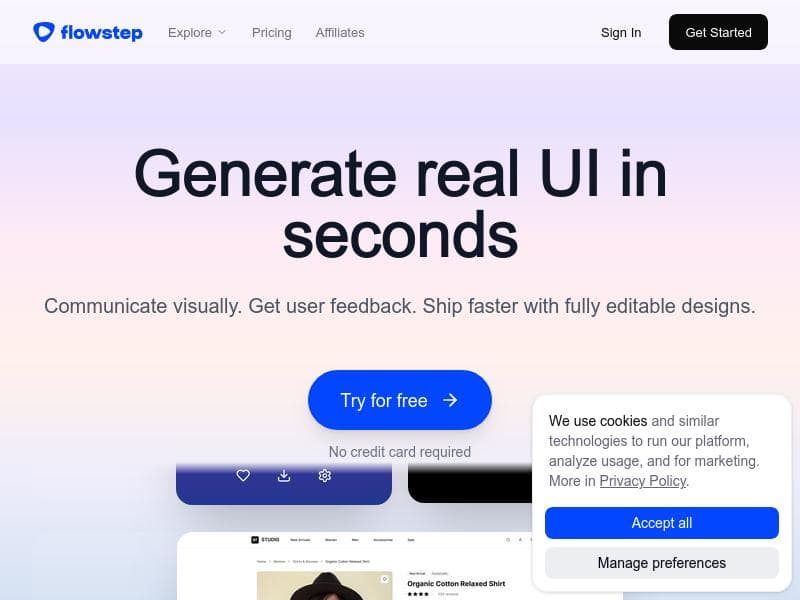
Flowstep 1.0 revolutionizes UI design by combining AI-powered chat-driven creation with direct production code export, eliminating the tedious handoff between design and development. Ideal for developers and technical designers seeking rapid, collaborative, and precise design workflows, Flowstep ensures what you design is exactly what ships.
Flowstep 1.0 is an innovative AI-powered design engineering tool tailored specifically for developers and technical designers who are frustrated with the repetitive and time-consuming task of rebuilding UI designs into code. Its core purpose is to streamline the design-to-development workflow by enabling users to create, edit, and iterate UI designs directly on an infinite canvas, using natural language prompts or manual adjustments. This eliminates the traditional disconnect between design mockups and production-ready code, ensuring that what you design is exactly what ships. Flowstep bridges the gap between creative design and functional implementation, making it a powerful assistant in modern software development cycles. At the heart of Flowstep 1.0 are several key features that enhance productivity and collaboration. First, it allows users to quickly generate UI designs and wireframes simply by chatting with the AI, which interprets prompts to produce detailed and customizable design elements. This conversational interface reduces the need for specialized design software skills and accelerates the initial concept phase. Second, Flowstep supports effortless collaboration among team members, enabling designers, developers, and stakeholders to work together in real-time on the infinite canvas. This shared workspace fosters transparency and rapid feedback, which is critical for agile development environments. Third, the tool excels at rapid iteration of design concepts using AI, allowing users to refine and evolve their designs quickly without starting from scratch. Additionally, Flowstep offers seamless export of production-ready code, which can be directly integrated into development pipelines or connected with other agents and applications via its MCP (Modular Communication Protocol). This integration capability ensures that designs are not only visually accurate but also functionally precise when deployed. Flowstep 1.0 is best suited for software developers, UI/UX designers, product managers, and technical teams who want to reduce the friction between design and development. It is especially valuable for startups and agile teams that require fast prototyping and iteration cycles without sacrificing code quality. Use cases include rapid wireframing for new app interfaces, collaborative design sessions with remote teams, and automating the translation of design concepts into production code. Its chat-driven design approach makes it accessible to users who may not be expert designers but need to communicate UI ideas effectively. Regarding pricing, Flowstep 1.0 follows a freemium model, allowing users to access core features at no cost while offering premium capabilities and integrations through paid plans. This approach enables individuals and small teams to experiment with the tool before committing financially. Detailed pricing tiers and feature distinctions are available on the official website, providing flexibility based on user needs and scale. Compared to traditional design tools and code handoff platforms, Flowstep stands out by combining AI-driven design generation with direct production code export, eliminating the common bottleneck of manual code translation. Unlike static design tools that require separate development efforts, Flowstep ensures fidelity between design and implementation. While other AI design assistants may focus solely on mockup creation, Flowstep’s integration with MCP and its infinite canvas environment offer a more holistic and interactive design engineering experience. However, some limitations to consider include the learning curve associated with mastering the infinite canvas and chat-based design prompts, which may require adjustment for users accustomed to conventional design software. Additionally, as with any AI-generated output, users should carefully review and test the exported code to ensure it meets specific project standards and performance requirements. Integration with existing development environments may also require some setup depending on the complexity of the user’s tech stack. Overall, Flowstep 1.0 represents a significant advancement in AI-assisted design engineering, empowering technical teams to accelerate UI development while maintaining high fidelity between design intent and shipped products.

Description
Flowstep 1.0 revolutionizes UI design by combining AI-powered chat-driven creation with direct production code export, eliminating the tedious handoff between design and development. Ideal for developers and technical designers seeking rapid, collaborative, and precise design workflows, Flowstep ensures what you design is exactly what ships.
Flowstep 1.0 is an innovative AI-powered design engineering tool tailored specifically for developers and technical designers who are frustrated with the repetitive and time-consuming task of rebuilding UI designs into code. Its core purpose is to streamline the design-to-development workflow by enabling users to create, edit, and iterate UI designs directly on an infinite canvas, using natural language prompts or manual adjustments. This eliminates the traditional disconnect between design mockups and production-ready code, ensuring that what you design is exactly what ships. Flowstep bridges the gap between creative design and functional implementation, making it a powerful assistant in modern software development cycles. At the heart of Flowstep 1.0 are several key features that enhance productivity and collaboration. First, it allows users to quickly generate UI designs and wireframes simply by chatting with the AI, which interprets prompts to produce detailed and customizable design elements. This conversational interface reduces the need for specialized design software skills and accelerates the initial concept phase. Second, Flowstep supports effortless collaboration among team members, enabling designers, developers, and stakeholders to work together in real-time on the infinite canvas. This shared workspace fosters transparency and rapid feedback, which is critical for agile development environments. Third, the tool excels at rapid iteration of design concepts using AI, allowing users to refine and evolve their designs quickly without starting from scratch. Additionally, Flowstep offers seamless export of production-ready code, which can be directly integrated into development pipelines or connected with other agents and applications via its MCP (Modular Communication Protocol). This integration capability ensures that designs are not only visually accurate but also functionally precise when deployed. Flowstep 1.0 is best suited for software developers, UI/UX designers, product managers, and technical teams who want to reduce the friction between design and development. It is especially valuable for startups and agile teams that require fast prototyping and iteration cycles without sacrificing code quality. Use cases include rapid wireframing for new app interfaces, collaborative design sessions with remote teams, and automating the translation of design concepts into production code. Its chat-driven design approach makes it accessible to users who may not be expert designers but need to communicate UI ideas effectively. Regarding pricing, Flowstep 1.0 follows a freemium model, allowing users to access core features at no cost while offering premium capabilities and integrations through paid plans. This approach enables individuals and small teams to experiment with the tool before committing financially. Detailed pricing tiers and feature distinctions are available on the official website, providing flexibility based on user needs and scale. Compared to traditional design tools and code handoff platforms, Flowstep stands out by combining AI-driven design generation with direct production code export, eliminating the common bottleneck of manual code translation. Unlike static design tools that require separate development efforts, Flowstep ensures fidelity between design and implementation. While other AI design assistants may focus solely on mockup creation, Flowstep’s integration with MCP and its infinite canvas environment offer a more holistic and interactive design engineering experience. However, some limitations to consider include the learning curve associated with mastering the infinite canvas and chat-based design prompts, which may require adjustment for users accustomed to conventional design software. Additionally, as with any AI-generated output, users should carefully review and test the exported code to ensure it meets specific project standards and performance requirements. Integration with existing development environments may also require some setup depending on the complexity of the user’s tech stack. Overall, Flowstep 1.0 represents a significant advancement in AI-assisted design engineering, empowering technical teams to accelerate UI development while maintaining high fidelity between design intent and shipped products.
Tool Features
- Create UI designs and wireframes quickly via chat
- Collaborate effortlessly with team members
- Rapid iteration of design concepts using AI
Frequently Asked Questions
What is Flowstep 1.0?
Flowstep 1.0 is an AI design engineering tool that helps developers and technical designers create, edit, and iterate UI designs on an infinite canvas. It enables users to generate wireframes via chat prompts and export production-ready code, streamlining the transition from design to development.
How much does Flowstep 1.0 cost?
Flowstep 1.0 offers a freemium pricing model, providing access to core features for free with options to upgrade to paid plans for additional capabilities and integrations. Specific pricing details are available on their website.
Who is Flowstep 1.0 best for?
Flowstep 1.0 is best suited for software developers, UI/UX designers, product managers, and technical teams who want to accelerate UI design and development workflows, especially those working in agile environments or startups needing rapid prototyping.
What are the main features of Flowstep 1.0?
Key features include quick UI design and wireframe creation via chat prompts, effortless team collaboration on an infinite canvas, rapid AI-driven iteration of design concepts, and the ability to export production-ready code or connect designs with other apps and agents via MCP.
Does Flowstep 1.0 offer a free trial?
Yes, Flowstep 1.0’s freemium model allows users to try core features at no cost, effectively serving as a free trial. Users can explore the tool before deciding to upgrade to premium plans.
What integrations does Flowstep 1.0 support?
Flowstep 1.0 supports integration with other agents and applications through its Modular Communication Protocol (MCP), enabling seamless connectivity within development and design ecosystems.
How does Flowstep 1.0 work?
Users interact with Flowstep 1.0 by prompting the AI via chat to create or edit UI designs on an infinite canvas. The AI generates wireframes and design elements that can be iterated rapidly. Once finalized, designs can be exported as production-ready code or connected to other tools through MCP for deployment.
Socials
Use ToolSponsored Tools





























Reviews
No reviews yet. Be the first to share your experience.