Claude Code & Codex Usage Trading Cards by Rudel
Description
Claude Code & Codex Usage Trading Cards by Rudel uniquely transforms your AI coding sessions into personalized, data-rich trading cards that reveal your usage patterns and AI interaction style. Ideal for developers and AI enthusiasts, it combines detailed analytics with engaging visual archetypes to optimize and showcase your AI workflows.
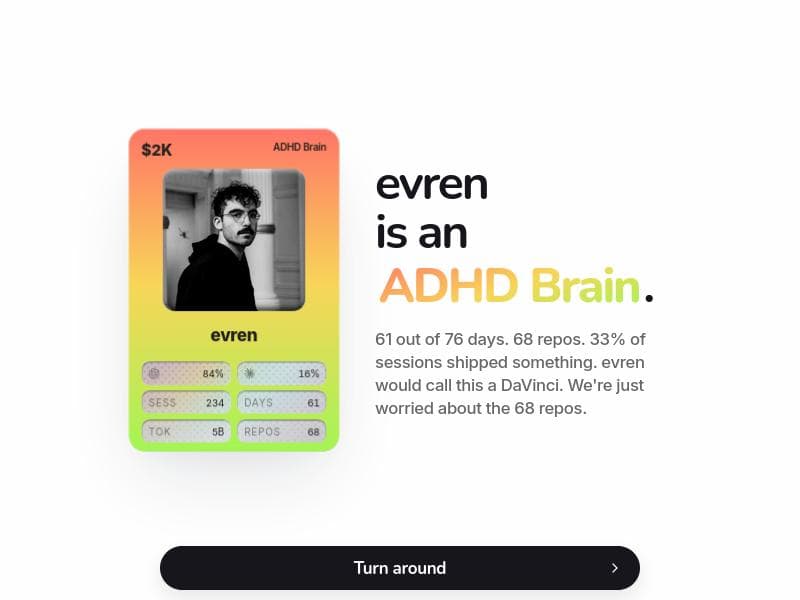
Claude Code & Codex Usage Trading Cards by Rudel is an innovative AI analytics and visualization tool designed to transform your interactions with Claude Code and Codex AI models into engaging, data-rich trading cards. Its core purpose is to provide users with a comprehensive and personalized overview of their AI usage patterns by analyzing various metrics such as session shape, token usage, model mix, repository breadth, cost intensity, output signals, errors, and behavioral patterns. By distilling complex AI interaction data into visually appealing archetypes, this tool offers a unique way to understand and optimize your AI workflows. At its heart, the tool captures extensive token usage data, effectively representing an "AI brain" that reflects your unique interaction style and preferences. It tracks individual sessions and token counts meticulously, enabling users to gain deep insights into their AI consumption and performance over time. This granular tracking supports a personalized AI experience, allowing users to identify trends, optimize costs, and improve output quality. One of the standout features is the ability to create your own AI brain, which means users can customize and evolve their AI usage profiles based on their specific needs and coding habits. The visual representation of AI interaction data is another key capability. The trading cards generated by Rudel are not just static summaries; they are archetypes that encapsulate the essence of your AI sessions, making it easier to comprehend complex data at a glance. This visual approach is particularly useful for developers, data scientists, and AI enthusiasts who want to monitor and showcase their AI usage patterns in a compelling format. Furthermore, the tool integrates seamlessly with the Rudel AI platform, enhancing its functionality and providing a cohesive user experience for those already utilizing Rudel's ecosystem. Claude Code & Codex Usage Trading Cards is best suited for developers, AI researchers, and organizations that rely heavily on Claude Code and Codex models for coding assistance, automation, or AI-driven development. It is especially useful for users who want to optimize their AI usage costs, track performance metrics, and gain actionable insights into their AI interactions. By turning session data into trading cards, it also appeals to users interested in gamification and visualization of AI data, making it a valuable tool for educational purposes or team collaboration where AI usage patterns need to be shared and analyzed. The tool operates on a freemium pricing model, allowing users to access core features for free while offering advanced capabilities or integrations under premium plans. Additionally, it is open source and self-hostable, providing flexibility and control for users who prefer to run the software on their own infrastructure. This openness ensures transparency, customization, and the ability to extend the tool according to specific organizational requirements. Compared to alternative AI usage analytics tools, Claude Code & Codex Usage Trading Cards stands out due to its unique trading card metaphor and archetype-based visualization. While many tools focus solely on raw metrics or dashboards, Rudel’s approach combines data analytics with creative representation, making AI usage data more accessible and engaging. Its integration with the Rudel AI platform further enhances its appeal by providing a unified environment for AI interaction and analysis. However, users looking for more generalized AI usage tracking beyond Claude Code and Codex models might find its scope somewhat specialized. Notable limitations include the dependency on Rudel’s platform for full integration benefits and the focus on specific AI models, which might limit applicability for users working with a broader range of AI tools. Additionally, while the open-source nature is a strength, it may require technical expertise to self-host and customize effectively. Users should also consider that the trading card visualization, while innovative, may not replace traditional detailed analytics for all professional use cases. Overall, Claude Code & Codex Usage Trading Cards by Rudel offers a fresh, insightful way to monitor and celebrate your AI coding interactions, blending data science with creative visualization.

Description
Claude Code & Codex Usage Trading Cards by Rudel uniquely transforms your AI coding sessions into personalized, data-rich trading cards that reveal your usage patterns and AI interaction style. Ideal for developers and AI enthusiasts, it combines detailed analytics with engaging visual archetypes to optimize and showcase your AI workflows.
Claude Code & Codex Usage Trading Cards by Rudel is an innovative AI analytics and visualization tool designed to transform your interactions with Claude Code and Codex AI models into engaging, data-rich trading cards. Its core purpose is to provide users with a comprehensive and personalized overview of their AI usage patterns by analyzing various metrics such as session shape, token usage, model mix, repository breadth, cost intensity, output signals, errors, and behavioral patterns. By distilling complex AI interaction data into visually appealing archetypes, this tool offers a unique way to understand and optimize your AI workflows. At its heart, the tool captures extensive token usage data, effectively representing an "AI brain" that reflects your unique interaction style and preferences. It tracks individual sessions and token counts meticulously, enabling users to gain deep insights into their AI consumption and performance over time. This granular tracking supports a personalized AI experience, allowing users to identify trends, optimize costs, and improve output quality. One of the standout features is the ability to create your own AI brain, which means users can customize and evolve their AI usage profiles based on their specific needs and coding habits. The visual representation of AI interaction data is another key capability. The trading cards generated by Rudel are not just static summaries; they are archetypes that encapsulate the essence of your AI sessions, making it easier to comprehend complex data at a glance. This visual approach is particularly useful for developers, data scientists, and AI enthusiasts who want to monitor and showcase their AI usage patterns in a compelling format. Furthermore, the tool integrates seamlessly with the Rudel AI platform, enhancing its functionality and providing a cohesive user experience for those already utilizing Rudel's ecosystem. Claude Code & Codex Usage Trading Cards is best suited for developers, AI researchers, and organizations that rely heavily on Claude Code and Codex models for coding assistance, automation, or AI-driven development. It is especially useful for users who want to optimize their AI usage costs, track performance metrics, and gain actionable insights into their AI interactions. By turning session data into trading cards, it also appeals to users interested in gamification and visualization of AI data, making it a valuable tool for educational purposes or team collaboration where AI usage patterns need to be shared and analyzed. The tool operates on a freemium pricing model, allowing users to access core features for free while offering advanced capabilities or integrations under premium plans. Additionally, it is open source and self-hostable, providing flexibility and control for users who prefer to run the software on their own infrastructure. This openness ensures transparency, customization, and the ability to extend the tool according to specific organizational requirements. Compared to alternative AI usage analytics tools, Claude Code & Codex Usage Trading Cards stands out due to its unique trading card metaphor and archetype-based visualization. While many tools focus solely on raw metrics or dashboards, Rudel’s approach combines data analytics with creative representation, making AI usage data more accessible and engaging. Its integration with the Rudel AI platform further enhances its appeal by providing a unified environment for AI interaction and analysis. However, users looking for more generalized AI usage tracking beyond Claude Code and Codex models might find its scope somewhat specialized. Notable limitations include the dependency on Rudel’s platform for full integration benefits and the focus on specific AI models, which might limit applicability for users working with a broader range of AI tools. Additionally, while the open-source nature is a strength, it may require technical expertise to self-host and customize effectively. Users should also consider that the trading card visualization, while innovative, may not replace traditional detailed analytics for all professional use cases. Overall, Claude Code & Codex Usage Trading Cards by Rudel offers a fresh, insightful way to monitor and celebrate your AI coding interactions, blending data science with creative visualization.
Tool Features
- Represents an AI brain with extensive token usage data
- Tracks sessions and token counts for personalized AI experience
- Allows users to create their own AI brain
- Visual representation of AI interaction data
- Integration with Rudel AI platform
Frequently Asked Questions
What is Claude Code & Codex Usage Trading Cards by Rudel?
It is a tool that converts your Claude Code and Codex AI sessions into personalized trading cards based on detailed usage data such as token counts, session shapes, model mixes, and error patterns, providing a visual and analytical representation of your AI interactions.
How much does Claude Code & Codex Usage Trading Cards by Rudel cost?
The tool operates on a freemium model, offering core features for free with optional premium plans for advanced capabilities. It is also open source and self-hostable, allowing users to run it independently without cost.
Who is Claude Code & Codex Usage Trading Cards by Rudel best for?
It is best suited for developers, AI researchers, and organizations using Claude Code and Codex models who want to track, analyze, and optimize their AI usage patterns through engaging visualizations and detailed metrics.
What are the main features of Claude Code & Codex Usage Trading Cards by Rudel?
Key features include extensive token usage tracking, session monitoring, personalized AI brain creation, visual trading card archetypes representing AI interaction data, and integration with the Rudel AI platform.
Does Claude Code & Codex Usage Trading Cards by Rudel offer a free trial?
Yes, the tool offers free access to its core features under its freemium pricing model, allowing users to try it without upfront cost.
What integrations does Claude Code & Codex Usage Trading Cards by Rudel support?
It integrates primarily with the Rudel AI platform, enhancing the user experience by combining AI session tracking with Rudel’s broader AI tools and infrastructure.
How does Claude Code & Codex Usage Trading Cards by Rudel work?
The tool analyzes your AI sessions by collecting data on token usage, session structure, model selection, and other metrics, then generates a trading card archetype that visually summarizes your AI usage patterns and performance.
Socials
Use ToolSponsored Tools






































Reviews
No reviews yet. Be the first to share your experience.