

Description
cito is a semantic search engine designed to transform academic research by enabling users to find papers based on meaning rather than just keywords. Leveraging SPECTER2 embeddings and supporting hybrid retrieval modes, it offers researchers a powerful, flexible tool to explore a vast corpus of 148 million academic papers with enhanced relevance and precision.
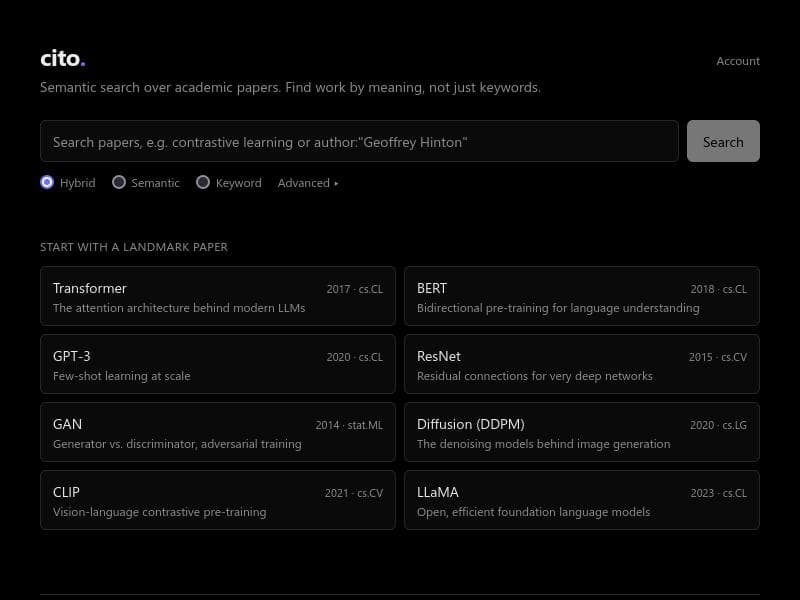
cito is a cutting-edge semantic search engine specifically designed to revolutionize how researchers, academics, and students discover academic papers. Unlike traditional search engines that rely primarily on keyword matching, cito leverages advanced semantic search technology to understand the meaning behind queries, enabling users to find relevant research work even when exact keywords are not present. This approach significantly enhances the precision and relevance of search results, making it an invaluable tool for navigating the vast and ever-growing corpus of academic literature. At its core, cito supports hybrid, semantic, and keyword retrieval modes, offering users flexible search options tailored to their needs. The hybrid mode combines the strengths of semantic understanding with traditional keyword matching, ensuring comprehensive coverage. Semantic mode focuses on meaning-based retrieval, ideal for exploratory research or when users are looking for conceptually related papers. Keyword mode remains available for users who prefer classic search methods or need to find papers with specific terms. The engine operates over an extensive dataset of approximately 148 million academic papers, sourced from Semantic Scholar and OpenAlex, ensuring broad and up-to-date coverage across numerous disciplines. A key technological foundation of cito is its use of SPECTER2 embeddings, a state-of-the-art method for representing academic papers as dense vectors that capture their semantic content. This embedding technique allows cito to measure the similarity between papers and queries at a conceptual level rather than just surface-level text matches. As a result, users can discover relevant research that might otherwise be missed by keyword-only searches. Additionally, cito includes a curated set of landmark papers, such as seminal works on Transformer architectures, BERT, GPT-3, ResNet, GANs, and more, providing users with quick starting points for popular research topics. The platform also supports advanced search options, enabling users to refine their queries with filters like author names, publication years, and specific research fields. This level of granularity helps researchers pinpoint exactly the papers they need for their work. The user interface is designed for ease of use, with a clean, responsive layout and intuitive controls that facilitate efficient searching and exploration. cito is best suited for academic researchers, graduate students, educators, and professionals who require deep and precise access to scholarly literature. It is particularly valuable for those conducting literature reviews, preparing research proposals, or staying current with developments in their fields. By focusing on semantic relevance, cito helps users uncover connections between papers that keyword searches might overlook, fostering more insightful and comprehensive research outcomes. Regarding pricing, cito currently offers free access to its search capabilities, making it accessible to a wide audience without financial barriers. While detailed information about premium plans or enterprise offerings is not explicitly provided, the free availability combined with powerful features positions cito as an attractive option for individual researchers and academic institutions alike. When compared to alternatives such as Google Scholar, Semantic Scholar, or other academic search engines, cito stands out due to its emphasis on semantic search powered by SPECTER2 embeddings and its hybrid retrieval modes. This allows for a more nuanced understanding of research topics and better discovery of relevant papers beyond exact keyword matches. However, unlike some platforms that integrate citation metrics, author profiles, or full-text access, cito focuses primarily on search relevance and exploration, which may require users to complement it with other tools for comprehensive research management. Notable limitations include the reliance on metadata and abstracts rather than full-text indexing, which might affect the depth of search results in some cases. Additionally, while the corpus is extensive, it is a snapshot as of mid-2026, so the very latest publications may not be immediately available. Users should also be aware that advanced search features, while powerful, may have a learning curve for those unfamiliar with semantic search concepts. Despite these considerations, cito offers a robust, innovative platform that significantly enhances academic paper discovery through meaning-based search.

Description
cito is a semantic search engine designed to transform academic research by enabling users to find papers based on meaning rather than just keywords. Leveraging SPECTER2 embeddings and supporting hybrid retrieval modes, it offers researchers a powerful, flexible tool to explore a vast corpus of 148 million academic papers with enhanced relevance and precision.
cito is a cutting-edge semantic search engine specifically designed to revolutionize how researchers, academics, and students discover academic papers. Unlike traditional search engines that rely primarily on keyword matching, cito leverages advanced semantic search technology to understand the meaning behind queries, enabling users to find relevant research work even when exact keywords are not present. This approach significantly enhances the precision and relevance of search results, making it an invaluable tool for navigating the vast and ever-growing corpus of academic literature. At its core, cito supports hybrid, semantic, and keyword retrieval modes, offering users flexible search options tailored to their needs. The hybrid mode combines the strengths of semantic understanding with traditional keyword matching, ensuring comprehensive coverage. Semantic mode focuses on meaning-based retrieval, ideal for exploratory research or when users are looking for conceptually related papers. Keyword mode remains available for users who prefer classic search methods or need to find papers with specific terms. The engine operates over an extensive dataset of approximately 148 million academic papers, sourced from Semantic Scholar and OpenAlex, ensuring broad and up-to-date coverage across numerous disciplines. A key technological foundation of cito is its use of SPECTER2 embeddings, a state-of-the-art method for representing academic papers as dense vectors that capture their semantic content. This embedding technique allows cito to measure the similarity between papers and queries at a conceptual level rather than just surface-level text matches. As a result, users can discover relevant research that might otherwise be missed by keyword-only searches. Additionally, cito includes a curated set of landmark papers, such as seminal works on Transformer architectures, BERT, GPT-3, ResNet, GANs, and more, providing users with quick starting points for popular research topics. The platform also supports advanced search options, enabling users to refine their queries with filters like author names, publication years, and specific research fields. This level of granularity helps researchers pinpoint exactly the papers they need for their work. The user interface is designed for ease of use, with a clean, responsive layout and intuitive controls that facilitate efficient searching and exploration. cito is best suited for academic researchers, graduate students, educators, and professionals who require deep and precise access to scholarly literature. It is particularly valuable for those conducting literature reviews, preparing research proposals, or staying current with developments in their fields. By focusing on semantic relevance, cito helps users uncover connections between papers that keyword searches might overlook, fostering more insightful and comprehensive research outcomes. Regarding pricing, cito currently offers free access to its search capabilities, making it accessible to a wide audience without financial barriers. While detailed information about premium plans or enterprise offerings is not explicitly provided, the free availability combined with powerful features positions cito as an attractive option for individual researchers and academic institutions alike. When compared to alternatives such as Google Scholar, Semantic Scholar, or other academic search engines, cito stands out due to its emphasis on semantic search powered by SPECTER2 embeddings and its hybrid retrieval modes. This allows for a more nuanced understanding of research topics and better discovery of relevant papers beyond exact keyword matches. However, unlike some platforms that integrate citation metrics, author profiles, or full-text access, cito focuses primarily on search relevance and exploration, which may require users to complement it with other tools for comprehensive research management. Notable limitations include the reliance on metadata and abstracts rather than full-text indexing, which might affect the depth of search results in some cases. Additionally, while the corpus is extensive, it is a snapshot as of mid-2026, so the very latest publications may not be immediately available. Users should also be aware that advanced search features, while powerful, may have a learning curve for those unfamiliar with semantic search concepts. Despite these considerations, cito offers a robust, innovative platform that significantly enhances academic paper discovery through meaning-based search.
Tool Features
- Semantic search over ~148M academic papers
- Hybrid, semantic, and keyword retrieval modes
- Search by meaning, not just keywords
- Uses SPECTER2 embeddings for enhanced search relevance
- Includes landmark papers for quick start
- Supports advanced search options
Frequently Asked Questions
What is cito?
cito is a semantic search engine tailored for academic papers that allows users to find research work based on the meaning of their queries rather than relying solely on keyword matching. It supports hybrid, semantic, and keyword search modes over a large dataset of approximately 148 million papers.
How much does cito cost?
cito currently offers free access to its search functionalities, making it accessible to individual researchers and students without any cost. There is no publicly available information about paid plans or premium features at this time.
Who is cito best for?
cito is ideal for academic researchers, graduate students, educators, and professionals who need to conduct thorough literature reviews, explore research topics deeply, or stay updated with relevant academic papers across various disciplines.
What are the main features of cito?
Key features include semantic search over around 148 million academic papers, hybrid retrieval combining semantic and keyword search, use of SPECTER2 embeddings for enhanced relevance, inclusion of landmark papers for quick research starts, and advanced search options such as filtering by author or topic.
Does cito offer a free trial?
Since cito is currently free to use, there is no need for a trial period. Users can access its full search capabilities without subscription or payment.
What integrations does cito support?
cito primarily functions as a standalone semantic search engine for academic papers. There is no explicit information about integrations with other platforms or research management tools.
How does cito work?
cito uses SPECTER2 embeddings to represent academic papers and user queries as semantic vectors. It then performs similarity searches to find papers that match the meaning of the query, supporting hybrid, semantic, and keyword search modes to deliver relevant results from a large corpus of scholarly literature.
Sponsored Tools
































Reviews
No reviews yet. Be the first to share your experience.