Description
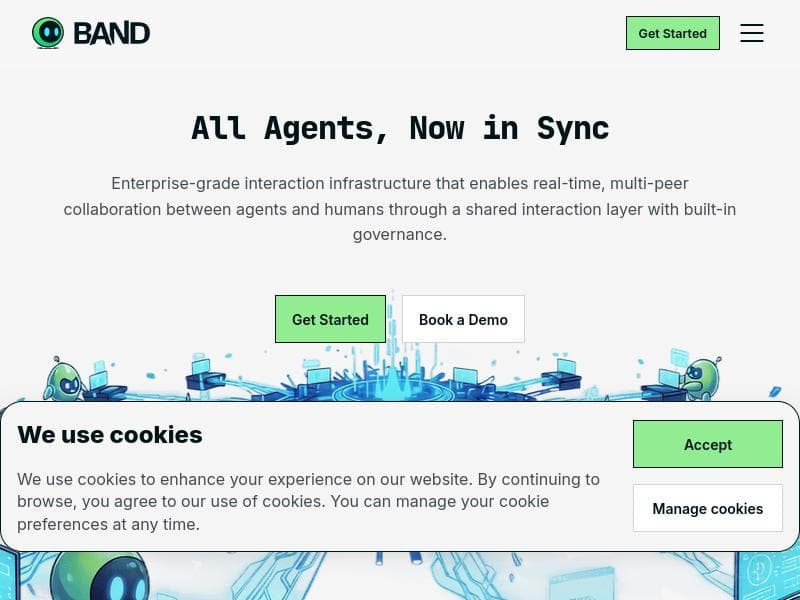
BAND revolutionizes collaboration by governing the interaction layer between distributed AI agents and human teams, enabling real-time, multi-peer coordination with built-in governance. Ideal for organizations blending AI and human workflows, BAND reduces fragmentation and streamlines collaboration at scale.
BAND is a cutting-edge collaboration platform designed to facilitate and govern interactions between distributed AI agents and human teams. Its core purpose is to provide a unified interaction layer that enables real-time multi-peer collaboration while embedding governance mechanisms to ensure structured and reliable communication. Unlike traditional orchestration tools or agent frameworks that focus primarily on managing individual agents or workflows, BAND uniquely governs the interaction layer itself. This approach reduces fragmentation often seen in multi-agent environments and human collaborations, making it easier for organizations to coordinate complex tasks at scale with confidence and clarity. At the heart of BAND are several powerful features tailored to enhance team productivity and streamline workflows. It offers comprehensive team communication tools that support seamless messaging and collaboration among members and AI agents alike. Task and project management capabilities allow teams to organize, assign, and track work efficiently, ensuring accountability and progress visibility. BAND also excels in information sharing and organization, enabling teams to centralize knowledge and resources for easy access and reference. Integration with other popular productivity tools further enhances its utility by allowing teams to connect BAND with their existing software ecosystems, creating a cohesive work environment. Importantly, BAND is designed to support teams of any size, from small groups to large enterprises, making it a versatile solution across industries. Its streamlined collaboration workflows reduce friction and help teams focus on delivering results rather than managing communication overhead. BAND is best suited for organizations that rely on a combination of human expertise and AI capabilities to drive their operations. This includes tech companies developing AI-driven products, research teams coordinating complex experiments, customer support centers leveraging AI agents alongside human agents, and any business seeking to improve coordination between automated systems and human collaborators. Specific use cases include managing AI-assisted project workflows, governing multi-agent decision-making processes, and enabling real-time collaboration in distributed teams where both AI and humans contribute to outcomes. The platform follows a freemium pricing model, allowing users to start with a free tier that provides essential features to get teams up and running. Paid plans offer advanced governance controls, increased capacity for users and agents, and enhanced integrations, catering to the needs of larger organizations or those requiring more robust management capabilities. This flexible pricing approach makes BAND accessible to startups and scalable for enterprises. Compared to alternatives, BAND stands out by focusing on the interaction layer governance rather than just agent orchestration or workflow automation. While many tools provide frameworks to build or manage AI agents, BAND ensures that the communication and coordination between agents and humans are governed systematically. This reduces the risk of miscommunication, duplicated efforts, or fragmented workflows that can occur when multiple agents operate independently. BAND’s emphasis on real-time multi-peer collaboration with built-in governance makes it uniquely reliable for complex, distributed environments. However, potential users should consider that BAND’s specialized focus on interaction governance means it may not replace all traditional project management or communication tools outright but rather complement them. Organizations heavily invested in existing ecosystems might need to evaluate integration capabilities carefully. Additionally, as a relatively new platform, some advanced features or integrations may still be evolving. Overall, BAND offers a robust, innovative solution for teams looking to harmonize human and AI collaboration with governance and scalability at its core.

Description
BAND revolutionizes collaboration by governing the interaction layer between distributed AI agents and human teams, enabling real-time, multi-peer coordination with built-in governance. Ideal for organizations blending AI and human workflows, BAND reduces fragmentation and streamlines collaboration at scale.
BAND is a cutting-edge collaboration platform designed to facilitate and govern interactions between distributed AI agents and human teams. Its core purpose is to provide a unified interaction layer that enables real-time multi-peer collaboration while embedding governance mechanisms to ensure structured and reliable communication. Unlike traditional orchestration tools or agent frameworks that focus primarily on managing individual agents or workflows, BAND uniquely governs the interaction layer itself. This approach reduces fragmentation often seen in multi-agent environments and human collaborations, making it easier for organizations to coordinate complex tasks at scale with confidence and clarity. At the heart of BAND are several powerful features tailored to enhance team productivity and streamline workflows. It offers comprehensive team communication tools that support seamless messaging and collaboration among members and AI agents alike. Task and project management capabilities allow teams to organize, assign, and track work efficiently, ensuring accountability and progress visibility. BAND also excels in information sharing and organization, enabling teams to centralize knowledge and resources for easy access and reference. Integration with other popular productivity tools further enhances its utility by allowing teams to connect BAND with their existing software ecosystems, creating a cohesive work environment. Importantly, BAND is designed to support teams of any size, from small groups to large enterprises, making it a versatile solution across industries. Its streamlined collaboration workflows reduce friction and help teams focus on delivering results rather than managing communication overhead. BAND is best suited for organizations that rely on a combination of human expertise and AI capabilities to drive their operations. This includes tech companies developing AI-driven products, research teams coordinating complex experiments, customer support centers leveraging AI agents alongside human agents, and any business seeking to improve coordination between automated systems and human collaborators. Specific use cases include managing AI-assisted project workflows, governing multi-agent decision-making processes, and enabling real-time collaboration in distributed teams where both AI and humans contribute to outcomes. The platform follows a freemium pricing model, allowing users to start with a free tier that provides essential features to get teams up and running. Paid plans offer advanced governance controls, increased capacity for users and agents, and enhanced integrations, catering to the needs of larger organizations or those requiring more robust management capabilities. This flexible pricing approach makes BAND accessible to startups and scalable for enterprises. Compared to alternatives, BAND stands out by focusing on the interaction layer governance rather than just agent orchestration or workflow automation. While many tools provide frameworks to build or manage AI agents, BAND ensures that the communication and coordination between agents and humans are governed systematically. This reduces the risk of miscommunication, duplicated efforts, or fragmented workflows that can occur when multiple agents operate independently. BAND’s emphasis on real-time multi-peer collaboration with built-in governance makes it uniquely reliable for complex, distributed environments. However, potential users should consider that BAND’s specialized focus on interaction governance means it may not replace all traditional project management or communication tools outright but rather complement them. Organizations heavily invested in existing ecosystems might need to evaluate integration capabilities carefully. Additionally, as a relatively new platform, some advanced features or integrations may still be evolving. Overall, BAND offers a robust, innovative solution for teams looking to harmonize human and AI collaboration with governance and scalability at its core.
Tool Features
- Team communication tools
- Task and project management
- Information sharing and organization
- Integration with other productivity tools
- Supports teams of any size
- Streamlined collaboration workflows
Frequently Asked Questions
What is BAND?
BAND is a collaboration platform that enables and governs interactions between distributed AI agents and human teams through a shared interaction layer, supporting real-time multi-peer collaboration with built-in governance.
How much does BAND cost?
BAND offers a freemium pricing model with a free tier providing essential features, and paid plans that include advanced governance controls, higher user and agent capacity, and enhanced integrations.
Who is BAND best for?
BAND is best suited for organizations that combine human expertise with AI capabilities, such as tech companies, research teams, customer support centers, and any teams needing structured, scalable collaboration between AI agents and humans.
What are the main features of BAND?
Key features include team communication tools, task and project management, information sharing and organization, integration with other productivity tools, support for teams of any size, and streamlined collaboration workflows with built-in governance.
Does BAND offer a free trial?
Yes, BAND provides a free tier as part of its freemium model, allowing users to try essential features without cost.
What integrations does BAND support?
BAND supports integration with various productivity tools to connect with existing software ecosystems, enhancing workflow cohesion and collaboration, though specific integrations may vary and evolve over time.
How does BAND work?
BAND works by providing a shared interaction layer that governs communication and coordination between distributed AI agents and human team members, enabling real-time multi-peer collaboration with structured governance to reduce fragmentation and improve reliability.
Socials
Use ToolSponsored Tools





























Reviews
No reviews yet. Be the first to share your experience.