.png%3Falt%3Dmedia%26token%3D35581a0f-389e-4afd-b522-d23ea260ffd4&w=64&q=75)
Description
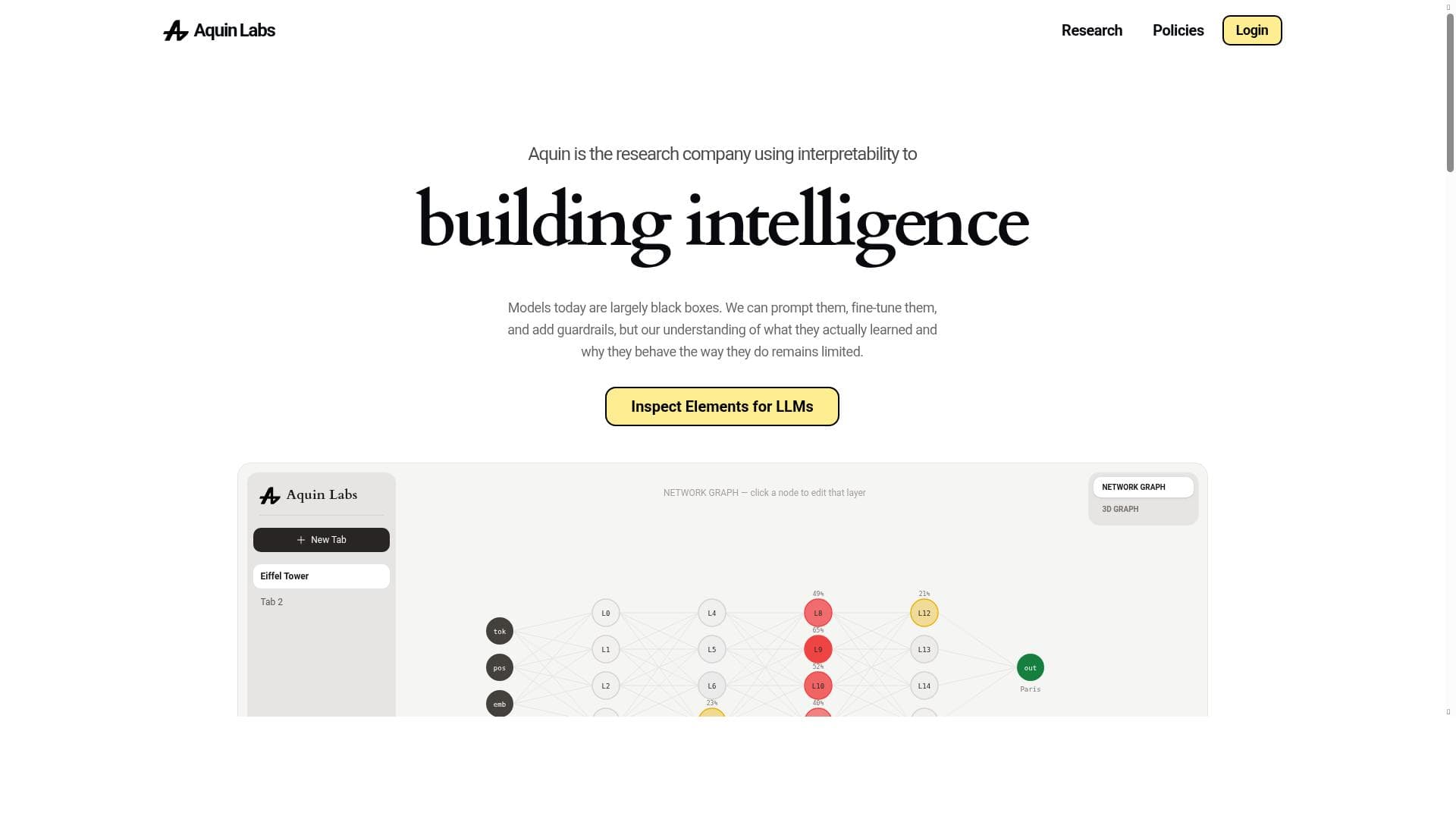
Aquin enables users to effortlessly create private, secure, and customizable large language models in minutes, handling complex AI training processes behind the scenes. Ideal for developers, businesses, and AI enthusiasts seeking privacy-focused, offline-capable AI companions and models without the need for extensive ML expertise.
Aquin is an innovative AI platform designed to empower users to create their own private, secure large language models (LLMs) quickly and easily. Its core purpose is to democratize access to custom AI models by eliminating the traditional barriers of high cost, technical complexity, and the need for deep machine learning expertise. With Aquin, users can upload data from a variety of sources including files, websites, videos, emails, or cloud drives, then select a base model and customize training specifications. The platform automates complex processes such as fine-tuning, LoRA/QLoRA optimization, retrieval-augmented generation (RAG), checkpoint management, and background training, allowing users to focus on building AI models tailored to their specific needs without requiring advanced technical skills. Aquin’s feature set is comprehensive and designed to support both novice and advanced users. It offers local AI processing capabilities, ensuring that sensitive data can be handled securely and privately without reliance on external servers. This privacy-focused approach is complemented by offline AI functionality, enabling users to operate their models without an internet connection, which is critical for environments with strict data security requirements. The platform also supports system-wide AI integration, allowing users to embed their custom models across different applications and workflows seamlessly. Context-aware AI features enhance the intelligence of the models by enabling them to understand and respond based on the specific context of user interactions. Additionally, Aquin provides a transparent AI window, giving users clear insights into model behavior and decision-making processes. Users can test, deploy, publish, and even monetize their AI models through APIs, marketplaces, and web access, maintaining full control over their creations. Aquin is ideal for a wide range of users including developers, businesses, researchers, and AI enthusiasts who want to create personalized AI companions or domain-specific models without investing heavily in infrastructure or expertise. Use cases span from automating customer support with tailored chatbots, enhancing productivity with custom AI assistants, securing sensitive data with local processing, to monetizing AI models in niche markets. Its flexibility makes it suitable for industries such as education, healthcare, finance, and content creation, where privacy and customization are paramount. The platform operates on a freemium pricing model, allowing users to start building and experimenting with their own AI models at no initial cost. This approach lowers the entry barrier and encourages adoption by individuals and small teams. Paid plans likely offer expanded features, higher usage limits, and advanced customization options, though specific pricing tiers are not detailed in the provided information. Compared to alternative AI model-building platforms, Aquin stands out by combining ease of use with powerful customization and privacy features. Many competitors require significant machine learning knowledge or rely heavily on cloud processing, which can raise costs and privacy concerns. Aquin’s support for local and offline AI processing, along with its transparent AI window and system-wide integration, provide a unique blend of control, security, and flexibility. However, users should consider potential limitations such as the learning curve associated with customizing training specifications and the performance constraints that may come with local processing on less powerful hardware. In summary, Aquin offers a robust, user-friendly solution for anyone looking to create secure, private, and personalized AI models quickly. Its combination of advanced features, privacy-first design, and accessible pricing makes it a compelling choice for individuals and organizations seeking to harness the power of AI without the usual complexity and cost.

Description
Aquin enables users to effortlessly create private, secure, and customizable large language models in minutes, handling complex AI training processes behind the scenes. Ideal for developers, businesses, and AI enthusiasts seeking privacy-focused, offline-capable AI companions and models without the need for extensive ML expertise.
Aquin is an innovative AI platform designed to empower users to create their own private, secure large language models (LLMs) quickly and easily. Its core purpose is to democratize access to custom AI models by eliminating the traditional barriers of high cost, technical complexity, and the need for deep machine learning expertise. With Aquin, users can upload data from a variety of sources including files, websites, videos, emails, or cloud drives, then select a base model and customize training specifications. The platform automates complex processes such as fine-tuning, LoRA/QLoRA optimization, retrieval-augmented generation (RAG), checkpoint management, and background training, allowing users to focus on building AI models tailored to their specific needs without requiring advanced technical skills. Aquin’s feature set is comprehensive and designed to support both novice and advanced users. It offers local AI processing capabilities, ensuring that sensitive data can be handled securely and privately without reliance on external servers. This privacy-focused approach is complemented by offline AI functionality, enabling users to operate their models without an internet connection, which is critical for environments with strict data security requirements. The platform also supports system-wide AI integration, allowing users to embed their custom models across different applications and workflows seamlessly. Context-aware AI features enhance the intelligence of the models by enabling them to understand and respond based on the specific context of user interactions. Additionally, Aquin provides a transparent AI window, giving users clear insights into model behavior and decision-making processes. Users can test, deploy, publish, and even monetize their AI models through APIs, marketplaces, and web access, maintaining full control over their creations. Aquin is ideal for a wide range of users including developers, businesses, researchers, and AI enthusiasts who want to create personalized AI companions or domain-specific models without investing heavily in infrastructure or expertise. Use cases span from automating customer support with tailored chatbots, enhancing productivity with custom AI assistants, securing sensitive data with local processing, to monetizing AI models in niche markets. Its flexibility makes it suitable for industries such as education, healthcare, finance, and content creation, where privacy and customization are paramount. The platform operates on a freemium pricing model, allowing users to start building and experimenting with their own AI models at no initial cost. This approach lowers the entry barrier and encourages adoption by individuals and small teams. Paid plans likely offer expanded features, higher usage limits, and advanced customization options, though specific pricing tiers are not detailed in the provided information. Compared to alternative AI model-building platforms, Aquin stands out by combining ease of use with powerful customization and privacy features. Many competitors require significant machine learning knowledge or rely heavily on cloud processing, which can raise costs and privacy concerns. Aquin’s support for local and offline AI processing, along with its transparent AI window and system-wide integration, provide a unique blend of control, security, and flexibility. However, users should consider potential limitations such as the learning curve associated with customizing training specifications and the performance constraints that may come with local processing on less powerful hardware. In summary, Aquin offers a robust, user-friendly solution for anyone looking to create secure, private, and personalized AI models quickly. Its combination of advanced features, privacy-first design, and accessible pricing makes it a compelling choice for individuals and organizations seeking to harness the power of AI without the usual complexity and cost.
Tool Features
- Local AI processing
- Personalized AI companion
- Privacy-focused AI
- Offline AI functionality
- System-wide AI integration
- Context-aware AI
- Custom AI models
- Transparent AI window
Frequently Asked Questions
What is Aquin?
Aquin is a platform that allows users to quickly build their own private and secure large language models by uploading data, selecting base models, and customizing training parameters. It automates complex AI training tasks and supports deployment, monetization, and integration of custom AI models.
How much does Aquin cost?
Aquin offers a freemium pricing model, enabling users to start building and testing AI models for free. Paid plans likely provide additional features, higher usage limits, and advanced customization, though specific pricing details are not provided.
Who is Aquin best for?
Aquin is best suited for developers, businesses, researchers, and AI enthusiasts who want to create personalized, secure AI models without deep machine learning expertise. It is especially valuable for those needing privacy-focused, offline-capable AI solutions.
What are the main features of Aquin?
Key features include local AI processing, personalized AI companions, privacy-focused design, offline functionality, system-wide AI integration, context-aware AI, custom AI model creation, and a transparent AI window for insight into model behavior.
Does Aquin offer a free trial?
Yes, Aquin operates on a freemium model, allowing users to try the platform and create AI models at no initial cost.
What integrations does Aquin support?
Aquin supports deployment and integration via APIs, marketplaces, and web access, enabling users to embed their custom AI models into various applications and workflows.
How does Aquin work?
Users upload data from multiple sources, choose a base model, and customize training specifications. Aquin then automates fine-tuning, LoRA/QLoRA optimization, RAG, checkpointing, and background training. Users can test, deploy, and monetize their models with full control.
Socials
Use ToolSponsored Tools

































Reviews
No reviews yet. Be the first to share your experience.