Description
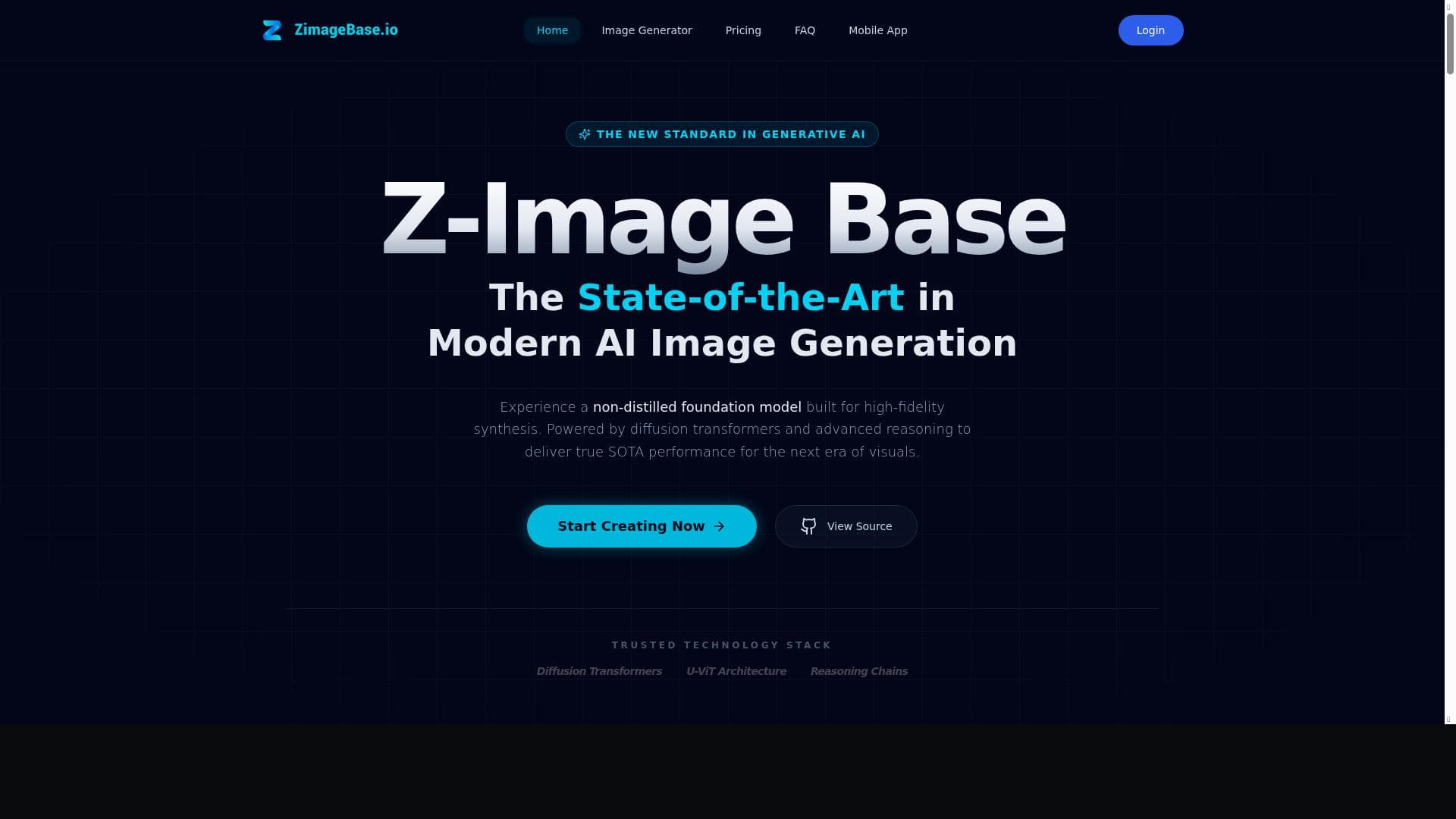
Z-Image Base is a cutting-edge AI foundation model that uniquely combines photorealistic image generation and editing with bilingual text rendering and logic-driven control. Ideal for developers and creators seeking a powerful, unified tool, it offers state-of-the-art performance and advanced customization options—all available for free.
Z-Image Base is an advanced, non-distilled foundation model designed to seamlessly unify image generation and editing within a single framework. Its core purpose is to empower developers, digital artists, and content creators by delivering photorealistic image outputs combined with sophisticated editing capabilities. Unlike many models that specialize in either generation or editing, Z-Image Base integrates both functionalities, enabling users to create and refine images with unprecedented control and quality. This dual capability is achieved through the innovative use of diffusion transformers paired with a structured reasoning chain, which enhances the model's ability to understand and manipulate visual content logically and contextually. One of the standout features of Z-Image Base is its uncompromised photorealism. The model generates images that are highly detailed and visually convincing, making it suitable for professional-grade applications such as advertising, digital media, and virtual prototyping. Additionally, it supports state-of-the-art bilingual text rendering, allowing for accurate and aesthetically pleasing incorporation of text in multiple languages within images. This is particularly valuable for global brands and multilingual content creators who require precise text placement and style consistency. The logic-driven reasoning embedded in Z-Image Base distinguishes it from many other AI image models. This feature enables the model to follow complex instructions and maintain logical coherence in image edits and generation, which is crucial for tasks that require sequential modifications or adherence to specific design rules. Furthermore, the model is non-distilled, meaning it retains its full capacity and complexity without simplification, offering developers a robust and flexible tool for experimentation and customization. Additional technical capabilities include Classifier-Free Guidance (CFG), which enhances the quality and diversity of generated images by balancing adherence to prompts with creative variation. Z-Image Base also supports LoRA (Low-Rank Adaptation) and ControlNet training methods, providing users with advanced options for fine-tuning and controlling the model’s behavior to suit specialized needs. This makes it highly adaptable for various domains, from creative arts to industrial design. Z-Image Base is particularly well-suited for developers, AI researchers, digital artists, and content creators who demand high fidelity and versatility in image-related tasks. Its unified approach simplifies workflows by eliminating the need to switch between separate tools for generation and editing. Use cases range from creating photorealistic marketing visuals, enhancing digital artwork, producing multilingual advertising content, to prototyping product designs with precise control over visual elements. The tool is offered free of charge, making it accessible to a wide audience including startups, independent developers, and educational institutions. This pricing model encourages experimentation and broad adoption without financial barriers. Compared to alternatives, Z-Image Base stands out due to its non-distilled architecture, bilingual text capabilities, and integrated reasoning chain, which collectively provide superior image quality and editing precision. While many competing models focus on either generation or editing, Z-Image Base’s unified approach streamlines creative processes and reduces complexity. However, users should consider that the model’s advanced features and non-distilled nature may require more computational resources than lighter, distilled models. This could impact deployment in resource-constrained environments. Additionally, while the model excels at bilingual text rendering, support for languages beyond the primary two may vary and could require further customization. Overall, Z-Image Base represents a cutting-edge solution for those seeking a powerful, flexible, and free AI tool for high-quality image generation and editing.

Description
Z-Image Base is a cutting-edge AI foundation model that uniquely combines photorealistic image generation and editing with bilingual text rendering and logic-driven control. Ideal for developers and creators seeking a powerful, unified tool, it offers state-of-the-art performance and advanced customization options—all available for free.
Z-Image Base is an advanced, non-distilled foundation model designed to seamlessly unify image generation and editing within a single framework. Its core purpose is to empower developers, digital artists, and content creators by delivering photorealistic image outputs combined with sophisticated editing capabilities. Unlike many models that specialize in either generation or editing, Z-Image Base integrates both functionalities, enabling users to create and refine images with unprecedented control and quality. This dual capability is achieved through the innovative use of diffusion transformers paired with a structured reasoning chain, which enhances the model's ability to understand and manipulate visual content logically and contextually. One of the standout features of Z-Image Base is its uncompromised photorealism. The model generates images that are highly detailed and visually convincing, making it suitable for professional-grade applications such as advertising, digital media, and virtual prototyping. Additionally, it supports state-of-the-art bilingual text rendering, allowing for accurate and aesthetically pleasing incorporation of text in multiple languages within images. This is particularly valuable for global brands and multilingual content creators who require precise text placement and style consistency. The logic-driven reasoning embedded in Z-Image Base distinguishes it from many other AI image models. This feature enables the model to follow complex instructions and maintain logical coherence in image edits and generation, which is crucial for tasks that require sequential modifications or adherence to specific design rules. Furthermore, the model is non-distilled, meaning it retains its full capacity and complexity without simplification, offering developers a robust and flexible tool for experimentation and customization. Additional technical capabilities include Classifier-Free Guidance (CFG), which enhances the quality and diversity of generated images by balancing adherence to prompts with creative variation. Z-Image Base also supports LoRA (Low-Rank Adaptation) and ControlNet training methods, providing users with advanced options for fine-tuning and controlling the model’s behavior to suit specialized needs. This makes it highly adaptable for various domains, from creative arts to industrial design. Z-Image Base is particularly well-suited for developers, AI researchers, digital artists, and content creators who demand high fidelity and versatility in image-related tasks. Its unified approach simplifies workflows by eliminating the need to switch between separate tools for generation and editing. Use cases range from creating photorealistic marketing visuals, enhancing digital artwork, producing multilingual advertising content, to prototyping product designs with precise control over visual elements. The tool is offered free of charge, making it accessible to a wide audience including startups, independent developers, and educational institutions. This pricing model encourages experimentation and broad adoption without financial barriers. Compared to alternatives, Z-Image Base stands out due to its non-distilled architecture, bilingual text capabilities, and integrated reasoning chain, which collectively provide superior image quality and editing precision. While many competing models focus on either generation or editing, Z-Image Base’s unified approach streamlines creative processes and reduces complexity. However, users should consider that the model’s advanced features and non-distilled nature may require more computational resources than lighter, distilled models. This could impact deployment in resource-constrained environments. Additionally, while the model excels at bilingual text rendering, support for languages beyond the primary two may vary and could require further customization. Overall, Z-Image Base represents a cutting-edge solution for those seeking a powerful, flexible, and free AI tool for high-quality image generation and editing.
Tool Features
- Uncompromised photorealism
- SOTA bilingual text rendering
- Logic-driven reasoning
- Non-distilled developer friendliness
- Classifier-Free Guidance (CFG)
- LoRA and ControlNet training
- Unified generation and editing
- Alibaba AI Arena top performer
Frequently Asked Questions
What is Z-Image Base?
Z-Image Base is a non-distilled foundation AI model that unifies image generation and editing, delivering photorealistic quality, bilingual text rendering, and logic-driven control through diffusion transformers and a structured reasoning chain.
How much does Z-Image Base cost?
Z-Image Base is available for free, allowing users to access its full capabilities without any subscription or payment.
Who is Z-Image Base best for?
Z-Image Base is ideal for developers, AI researchers, digital artists, and content creators who need a high-quality, unified tool for both image generation and editing with advanced control and bilingual text support.
What are the main features of Z-Image Base?
Key features include uncompromised photorealism, state-of-the-art bilingual text rendering, logic-driven reasoning, non-distilled developer friendliness, Classifier-Free Guidance (CFG), LoRA and ControlNet training support, and unified image generation and editing.
Does Z-Image Base offer a free trial?
Yes, Z-Image Base is offered entirely for free, so there is no need for a trial period.
What integrations does Z-Image Base support?
While specific integrations are not detailed, Z-Image Base supports advanced training methods like LoRA and ControlNet, making it adaptable for integration into various development workflows and AI pipelines.
How does Z-Image Base work?
Z-Image Base uses diffusion transformers combined with a structured reasoning chain to generate and edit images. This approach enables photorealistic outputs, bilingual text rendering, and logic-driven control, allowing users to create and modify images with high precision and contextual understanding.
Sponsored Tools


































Reviews
No reviews yet. Be the first to share your experience.