Description
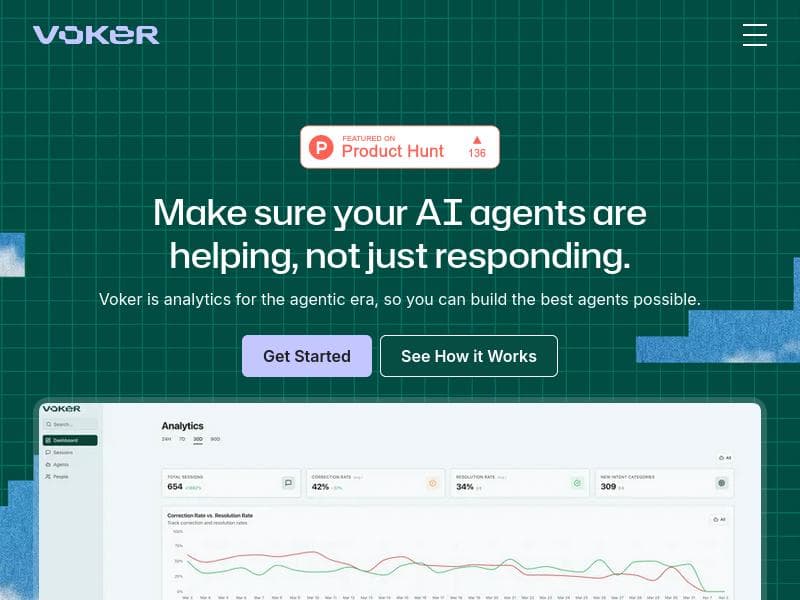
Voker is a powerful Agent Analytics Platform that delivers deep insights into AI agent performance and user interactions, enabling AI product teams to monitor and optimize their conversational agents at scale. Its provider-agnostic SDK and advanced detection features make it ideal for organizations seeking to build smarter, more effective AI assistants.
Voker is a comprehensive Agent Analytics Platform designed specifically for AI product teams aiming to monitor, analyze, and optimize their production AI agents at scale. Its core purpose is to provide deep insights into user-agent interactions by capturing usage behavior and agent performance metrics, enabling teams to build more effective and efficient AI assistants. By installing Voker's lightweight, provider-agnostic SDK, organizations can seamlessly integrate the platform into their existing AI infrastructure without being tied to a specific AI provider. Once integrated, Voker automatically detects key conversational elements such as user intent, corrections, and resolutions, reconstructs conversations, and offers queryable timelines to give a granular view of agent interactions over time. This allows product teams to identify bottlenecks, track agent success rates, and understand user behavior in a detailed manner. The platform's feature set is robust and tailored to meet the needs of AI product teams managing conversational agents. Self-Service Analytics empowers users to independently explore data without requiring extensive technical expertise, making it easier to derive actionable insights. Performance Intelligence tools provide detailed tracking of agent effectiveness, highlighting areas where agents excel or need improvement. Business Impact Tracking connects agent performance to broader business outcomes, helping teams understand how AI agents contribute to organizational goals. Voker's advanced intent detection capabilities automatically categorize user inputs to understand what users are trying to achieve, while correction detection identifies when users amend their queries, signaling potential misunderstandings or agent errors. Resolution detection measures whether user issues are successfully resolved, providing a critical metric for agent effectiveness. The platform also features queryable conversation timelines that allow teams to review entire interaction histories, facilitating root cause analysis and continuous improvement. Additionally, agent performance tracking and user behavior insights enable ongoing agent auto-optimization, ensuring AI assistants evolve with user needs. Voker is best suited for AI product teams, data analysts, and customer experience managers who rely on conversational AI agents to interact with users. It is particularly valuable for organizations deploying multiple AI agents across various channels, as it provides scalable monitoring and optimization capabilities. Use cases include customer support automation, virtual assistants, chatbots in e-commerce, and any scenario where understanding user-agent dialogue is critical to improving service quality and user satisfaction. By leveraging Voker, teams can reduce agent errors, enhance user engagement, and align AI agent performance with business objectives. Regarding pricing, Voker operates on a freemium model, allowing users to start with a free tier that offers essential analytics and monitoring features. This approach enables teams to evaluate the platform's capabilities before committing financially. For more advanced features such as comprehensive business impact tracking, enhanced performance intelligence, and larger scale usage, paid plans are available. These plans are designed to accommodate growing teams and enterprises requiring deeper insights and higher data volumes. Pricing details are accessible through Voker's website or by contacting their sales team, ensuring flexibility based on organizational needs. Compared to alternatives, Voker stands out due to its provider-agnostic SDK, which allows integration with any AI agent platform without vendor lock-in. Many competing analytics tools are either tightly coupled with specific AI providers or lack the depth of conversational reconstruction and automatic detection features that Voker offers. Its focus on intent, correction, and resolution detection combined with queryable timelines provides a uniquely detailed perspective on agent interactions. However, some alternatives might offer broader integrations with CRM or marketing platforms, which Voker may not emphasize as strongly. Teams should consider their specific integration requirements when evaluating options. Notable limitations of Voker include its reliance on the SDK installation, which may require development resources and time to implement properly. While the platform is designed to be lightweight, organizations with highly customized or proprietary AI agents might face integration challenges. Additionally, while the freemium plan is useful for initial exploration, larger teams or those needing advanced analytics will need to invest in paid tiers. Finally, as with any analytics platform, the quality of insights depends on the volume and quality of interaction data collected, so organizations with low user engagement might find limited value initially. Overall, Voker offers a powerful, scalable solution for AI product teams seeking to deeply understand and optimize their conversational agents. Its rich feature set, provider-agnostic approach, and focus on actionable insights make it a compelling choice for businesses aiming to enhance AI-driven user experiences.

Description
Voker is a powerful Agent Analytics Platform that delivers deep insights into AI agent performance and user interactions, enabling AI product teams to monitor and optimize their conversational agents at scale. Its provider-agnostic SDK and advanced detection features make it ideal for organizations seeking to build smarter, more effective AI assistants.
Voker is a comprehensive Agent Analytics Platform designed specifically for AI product teams aiming to monitor, analyze, and optimize their production AI agents at scale. Its core purpose is to provide deep insights into user-agent interactions by capturing usage behavior and agent performance metrics, enabling teams to build more effective and efficient AI assistants. By installing Voker's lightweight, provider-agnostic SDK, organizations can seamlessly integrate the platform into their existing AI infrastructure without being tied to a specific AI provider. Once integrated, Voker automatically detects key conversational elements such as user intent, corrections, and resolutions, reconstructs conversations, and offers queryable timelines to give a granular view of agent interactions over time. This allows product teams to identify bottlenecks, track agent success rates, and understand user behavior in a detailed manner. The platform's feature set is robust and tailored to meet the needs of AI product teams managing conversational agents. Self-Service Analytics empowers users to independently explore data without requiring extensive technical expertise, making it easier to derive actionable insights. Performance Intelligence tools provide detailed tracking of agent effectiveness, highlighting areas where agents excel or need improvement. Business Impact Tracking connects agent performance to broader business outcomes, helping teams understand how AI agents contribute to organizational goals. Voker's advanced intent detection capabilities automatically categorize user inputs to understand what users are trying to achieve, while correction detection identifies when users amend their queries, signaling potential misunderstandings or agent errors. Resolution detection measures whether user issues are successfully resolved, providing a critical metric for agent effectiveness. The platform also features queryable conversation timelines that allow teams to review entire interaction histories, facilitating root cause analysis and continuous improvement. Additionally, agent performance tracking and user behavior insights enable ongoing agent auto-optimization, ensuring AI assistants evolve with user needs. Voker is best suited for AI product teams, data analysts, and customer experience managers who rely on conversational AI agents to interact with users. It is particularly valuable for organizations deploying multiple AI agents across various channels, as it provides scalable monitoring and optimization capabilities. Use cases include customer support automation, virtual assistants, chatbots in e-commerce, and any scenario where understanding user-agent dialogue is critical to improving service quality and user satisfaction. By leveraging Voker, teams can reduce agent errors, enhance user engagement, and align AI agent performance with business objectives. Regarding pricing, Voker operates on a freemium model, allowing users to start with a free tier that offers essential analytics and monitoring features. This approach enables teams to evaluate the platform's capabilities before committing financially. For more advanced features such as comprehensive business impact tracking, enhanced performance intelligence, and larger scale usage, paid plans are available. These plans are designed to accommodate growing teams and enterprises requiring deeper insights and higher data volumes. Pricing details are accessible through Voker's website or by contacting their sales team, ensuring flexibility based on organizational needs. Compared to alternatives, Voker stands out due to its provider-agnostic SDK, which allows integration with any AI agent platform without vendor lock-in. Many competing analytics tools are either tightly coupled with specific AI providers or lack the depth of conversational reconstruction and automatic detection features that Voker offers. Its focus on intent, correction, and resolution detection combined with queryable timelines provides a uniquely detailed perspective on agent interactions. However, some alternatives might offer broader integrations with CRM or marketing platforms, which Voker may not emphasize as strongly. Teams should consider their specific integration requirements when evaluating options. Notable limitations of Voker include its reliance on the SDK installation, which may require development resources and time to implement properly. While the platform is designed to be lightweight, organizations with highly customized or proprietary AI agents might face integration challenges. Additionally, while the freemium plan is useful for initial exploration, larger teams or those needing advanced analytics will need to invest in paid tiers. Finally, as with any analytics platform, the quality of insights depends on the volume and quality of interaction data collected, so organizations with low user engagement might find limited value initially. Overall, Voker offers a powerful, scalable solution for AI product teams seeking to deeply understand and optimize their conversational agents. Its rich feature set, provider-agnostic approach, and focus on actionable insights make it a compelling choice for businesses aiming to enhance AI-driven user experiences.
Tool Features
- Self-Service Analytics
- Performance Intelligence
- Business Impact Tracking
- Intent Detection
- Correction Detection
- Resolution Detection
- Queryable Conversation Timelines
- Agent Performance Tracking
- User Behavior Insights
- Agent Auto-Optimization
Frequently Asked Questions
What is Voker?
Voker is an Agent Analytics Platform designed for AI product teams to monitor, analyze, and optimize AI conversational agents by providing detailed insights into usage behavior, agent performance, and user-agent interactions.
How much does Voker cost?
Voker offers a freemium pricing model with a free tier that includes essential analytics features. Paid plans with advanced capabilities and higher usage limits are available and can be accessed by contacting Voker's sales team or through their website.
Who is Voker best for?
Voker is best suited for AI product teams, data analysts, and customer experience managers who manage conversational AI agents and need to monitor and optimize agent performance at scale across multiple channels.
What are the main features of Voker?
Key features include self-service analytics, performance intelligence, business impact tracking, automatic intent detection, correction and resolution detection, queryable conversation timelines, agent performance tracking, user behavior insights, and agent auto-optimization.
Does Voker offer a free trial?
Yes, Voker provides a freemium plan that allows users to try essential features for free, enabling teams to evaluate the platform before upgrading to paid plans.
What integrations does Voker support?
Voker uses a lightweight, provider-agnostic SDK that can integrate with any AI agent platform, making it flexible and compatible with a wide range of conversational AI systems.
How does Voker work?
After installing Voker's SDK, the platform automatically captures user-agent interactions, detects user intent, corrections, and resolutions, reconstructs conversations, and provides queryable timelines and performance metrics to help teams analyze and optimize their AI agents.
Socials
Use ToolSponsored Tools





























Reviews
No reviews yet. Be the first to share your experience.