Description
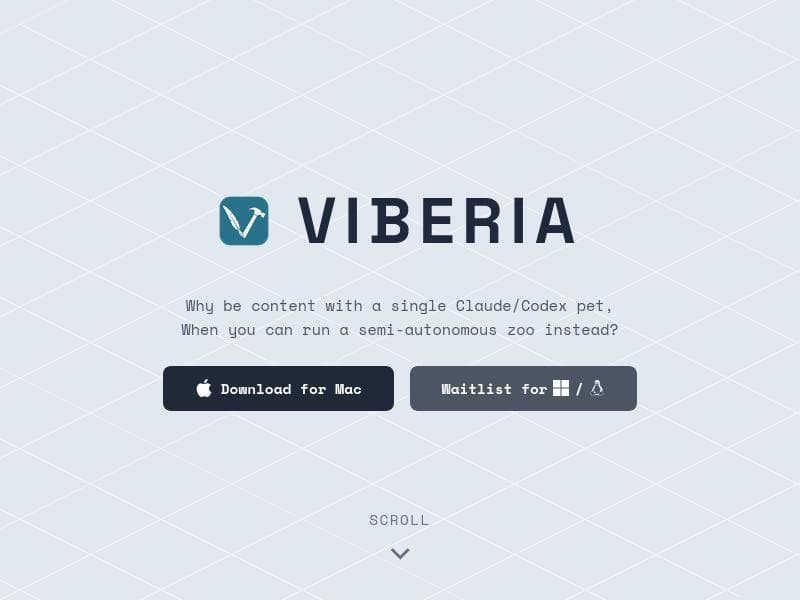
Viberia transforms AI management by turning your collection of Claude and Codex agents into an interactive, spatially organized command center. Ideal for developers and teams, it enables seamless multi-agent collaboration, letting your AI zoo work smarter together with built-in tools and customizable models.
Viberia is an innovative AI management platform designed to serve as a spatial command center for multiple AI agents, enabling users to orchestrate a dynamic and interactive AI ecosystem. Unlike traditional single-agent AI tools, Viberia allows users to manage an entire 'zoo' of AI models simultaneously, visualized on an intuitive isometric map. This unique interface provides real-time status indicators that show which agents are blocked, actively querying, or have completed their tasks, offering a comprehensive overview of your AI operations at a glance. Users can zoom in to engage in direct conversations with any AI agent, select from various AI models such as Claude and Codex, and even bring their own API keys for enhanced customization and control. The platform supports collaboration among agents, allowing them to form teams, share knowledge, and acquire new skills autonomously, which significantly enhances their problem-solving capabilities and efficiency. Additionally, Viberia integrates essential tools like document editors, terminals, and browsers directly within the platform, streamlining workflows and reducing the need to switch between multiple applications. Key features of Viberia include the ability to run multiple AI models simultaneously, providing flexibility and power in handling diverse AI tasks. The management of a semi-autonomous zoo of AI agents means that users can delegate complex workflows across different AI personalities, each specialized or configured for specific roles. This multi-agent collaboration is a standout capability, enabling agents to communicate, form sub-teams, and evolve their skills over time without constant user intervention. Support for leading AI models such as Claude and Codex ensures that users have access to state-of-the-art natural language processing and coding assistants, making Viberia suitable for a wide range of applications from creative writing to software development. The built-in tools like docs, terminals, and browsers further enhance the platform’s utility by allowing users to create, test, and research within the same environment. Viberia is best suited for AI enthusiasts, developers, product managers, and organizations looking to leverage multiple AI agents in a coordinated manner. It is particularly valuable for teams that require complex AI workflows involving different models or specialized agents working in tandem. Use cases include software development teams using Codex agents for coding assistance while simultaneously employing Claude agents for documentation and communication tasks, research teams managing multiple AI assistants for data analysis and report generation, and creative agencies orchestrating a variety of AI personalities to brainstorm, draft, and edit content collaboratively. Its spatial command center approach also appeals to users who prefer a visual and interactive way to manage AI workflows rather than linear or text-based interfaces. Viberia offers a freemium pricing model, allowing users to start with basic features at no cost and upgrade to paid plans for enhanced capabilities, such as increased agent limits, priority support, and advanced integrations. This pricing structure makes it accessible for individual users and small teams while scaling to meet the needs of larger organizations. While specific pricing tiers and limits are subject to change, the freemium approach encourages experimentation and gradual adoption. Compared to alternatives that typically focus on single AI models or linear task management, Viberia’s multi-agent spatial interface is a significant differentiator. Platforms like ChatGPT or standalone Codex implementations offer powerful AI but lack the collaborative multi-agent orchestration and visual management that Viberia provides. This makes Viberia uniquely positioned for users who want to harness the collective power of multiple AI agents working in concert, rather than relying on isolated AI interactions. However, users should consider that managing multiple agents and models may introduce complexity that requires a learning curve, and the platform’s reliance on external API keys means users must manage their own AI service subscriptions. Notable limitations include the potential for increased resource consumption when running many agents simultaneously, which may impact performance depending on the user’s hardware and network conditions. Additionally, while Viberia supports Claude and Codex models, integration with other AI models or platforms may be limited at present, which could restrict flexibility for users invested in alternative AI ecosystems. The semi-autonomous nature of the agents also means that some degree of oversight is necessary to ensure the quality and relevance of agent outputs. Overall, Viberia is a powerful and innovative tool for users seeking to elevate their AI workflows through multi-agent collaboration and spatial management, with a focus on flexibility, interactivity, and scalability.

Description
Viberia transforms AI management by turning your collection of Claude and Codex agents into an interactive, spatially organized command center. Ideal for developers and teams, it enables seamless multi-agent collaboration, letting your AI zoo work smarter together with built-in tools and customizable models.
Viberia is an innovative AI management platform designed to serve as a spatial command center for multiple AI agents, enabling users to orchestrate a dynamic and interactive AI ecosystem. Unlike traditional single-agent AI tools, Viberia allows users to manage an entire 'zoo' of AI models simultaneously, visualized on an intuitive isometric map. This unique interface provides real-time status indicators that show which agents are blocked, actively querying, or have completed their tasks, offering a comprehensive overview of your AI operations at a glance. Users can zoom in to engage in direct conversations with any AI agent, select from various AI models such as Claude and Codex, and even bring their own API keys for enhanced customization and control. The platform supports collaboration among agents, allowing them to form teams, share knowledge, and acquire new skills autonomously, which significantly enhances their problem-solving capabilities and efficiency. Additionally, Viberia integrates essential tools like document editors, terminals, and browsers directly within the platform, streamlining workflows and reducing the need to switch between multiple applications. Key features of Viberia include the ability to run multiple AI models simultaneously, providing flexibility and power in handling diverse AI tasks. The management of a semi-autonomous zoo of AI agents means that users can delegate complex workflows across different AI personalities, each specialized or configured for specific roles. This multi-agent collaboration is a standout capability, enabling agents to communicate, form sub-teams, and evolve their skills over time without constant user intervention. Support for leading AI models such as Claude and Codex ensures that users have access to state-of-the-art natural language processing and coding assistants, making Viberia suitable for a wide range of applications from creative writing to software development. The built-in tools like docs, terminals, and browsers further enhance the platform’s utility by allowing users to create, test, and research within the same environment. Viberia is best suited for AI enthusiasts, developers, product managers, and organizations looking to leverage multiple AI agents in a coordinated manner. It is particularly valuable for teams that require complex AI workflows involving different models or specialized agents working in tandem. Use cases include software development teams using Codex agents for coding assistance while simultaneously employing Claude agents for documentation and communication tasks, research teams managing multiple AI assistants for data analysis and report generation, and creative agencies orchestrating a variety of AI personalities to brainstorm, draft, and edit content collaboratively. Its spatial command center approach also appeals to users who prefer a visual and interactive way to manage AI workflows rather than linear or text-based interfaces. Viberia offers a freemium pricing model, allowing users to start with basic features at no cost and upgrade to paid plans for enhanced capabilities, such as increased agent limits, priority support, and advanced integrations. This pricing structure makes it accessible for individual users and small teams while scaling to meet the needs of larger organizations. While specific pricing tiers and limits are subject to change, the freemium approach encourages experimentation and gradual adoption. Compared to alternatives that typically focus on single AI models or linear task management, Viberia’s multi-agent spatial interface is a significant differentiator. Platforms like ChatGPT or standalone Codex implementations offer powerful AI but lack the collaborative multi-agent orchestration and visual management that Viberia provides. This makes Viberia uniquely positioned for users who want to harness the collective power of multiple AI agents working in concert, rather than relying on isolated AI interactions. However, users should consider that managing multiple agents and models may introduce complexity that requires a learning curve, and the platform’s reliance on external API keys means users must manage their own AI service subscriptions. Notable limitations include the potential for increased resource consumption when running many agents simultaneously, which may impact performance depending on the user’s hardware and network conditions. Additionally, while Viberia supports Claude and Codex models, integration with other AI models or platforms may be limited at present, which could restrict flexibility for users invested in alternative AI ecosystems. The semi-autonomous nature of the agents also means that some degree of oversight is necessary to ensure the quality and relevance of agent outputs. Overall, Viberia is a powerful and innovative tool for users seeking to elevate their AI workflows through multi-agent collaboration and spatial management, with a focus on flexibility, interactivity, and scalability.
Tool Features
- Run multiple AI models simultaneously
- Manage a semi-autonomous zoo of AI agents
- Supports Claude and Codex AI models
Frequently Asked Questions
What is Viberia?
Viberia is a spatial command center platform that allows users to manage multiple AI agents simultaneously on an interactive isometric map. It supports collaboration among AI models like Claude and Codex, enabling users to run, monitor, and communicate with a semi-autonomous zoo of AI assistants all within one interface.
How much does Viberia cost?
Viberia offers a freemium pricing model, providing basic features for free with options to upgrade to paid plans for additional capabilities such as more AI agents, advanced features, and priority support. Specific pricing details can be found on their website.
Who is Viberia best for?
Viberia is ideal for AI enthusiasts, developers, product managers, and teams who need to coordinate multiple AI models and agents simultaneously. It is especially useful for those managing complex AI workflows requiring collaboration between different AI personalities and models.
What are the main features of Viberia?
Key features include running multiple AI models at once, managing a semi-autonomous zoo of AI agents, support for Claude and Codex models, real-time status tracking of agents, interactive isometric map visualization, agent collaboration and team formation, and built-in tools such as document editors, terminals, and browsers.
Does Viberia offer a free trial?
Yes, Viberia’s freemium plan allows users to access core features at no cost, effectively serving as a free trial to explore the platform before committing to a paid plan.
What integrations does Viberia support?
Viberia supports integration with Claude and Codex AI models and allows users to bring their own API keys for these services. It also includes built-in tools like docs, terminals, and browsers to facilitate workflow without needing external apps.
How does Viberia work?
Viberia works by visualizing your AI agents on an isometric map where each agent’s status is displayed with icons. Users can zoom in to chat with agents, assign tasks, and select AI models. Agents can collaborate autonomously, form teams, and learn new skills, all managed through a spatial interface that integrates essential productivity tools.
Socials
Use ToolSponsored Tools





























Reviews
No reviews yet. Be the first to share your experience.