Description
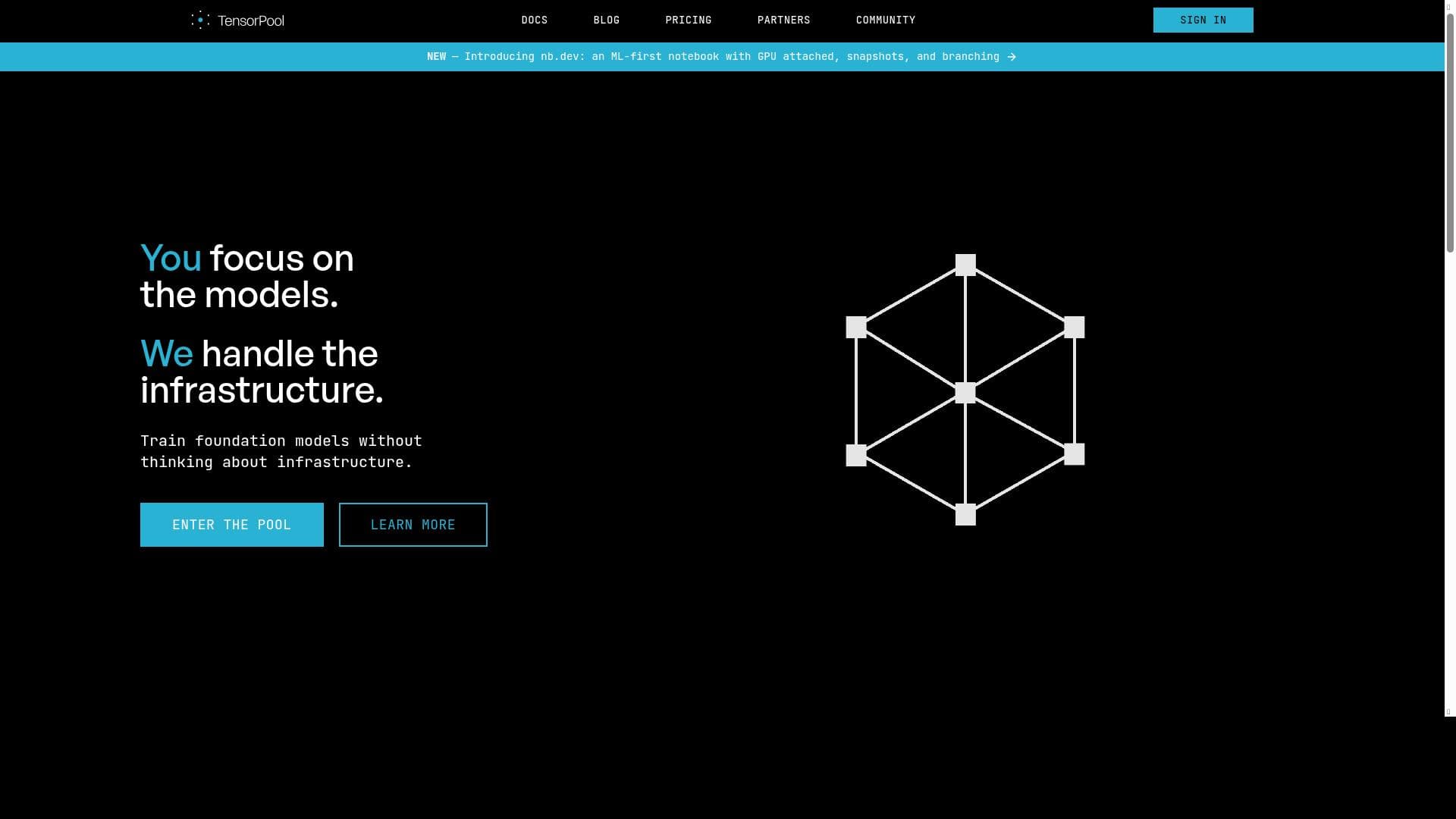
TensorPool revolutionizes ML model training by offering a CLI that effortlessly manages GPU orchestration and execution at half the cost of major cloud providers. Ideal for data scientists and AI developers, it enables rapid GPU cluster deployment and supports both training and inference workloads with unmatched simplicity and affordability.
TensorPool is an innovative AI tool designed to simplify and streamline the process of machine learning (ML) model training by providing an intuitive command-line interface (CLI) that abstracts away the complexities of GPU orchestration and infrastructure management. Its core purpose is to enable data scientists, ML engineers, and developers to focus on defining their ML jobs without worrying about the underlying hardware setup, execution logistics, or cost optimization. By describing the training or inference task in simple terms, users can leverage TensorPool's powerful backend to deploy GPU clusters rapidly and execute workloads efficiently, all while benefiting from significantly reduced costs compared to major cloud providers. One of TensorPool’s standout features is its ability to deploy GPU clusters in seconds, which drastically reduces the time to get started with large-scale ML experiments. This rapid deployment is complemented by a simple and fast GPU infrastructure that is designed to be user-friendly and highly performant. TensorPool supports both ML training and inference workloads, making it versatile for a wide range of AI projects, from model development and hyperparameter tuning to production inference pipelines. The platform’s pricing model is particularly attractive, offering GPU resources at roughly half the cost of leading cloud providers, making high-performance computing more accessible to startups, researchers, and enterprises with budget constraints. TensorPool is ideal for ML practitioners who require scalable GPU resources without the overhead of managing complex cloud infrastructure. This includes data scientists running deep learning experiments, AI researchers needing flexible compute environments, and development teams deploying inference services. Use cases span from training large neural networks and conducting distributed training jobs to deploying real-time inference models in production. Its CLI-centric design appeals to users comfortable with command-line tools, enabling seamless integration into existing development workflows and automation pipelines. Regarding pricing, TensorPool operates on a paid model with competitive rates that undercut major cloud providers, making it a cost-effective alternative for GPU-intensive workloads. While specific pricing tiers and plans are not detailed publicly, the emphasis on affordability suggests flexible options tailored to varying usage levels. This cost advantage, combined with rapid cluster deployment and ease of use, positions TensorPool as a compelling choice for organizations looking to optimize their ML infrastructure spend. Compared to alternatives like AWS, Google Cloud, or Azure GPU instances, TensorPool differentiates itself through its CLI-driven simplicity and aggressive pricing. Unlike traditional cloud platforms that require manual configuration of virtual machines, networking, and storage, TensorPool automates GPU orchestration, reducing setup time and operational complexity. However, it may not yet offer the extensive ecosystem integrations or global data center coverage of the largest cloud providers, which could be a consideration for users with specific compliance or latency requirements. Potential limitations include the reliance on a CLI interface, which might present a learning curve for users unfamiliar with command-line environments or those preferring graphical user interfaces. Additionally, as a specialized platform focusing on GPU orchestration and cost efficiency, TensorPool may have fewer ancillary services such as managed databases, serverless functions, or advanced monitoring tools compared to broader cloud ecosystems. Prospective users should evaluate their specific needs around ecosystem integration, support, and geographic availability when considering TensorPool. In summary, TensorPool offers a powerful, cost-effective solution for ML practitioners seeking to accelerate model training and inference with minimal infrastructure overhead. Its rapid GPU cluster deployment, straightforward CLI, and affordable pricing make it an attractive option for teams aiming to maximize productivity and reduce cloud expenses. While it may not replace full-featured cloud providers for all use cases, TensorPool excels as a focused platform for GPU resource orchestration and execution in machine learning workflows.

Description
TensorPool revolutionizes ML model training by offering a CLI that effortlessly manages GPU orchestration and execution at half the cost of major cloud providers. Ideal for data scientists and AI developers, it enables rapid GPU cluster deployment and supports both training and inference workloads with unmatched simplicity and affordability.
TensorPool is an innovative AI tool designed to simplify and streamline the process of machine learning (ML) model training by providing an intuitive command-line interface (CLI) that abstracts away the complexities of GPU orchestration and infrastructure management. Its core purpose is to enable data scientists, ML engineers, and developers to focus on defining their ML jobs without worrying about the underlying hardware setup, execution logistics, or cost optimization. By describing the training or inference task in simple terms, users can leverage TensorPool's powerful backend to deploy GPU clusters rapidly and execute workloads efficiently, all while benefiting from significantly reduced costs compared to major cloud providers. One of TensorPool’s standout features is its ability to deploy GPU clusters in seconds, which drastically reduces the time to get started with large-scale ML experiments. This rapid deployment is complemented by a simple and fast GPU infrastructure that is designed to be user-friendly and highly performant. TensorPool supports both ML training and inference workloads, making it versatile for a wide range of AI projects, from model development and hyperparameter tuning to production inference pipelines. The platform’s pricing model is particularly attractive, offering GPU resources at roughly half the cost of leading cloud providers, making high-performance computing more accessible to startups, researchers, and enterprises with budget constraints. TensorPool is ideal for ML practitioners who require scalable GPU resources without the overhead of managing complex cloud infrastructure. This includes data scientists running deep learning experiments, AI researchers needing flexible compute environments, and development teams deploying inference services. Use cases span from training large neural networks and conducting distributed training jobs to deploying real-time inference models in production. Its CLI-centric design appeals to users comfortable with command-line tools, enabling seamless integration into existing development workflows and automation pipelines. Regarding pricing, TensorPool operates on a paid model with competitive rates that undercut major cloud providers, making it a cost-effective alternative for GPU-intensive workloads. While specific pricing tiers and plans are not detailed publicly, the emphasis on affordability suggests flexible options tailored to varying usage levels. This cost advantage, combined with rapid cluster deployment and ease of use, positions TensorPool as a compelling choice for organizations looking to optimize their ML infrastructure spend. Compared to alternatives like AWS, Google Cloud, or Azure GPU instances, TensorPool differentiates itself through its CLI-driven simplicity and aggressive pricing. Unlike traditional cloud platforms that require manual configuration of virtual machines, networking, and storage, TensorPool automates GPU orchestration, reducing setup time and operational complexity. However, it may not yet offer the extensive ecosystem integrations or global data center coverage of the largest cloud providers, which could be a consideration for users with specific compliance or latency requirements. Potential limitations include the reliance on a CLI interface, which might present a learning curve for users unfamiliar with command-line environments or those preferring graphical user interfaces. Additionally, as a specialized platform focusing on GPU orchestration and cost efficiency, TensorPool may have fewer ancillary services such as managed databases, serverless functions, or advanced monitoring tools compared to broader cloud ecosystems. Prospective users should evaluate their specific needs around ecosystem integration, support, and geographic availability when considering TensorPool. In summary, TensorPool offers a powerful, cost-effective solution for ML practitioners seeking to accelerate model training and inference with minimal infrastructure overhead. Its rapid GPU cluster deployment, straightforward CLI, and affordable pricing make it an attractive option for teams aiming to maximize productivity and reduce cloud expenses. While it may not replace full-featured cloud providers for all use cases, TensorPool excels as a focused platform for GPU resource orchestration and execution in machine learning workflows.
Tool Features
- Deploy GPU clusters in seconds
- Simple and fast GPU infrastructure
- Affordable pricing for GPU resources
- Supports ML training and inference
Frequently Asked Questions
What is TensorPool?
TensorPool is a command-line interface tool that simplifies machine learning model training by automating GPU cluster deployment and orchestration, allowing users to focus on defining their ML jobs while it handles execution efficiently and cost-effectively.
How much does TensorPool cost?
TensorPool operates on a paid pricing model offering GPU resources at approximately half the cost of major cloud providers, making it an affordable option for GPU-intensive ML workloads. Specific pricing details can be found on their website or by contacting their sales team.
Who is TensorPool best for?
TensorPool is best suited for data scientists, machine learning engineers, AI researchers, and development teams who need scalable, fast, and affordable GPU infrastructure for training and inference without the complexity of managing cloud resources.
What are the main features of TensorPool?
Key features include rapid deployment of GPU clusters within seconds, a simple and fast GPU infrastructure, affordable pricing for GPU resources, and support for both machine learning training and inference workloads.
Does TensorPool offer a free trial?
The available information does not specify whether TensorPool offers a free trial. Interested users should visit the TensorPool website or contact their support team for the most current details on trial availability.
What integrations does TensorPool support?
TensorPool primarily integrates via its command-line interface, allowing seamless incorporation into existing ML workflows and automation pipelines. Specific third-party integrations are not detailed, so users should consult TensorPool documentation for more information.
How does TensorPool work?
Users describe their machine learning job through TensorPool's CLI, which then automatically orchestrates and deploys GPU clusters to execute the workload. This process abstracts away infrastructure management, enabling efficient and cost-effective model training and inference.
Socials
Use ToolSponsored Tools








































Reviews
No reviews yet. Be the first to share your experience.